组成图示
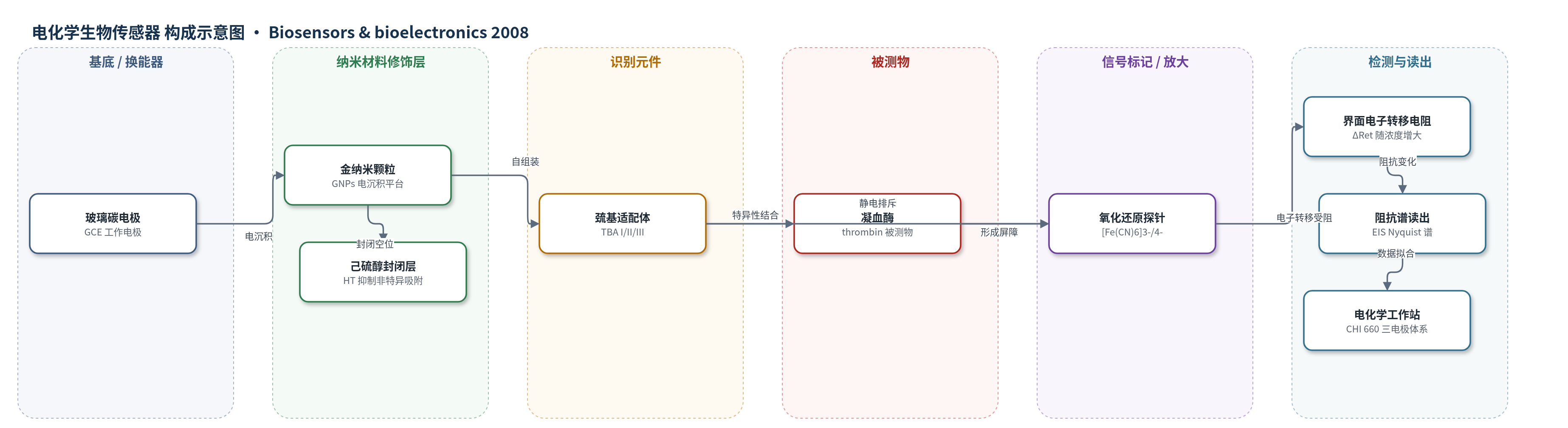
点击图片查看大图 · 依据论文自动绘制
传感器类型
电化学生物传感器
检测对象
人凝血酶(human α-thrombin, thrombin);样品基质:PBS 缓冲液(pH 7.40),未报告血浆/血液实际样品。
检测原理
传感器以电沉积 GNPs 修饰 GCE 为平台,5′-巯基 TBA 通过 Au–S 键自组装于 GNPs 表面,HT 封闭剩余金位点。检测时,凝血酶与 TBA 特异性结合,在电极界面形成适配体-凝血酶复合物层,增加对 [Fe(CN)6]3−/4− 氧化还原探针接近电极的静电排斥和空间阻碍,使界面电子转移阻力增大。EIS 在 +0.20 V、5 mV 正弦扰动下记录 Nyquist 谱,用 Randle 等效电路拟合得到 Ret。凝血酶浓度越高,结合量越多,ΔRet 越大,从而在 0.12–30 nM 内线性响应。GNPs 增大有效表面积并提高 TBA 表面密度,实现无标记信号增强。
检测灵敏度
LOD: 0.06 nM(TBA I)、0.03 nM(TBA II);线性范围: 0.12 nM–30 nM(TBA I/II/III);灵敏度斜率: 70.7 × 10⁻⁹(TBA I)、108.2 × 10⁻⁹(TBA II)、91.5 × 10⁻⁹(TBA III,c 单位 M);R^2 = 0.9924(TBA I)、0.9953(TBA II)、0.9929(TBA III)
效应效果
传感器对凝血酶具有良好选择性:四倍过量 BSA 和 Hb 的 ΔRet 分别仅 30 Ω 和 20 Ω,而凝血酶为 630 Ω。6.0 nM 凝血酶五次连续测量 RSD 为 4.5%。GNPs/GCE 水存 4 ℃ 10 天内 ΔRet 变化小于 5%;传感器 4 ℃ 保存 2 周对 6.0 nM 凝血酶响应无明显变化。TBA I 传感器 LOD 0.06 nM,低于 Radi 等报道的 2.0 nM;其灵敏度斜率 70.7×10⁻⁹ 高于金盘电极 54.1×10⁻⁹ 和金薄膜 GCE 59.3×10⁻⁹,TBA I 表面密度达 1.2×10^13 molecule cm−2。作者认为该方法可用于凝血酶检测及适配体-蛋白界面结合动力学研究。
传感器的构成
- 基底/换能器电极:玻璃碳电极(GCE),抛光后作为工作电极和电子传导基底。
- 纳米材料修饰层:金纳米颗粒(GNPs),由 HAuCl4 在 0.5 M H2SO4 中恒电位电沉积形成,粒径 10–60 nm,增大表面积并提供硫醇自组装平台。
- 识别元件:5′-巯基己基修饰的凝血酶结合适配体(TBA I/II/III),通过 Au–S 键自组装于 GNPs 表面,特异性识别凝血酶。
- 封闭剂:己硫醇(HT,1 mM 乙醇溶液),占据 GNPs 剩余空位,减少非特异性吸附。
- 氧化还原探针:[Fe(CN)6]3−/4−(10 mM K3Fe(CN)6 和 10 mM K4Fe(CN)6,含 10 mM NaCl),用于 EIS 监测界面电子转移电阻。
- 被测物:人凝血酶(human α-thrombin, thrombin),与 TBA 结合引起 Ret 增加。
- 检测系统:三电极体系(GCE 工作电极、铂丝对电极、Ag/AgCl 参比电极)和 CHI 660 电化学工作站,输出 EIS Nyquist 阻抗谱。
中文摘要
本文报道了一种基于凝血酶结合适配体(TBA)的简单、高灵敏电化学阻抗谱(EIS)生物传感器,用于凝血酶(thrombin)检测。传感器以玻璃碳电极(GCE)为基底,通过恒电位电沉积在 GCE 表面原位构建金纳米颗粒(GNPs)平台,再将 5′-巯基修饰的 TBA 通过硫醇-金相互作用自组装固定于 GNPs 表面,并用己硫醇(HT)封闭剩余空位以抑制非特异性吸附。检测时以 [Fe(CN)6]3−/4− 为氧化还原探针,监测界面电子转移电阻(Ret)变化。凝血酶与适配体结合后在电极界面形成绝缘层,阻碍探针电子转移,使 Ret 增大。在 0.12–30 nM 范围内,ΔRet 与凝血酶浓度呈线性关系。作者还测定了固定 TBA I 与凝血酶的结合/解离速率常数(6.7×10^3 M−1 s−1 和 1.0×10⁻⁴ s−1),并比较了三种 TBA 的解离常数。结果表明,GNPs 修饰 GCE 可显著提高 EIS 适配体生物传感器的灵敏度,EIS 也可用于研究适配体-蛋白界面相互作用。
英文摘要
A simple and highly sensitive electrochemical impedance spectroscopy (EIS) biosensor based on a thrombin-binding aptamer as molecular recognition element was developed for the determination of thrombin. The signal enhancement was achieved by using gold nanoparticles (GNPs), which was electrodeposited onto a glassy carbon electrode (GCE), as a platform for the immobilization of the thiolated aptamer. In the measurement of thrombin, the change in interfacial electron transfer resistance of the biosensor using a redox couple of [Fe(CN)(6)](3-/4-) as the probe was monitored. The increase of the electron transfer resistance of the biosensor is linear with the concentration of thrombin in the range from 0.12nM to 30nM. The association and dissociation rate constants of the immobilized aptamer-thrombin complex were 6.7x10(3)M(-1)s(-1) and 1.0x10(-4)s(-1), respectively. The association and dissociation constants of three different immobilized aptamers binding with thrombin were measured and the difference of the dissociation constants obtained was discussed. This work demonstrates that GNPs electrodeposited on GCE used as a platform for the immobilization of the thiolated aptamer can improve the sensitivity of an EIS biosensor for the determination of protein. This work also demonstrates that EIS method is an efficient method for the determination of association and dissociation constants on GNPs modified GCE.