组成图示
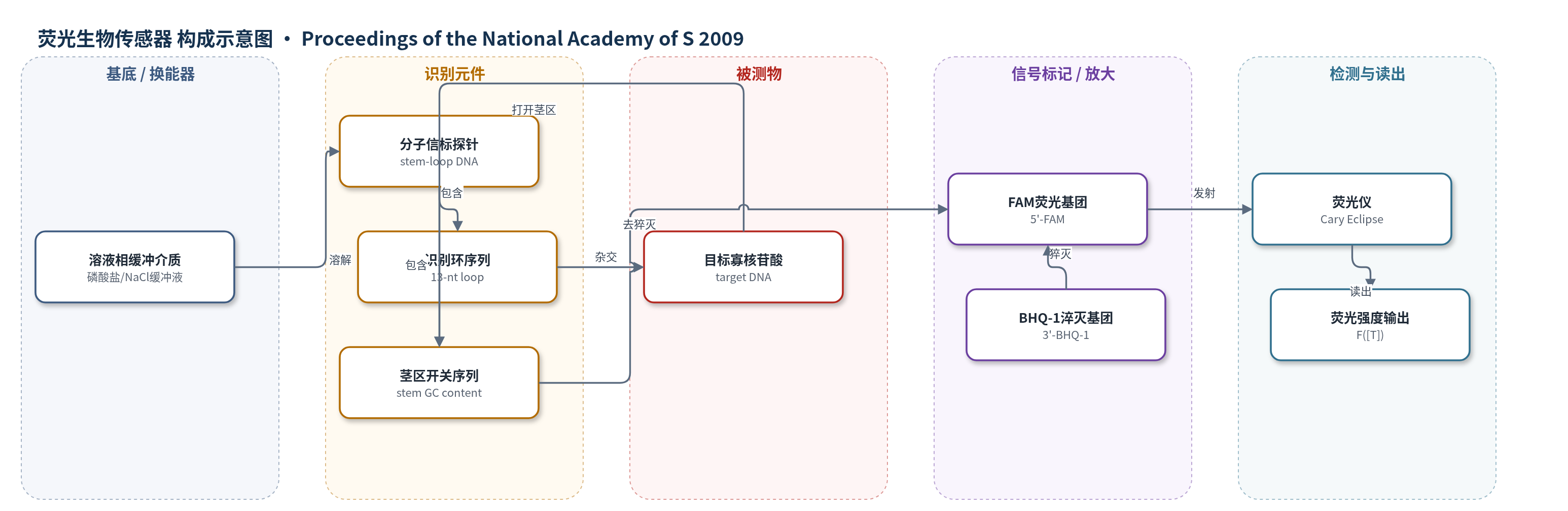
点击图片查看大图 · 依据论文自动绘制
传感器类型
荧光生物传感器
检测对象
目标DNA寡核苷酸(target DNA oligonucleotide);样品基质:磷酸盐缓冲液(50 mM phosphate, 150 mM NaCl, pH 7.0)
检测原理
分子信标为茎环DNA,5'端FAM与3'端BHQ-1在折叠茎环中接近而被猝灭。目标互补寡核苷酸与13-nt识别环杂交后,破坏茎区双链,探针转为伸展结合态,FAM与BHQ-1分离,荧光增强。该过程可用三态群体转移模型描述:非结合非信号态、结合能力信号态和结合态之间平衡受茎区GC含量决定的KS控制。目标浓度升高使结合态分数增加,荧光F([T])随之上升;表观亲和力KDobs=KDint(1+KS)/KS,因此调节KS可在不改变识别环的情况下移动动态范围并优化检测限。
检测灵敏度
LOD: 3 nM(0GC分子信标,绝对信号变化达最大可能信号变化5%);R^2 = 0.95(KDobs与KS关系拟合)
效应效果
在保持13-nt识别环不变的情况下,作者通过改变茎区GC含量将开关平衡常数KS从1.1调节至5.5×10^-5,使表观亲和力KDobs从10.4 nM移至330 μM,动态范围可跨4个数量级理性调节。0GC分子信标在绝对信号变化定义下获得3 nM检测限,而5GC分子信标检测限差4个数量级;KDobs与KS关系拟合R^2=0.95。论文未报告选择性、稳定性、RSD或实际样品回收率,但证明可通过改变开关热力学而非识别界面来优化结构转换生物传感器性能,为分子信标和天然生物开关设计提供原理。
传感器的构成
- 识别元件:13-nt DNA loop,与目标寡核苷酸互补杂交,决定固有亲和力KDint
- 开关茎区:stem DNA sequence,通过GC含量调节非结合茎环与结合态平衡常数KS
- 荧光标记物:5'-FAM,探针开放或结合态时发射荧光
- 淬灭基团:3'-BHQ-1,茎环折叠时猝灭FAM,开放/结合态时去猝灭
- 检测介质:50 mM sodium phosphate buffer, 150 mM NaCl, pH 7.0,维持杂交与荧光测量
中文摘要
结合诱导的生物分子开关在自然界和生物技术中广泛用于检测化学基团并将识别事件转换为有用输出。本文表明,这类开关的热力学可由一个简单的三态群体转移模型定量描述:非结合、非信号态与具有结合能力的信号态之间存在预先平衡,目标结合使平衡向信号态移动。因此,其性能受开关热力学内在权衡决定:有利于非结合构象的开关平衡常数可增大信号变化,但会降低表观亲和力,因为结合必须克服更不利的构象自由能。作者据此推导开关热力学与信号输出之间的关系,并用于理性调节代表性结构转换生物传感器——分子信标——的动态范围和检测限,使其跨越4个数量级。结果表明,通过改变开关热力学(如茎区GC含量)的突变可理性优化生物分子开关性能,并提示天然开关性能可能通过类似机制进化。
英文摘要
Binding-induced biomolecular switches are used throughout nature and, increasingly, throughout biotechnology for the detection of chemical moieties and the subsequent transduction of this detection into useful outputs. Here we show that the thermodynamics of these switches are quantitatively described by a simple 3-state population-shift model, in which the equilibrium between a nonbinding, nonsignaling state and the binding-competent, signaling state is shifted toward the latter upon target binding. Because of this, their performance is determined by the tradeoff inherent to their switching thermodynamics; while a switching equilibrium constant favoring the nonbinding, nonsignaling, conformation ensures a larger signal change (more molecules are poised to respond), it also reduces affinity (binding must overcome a more unfavorable conformational free energy). We then derive and employ the relationship between switching thermodynamics and switch signaling to rationally tune the dynamic range and detection limit of a representative structure-switching biosensor, a molecular beacon, over 4 orders of magnitude. These findings demonstrate that the performance of biomolecular switches can be rationally tuned via mutations that alter their switching thermodynamics and suggest a mechanism by which the performance of naturally occurring switches may have evolved.