组成图示
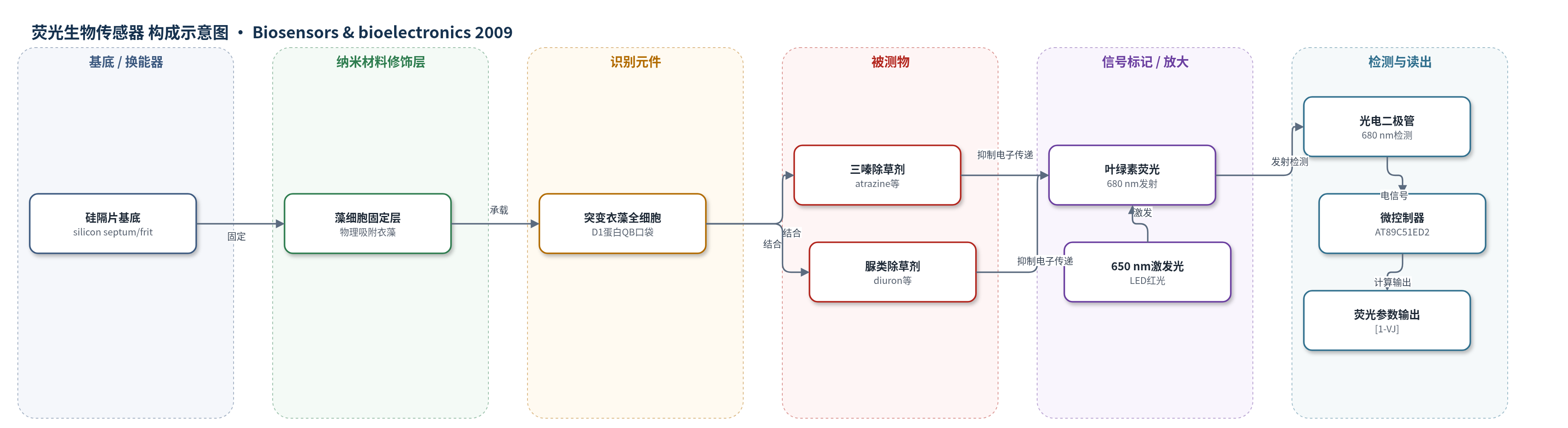
点击图片查看大图 · 依据论文自动绘制
传感器类型
荧光生物传感器
检测对象
莠去津(atrazine)、丙草丹(prometryn)、特丁津(terbuthylazine)、莠灭净(diuron)、绿麦隆(linuron);样品基质为环境水样/真实水基质及测量缓冲液
检测原理
传感器以突变衣藻全细胞为识别元件,其光系统II(PSII)D1 蛋白的 QB 结合口袋可结合三嗪类和脲类除草剂。除草剂进入 QB 口袋后取代质体醌 QB,抑制 QA− 的再氧化和 PSII 电子传递,使叶绿素荧光诱导曲线改变。仪器用 650 nm 红光激发藻细胞,680 nm 光电二极管检测荧光,自动计算 F0、FM、F2ms 和 VJ=(F2ms−F0)/(FM−F0),并以相对可变荧光 [1−VJ] 作为输出。[1−VJ] 反映 QA− 积累速率,随除草剂浓度升高而发生抑制或刺激变化;S268C 突变使结合能降低,结合更强,S264K 因空间位阻结合减弱,表现为抗性。多阵列组合不同突变体即可区分除草剂类别。
检测灵敏度
LOD: 0.8 × 10⁻¹¹ M(S268C, diuron)至 3.0 × 10⁻⁹ M(IL, terbuthylazine);原文另报告范围 0.9 × 10⁻¹¹–3.0 × 10⁻⁹ M。表3逐值:S268C 0.8±0.2×10⁻¹¹ M (diuron)、0.9±0.2×10⁻¹¹ M (linuron)、2.5±0.7×10⁻¹⁰ M (terbuthylazine)、6.5±1.9×10⁻¹⁰ M (prometryne)、6.8±2.0×10⁻¹⁰ M (atrazine);IL 1.0±0.8×10⁻⁹ M (diuron)、1.4±1.0×10⁻⁹ M (prometryne)、2.2±1.4×10⁻⁹ M (linuron)、2.4±1.2×10⁻⁹ M (atrazine)、3.0±1.1×10⁻⁹ M (terbuthylazine)。
效应效果
该传感器可区分三嗪类和脲类除草剂:S268C 对两类除草剂均更敏感,S264K 对两类除草剂均呈抗性,且在 10−10–10−9 M 范围内刺激 Fv/FM 18–30%。I30 显示 S268C 的抑制浓度低于 IL,如莠去津 (2.6±0.5)×10−8 M 对 (9.4±0.4)×10−8 M,绿麦隆 (1.2±0.3)×10−8 M 对 (4.4±0.4)×10−8 M。固定于硅隔片后,生物介质在室温下至少稳定 1 个月;用 TAP 洗涤再生后,初始活性保持 100±1.2%(10−7 M 莠去津)和 100±0.7%(10−10 M 莠去津)。真实水基质不抑制 PSII,甚至使氧释放激活 5–21%。作者主张其可用于环境水样中除草剂的实时、可重复监测。
传感器的构成
- 基底/固定层:硅隔片/硅滤片(silicon septum/frit,Pyrex)物理吸附藻细胞,形成可更换测量室
- 流路/泵:Delrin(polyoxymethylene)流路和 Watson Marlow 101U/R 蠕动泵输送测量缓冲液,Delrin 生物惰性且不吸附除草剂
- 识别元件:突变衣藻 Chlamydomonas reinhardtii 全细胞(IL、S268C、S264K),D1 蛋白 QB 口袋识别三嗪/脲类除草剂
- 信号元件:叶绿素(chlorophyll)内源荧光,无需外源标记物,650 nm 激发后发射 680 nm 荧光
- 介质/营养层:TAP 培养基(Tris–acetate–phosphate medium)或琼脂-TAP 固定并维持藻细胞活性;测量缓冲液(20 mM Tricine、70 sucrose、100 mM NaCl、5 mM MgCl2)输送样品
- 读出模块:荧光诱导分析仪(fluorimeter)650 nm 红光激发、680 nm 光电二极管检测,Atmel AT89C51ED2 微控制器控制泵和 LED 并输出数据
中文摘要
本研究利用基于同源的蛋白建模、计算筛选和虚拟突变分析,鉴定光合电子传递链中衣藻(Chlamydomonas reinhardtii)D1 蛋白上与除草剂相互作用的功能氨基酸,并构建用于制备生物介导体的功能突变库。通过计算 D1 蛋白与除草剂的结合能,筛选出对特定除草剂类具有最低或最高结合能的 D1 蛋白,作为环境生物传感器的识别元件。根据理论计算结果,作者通过定点突变制备了三个突变体,并用荧光分析进行表征;同时采用平衡吸附法研究其吸附和选择性识别能力。结果显示,S268C 和 S264K 生物介质分别对三嗪类和脲类除草剂表现出高敏感性和高抗性。将生物介质固定在硅隔片上后,其在室温下至少可稳定保持 1 个月。利用叶绿素荧光性质,作者开发了一种可重复使用、便携的多阵列光学生物传感器,用于环境监测,检出限在 0.8×10⁻¹¹ 至 3.0×10⁻⁹ M 之间,具体取决于目标分析物。此外,研究证明生物介质可再生且性能无明显下降。
英文摘要
Homology-based protein modelling and computational screening followed by virtual mutagenesis analyses were used to identify functional amino acids in the D1 protein of the photosynthetic electron transfer chain interacting with herbicides. A library of functional mutations in the unicellular green alga Chlamydomonas reinhardtii for preparing biomediators was built and their interactions with herbicides were calculated. D1 proteins giving the lowest and highest binding energy with herbicides were considered as suitable for preparing the environmental biosensors for detecting specific herbicide classes. Arising from the results of theoretical calculations, three mutants were prepared by site-directed mutagenesis and characterized by fluorescence analysis. Their adsorption and selective recognition ability were studied by an equilibrium-adsorption method. The S268C and S264K biomediators showed high sensitivity and resistance, respectively, to both triazine and urea classes of herbicides. When immobilized on a silicon septum, the biomediators were found to be highly stable, remaining so for at least 1-month at room temperature. The fluorescence properties were exploited and a reusable and portable multiarray optical biosensor for environmental monitoring was developed with limits of detection between 0.8 x 10(-11) and 3.0 x 10(-9), depending on the target analyte. In addition, biomediator regeneration without obvious deterioration in performance was demonstrated.