组成图示
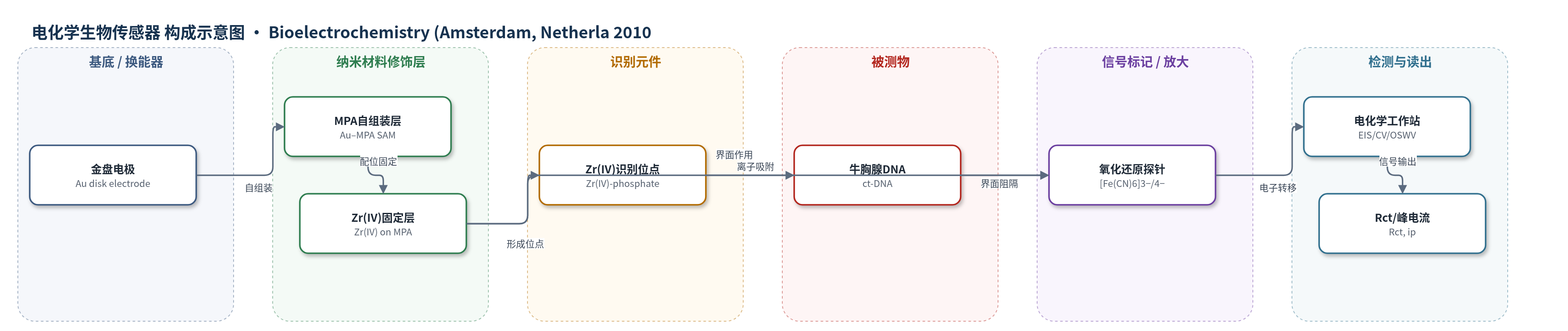
点击图片查看大图 · 依据论文自动绘制
传感器类型
电化学生物传感器
检测对象
牛胸腺 DNA(calf thymus DNA, ct-DNA);样品基质:醋酸缓冲盐水(ABS, pH 3)溶液
检测原理
该传感器以 Au–MPA–Zr(IV) SAM 为识别界面。在 pH 3 的醋酸缓冲盐水中,MPA 羧基与 Zr(IV) 结合形成带正电的固定层;ct-DNA 的磷酸二酯骨架通过静电吸引和 Zr(IV) 配位作用吸附到表面,并可在相邻 Zr(IV) 之间形成桥接。DNA 吸附后,电极表面负电荷增加,且磷酸骨架对界面产生物理阻隔,使 [Fe(CN)6]3−/4− 探针难以接近金电极表面,电子转移受阻。EIS 在 +0.20 V、5 mV 交流扰动下监测电荷转移电阻 Rct,ct-DNA 浓度越高,Rct 越大;CV 和 OSWV 则表现为峰电流降低。该方法无需标记或杂交,依靠金属离子–磷酸骨架结合实现 DNA 浓度定量。
检测灵敏度
EIS: LOD: 9.5×10⁻⁸ g mL−1;线性范围: 5.0×10⁻⁷–1.0×10⁻⁴ g mL−1;灵敏度: Rct/kΩ=9.90 [C(DNA/g mL−1)×10−6]/kΩ+30.10/kΩ;RSD: 1.8–3.2% (n=4)
效应效果
在 EIS 最佳条件下,ct-DNA 定量 RSD 为 1.8–3.2%(n=4),摘要报告平均 RSD 为 2.5%。干扰实验表明,100 倍 Na+、K+、Fe2+、Ca2+,多巴胺、抗坏血酸、尿酸,以及 Cl−、NO3−、NO2−、COO−、ClO4− 等对 1.0×10⁻⁶ g/mL ct-DNA 的 Rct 无显著影响;50 倍 SO4^2− 和 10 倍柠檬酸也不干扰,但漆酶和葡萄糖氧化酶等蛋白质/酶会显著干扰。电极经 0.1 M KOH 超声 5 min 再生并用 1.0×10⁻³ M Zr(IV) 修复后,RSD 为 1.5%(n=4)。储存于 1.0×10⁻³ M Zr(IV)(pH≈1,氩气保护)中约一周,[Fe(CN)6]3− 阴极峰电流仅下降 4%。作者认为该传感器结构简单、可再生,适合 DNA 浓度的快速电化学分析。
传感器的构成
- 基底/换能器电极:金盘电极(Au disk electrode),作为工作电极和电子转移基底
- 自组装修饰层:3-巯基丙酸(MPA)在金表面形成 Au–MPA SAM,提供羧基结合位点
- 金属离子固定层:Zr(IV)(ZrCl4 来源)与 MPA 羧基结合,形成 Au–MPA–Zr(IV) SAM
- 识别元件:Zr(IV) 金属离子,通过离子/配位作用结合 ct-DNA 磷酸二酯骨架
- 氧化还原探针:[Fe(CN)6]3−/4−(5.0×10−4 M),提供 CV、OSWV 和 EIS 电子转移信号
中文摘要
本文报道了一种基于金–巯基丙酸自组装单分子层(Au–MPA SAM)上固定 Zr(IV) 的电化学生物传感器,用于灵敏定量牛胸腺 DNA(ct-DNA)。传感器利用 ct-DNA 磷酸骨架与 Au–MPA–Zr(IV) SAM 表面 Zr(IV) 之间的离子/配位吸附实现识别,并以 [Fe(CN)6]3−/4− 作为氧化还原探针,通过循环伏安法(CV)、Osteryoung 方波伏安法(OSWV)和电化学阻抗谱(EIS)监测界面电子转移变化。在最佳条件下,EIS 法获得 5.0×10⁻⁷ 至 1.0×10⁻⁴ g/mL 的线性范围,检出限为 9.5×10⁻⁸ g/mL,各点相对标准偏差平均为 2.5%(n=4)。电极表面可通过 0.1 M KOH 超声 5 min 再生,并在 1.0×10⁻³ M Zr(IV) 中孵育 1 min 修复,重现性 RSD 为 1.5%(n=4)。研究还考察了 pH、离子强度、干扰物及长期稳定性,表明该传感器可用于 DNA 浓度的快速电化学测定。
英文摘要
An electrochemical biosensor, constructed by immobilization of Zr(IV) on the topside of gold-mercaptopropionic acid self-assembled monolayer (Au-MPA-Zr SAM), is developed for the sensitive quantification of calf thymus DNA (ct-DNA). The sensor is based on ionic adsorption of ct-DNA from its phosphate backbone onto the Au-MPA-Zr(IV) SAM electrode. Preparation, characterization, and application of the sensor for determination of ct-DNA are described by cyclic voltammetry (CV), electrochemical impedance spectroscopy (EIS), and Osteryoung square wave voltammetry (OSWV) in the presence of an appropriate redox reaction probe. Parameters influencing the method have been tested. A linear range calibration curve from 1.0x10(-4) to 5.0x10(-7) g mL(-1) ct-DNA with a detection limit of 9.5x10(-8) g mL(-1) and mean of relative standard deviations (R.S.D) of 2.5% for n=4 at each point was observed in the best conditions by EIS. Regeneration of the surface was carried out successfully by 5 min sonication in 0.1 M KOH solution and then 1 min incubation in 1.0x10(-3) M Zr(IV) with a good reproducibility, R.S.D=1.5% for n=4 as detected by EIS. The long-term storage stability of the electrode was also studied.