组成图示
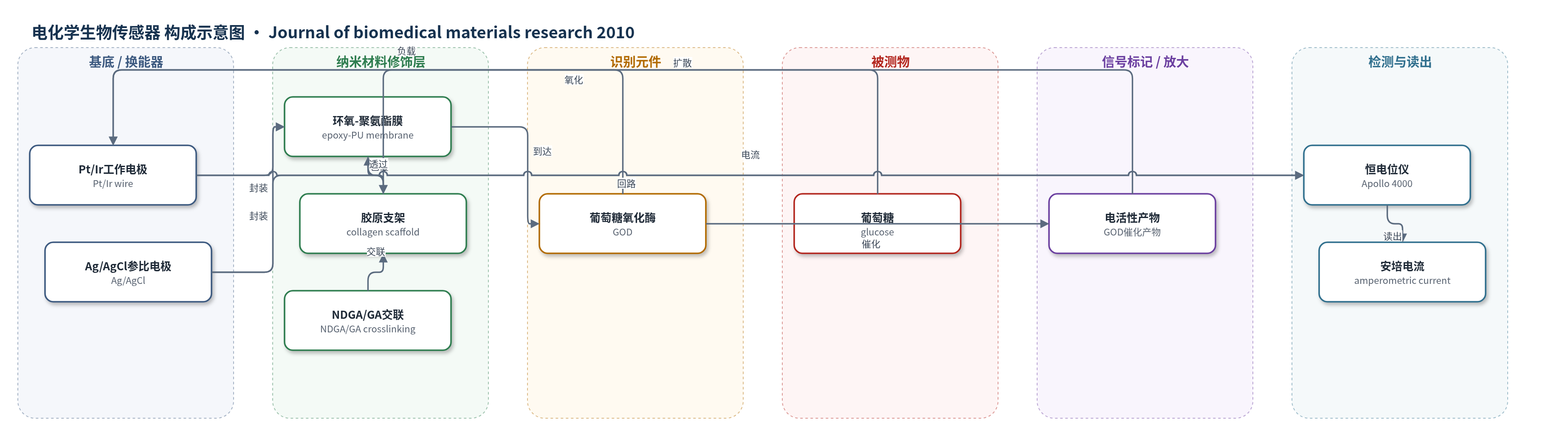
点击图片查看大图 · 依据论文自动绘制
传感器类型
电化学生物传感器
检测对象
葡萄糖(glucose);样品基质:PBS 葡萄糖溶液、大鼠皮下组织液/血液
检测原理
该传感器为酶法安培式植入葡萄糖传感器。葡萄糖从大鼠皮下组织液或 PBS 溶液中扩散,依次穿过 NDGA/GA 交联多孔胶原支架和环氧-聚氨酯膜,到达负载于 Pt/Ir 工作电极的葡萄糖氧化酶 GOD。GOD 催化葡萄糖氧化,产生可在电极表面氧化的电活性产物(通常为 H2O2)。在 +0.7 V(vs Ag/AgCl)恒电位下,电活性产物在 Pt/Ir 电极发生氧化,产生与葡萄糖浓度成正比的安培电流;Ag/AgCl 参比/对电极维持电位和电流回路,Apollo 4000 恒电位仪记录电流变化。系统未采用 HCR、RCA 或 CRISPR 等额外放大策略,信号放大主要依赖酶催化和电极氧化。
检测灵敏度
初始敏感性在 5 和 15 mM 葡萄糖中测定;原文未报告具体 LOD、线性范围、灵敏度斜率数值和相关系数;仅定义灵敏度 S=(I2-I1)/(C2-C1),体内灵敏度=(Imax-I0)/(Cmax-C0),单位 nA/mM。
效应效果
体外 4 周,裸传感器与 NDGA/GA 支架传感器均保持功能,敏感性保留率均高于 80%,支架未显著影响体外敏感性(p>0.05)。体内 4 周,所有传感器植入后第 1 周敏感性下降 30–60%,随后相对稳定。短传感器敏感性和存活率高于长传感器,可能因微动较小。NDGA 支架传感器敏感性和存活率高于 GA 支架。4 周工作数:CS 6/8、CL 4/8、NS 4/8、NL 2/8、GS 4/8、GL 1/8。组织学显示 GA 支架 2 周和 4 周炎症浸润深度均超过 300 μm,NDGA 支架分别为 100–150 μm 和小于 100 μm。作者认为 NDGA 交联胶原支架可经降低异物反应改善植入式传感器功能与寿命,但本研究裸传感器表现更好,支架仍需优化。
传感器的构成
- 工作电极:Pt/Ir 铂铱合金线(Pt:Ir 9:1,Teflon 包覆),作为葡萄糖指示电极并产生安培信号
- 参比/对电极:Ag/AgCl 银/氯化银电极,与 Pt/Ir 电极构成两电极系统,提供参比电位和电流回路
- 酶识别层:葡萄糖氧化酶 GOD(glucose oxidase,Aspergillus niger),负载于工作电极,催化葡萄糖氧化
- 封装膜:环氧-聚氨酯膜(epoxy-PU membrane,含 epoxy adhesive ATACS 5104 与 polyurethane PU),控制葡萄糖扩散并保护电极
- 电极线圈:Pt/Ir 工作电极与 Ag/AgCl 电极绕成线圈,中间加环(loop)防止微短路,导线扭绞
- 胶原支架:牛腱 I 型胶原支架(bovine tendon type I collagen scaffold),冻干多孔结构包覆传感器,允许葡萄糖扩散并改善生物相容性
- 交联层:NDGA(nordihydroguaiaretic acid)或 GA(glutaraldehyde)交联胶原支架,提高物理稳定性和抗酶降解能力
- 固定结构:手术伤口夹(surgical wound clip)与 10/30 mm 导线,用于皮下固定和信号引出
中文摘要
我们开发了一种用于植入式葡萄糖传感器的新型三维多孔且生物稳定的胶原支架。支架制备于传感器周围,并用北二氢愈创木酸(NDGA)或戊二醛(GA)交联,以增强物理和生物稳定性。在长期(≥28天)体外和体内实验中考察支架对传感器功能和生物相容性的影响,并与无支架裸传感器对照。为评估传感器长度对微动和功能的影响,还制备了短型和长型传感器。在葡萄糖传感器周围应用三维多孔支架并未显著影响其长期体外敏感性;无论 NDGA 或 GA 交联,支架在 4 周体外研究中均保持围绕传感器的稳定。长期体内研究显示,短传感器敏感性高于长传感器,可能因为大鼠皮下微动较少。NDGA 交联支架传感器敏感性高于 GA 交联支架传感器。组织学检查显示,与 GA 交联支架相比,NDGA 交联支架保持物理结构且炎症反应降低。因此,NDGA 交联胶原支架可能通过降低体内异物反应,提高植入式生物传感器功能和寿命。
英文摘要
We have developed a new 3D porous and biostable collagen scaffold for implantable glucose sensors. The scaffolds were fabricated around the sensors and crosslinked using nordihydroguaiaretic acid (NDGA) or glutaraldehyde (GA) to enhance physical and biological stability. The effect of the scaffolds on sensor function and biocompatibility was examined during long-term (>or=28 days) in vitro and in vivo experiments and compared with control bare sensors. To evaluate the effect of the sensor length on micromotion and sensor function, we also fabricated short and long sensors. 3D porous scaffold application around glucose sensors did not significantly affect the long-term in vitro sensitivity of the sensors. The scaffolds, crosslinked by either NDGA or GA, remained stable around the sensors during the 4 week in vitro study. In the long-term in vivo study, the sensitivity of the short sensors was higher than the sensitivity of long sensors presumably because of less micromotion in the subcutis of the rats. The sensors with NDGA-crosslinked scaffolds had a higher sensitivity than the sensors with GA-crosslinked scaffolds. Histological examination showed that NDGA-crosslinked scaffolds retained their physical structure with reduced inflammation when compared with the GA-crosslinked scaffolds. Therefore, the application of NDGA-crosslinked collagen scaffolds might be a good method for enhancing the function and lifetime of implantable biosensors by minimizing the in vivo foreign body response.