组成图示
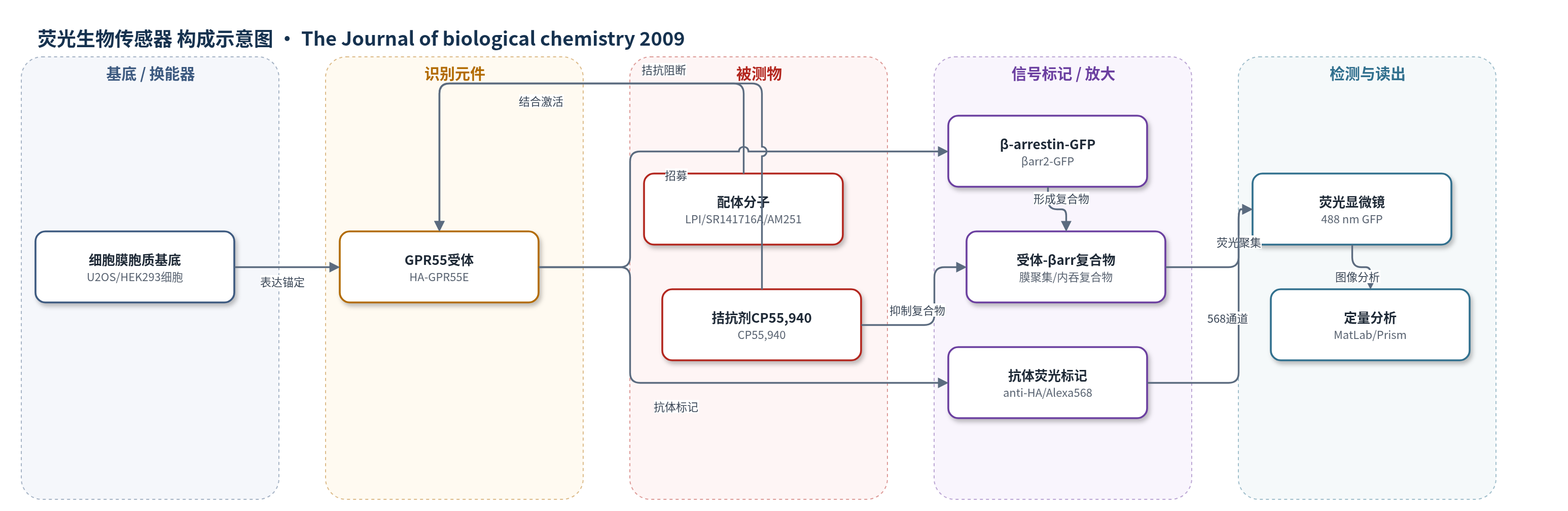
点击图片查看大图 · 依据论文自动绘制
传感器类型
荧光生物传感器
检测对象
溶血磷脂酰肌醇(LPI)、SR141716A(rimonabant)、AM251、CP55,940等GPR55配体;样品基质为细胞培养液(HEK293/U2OS细胞药物处理体系)
检测原理
该荧光生物传感器以表达HA-GPR55E的U2OS/HEK293细胞为基底,β-arrestin2-GFP(βarr2-GFP)作为信号标记物。当LPI、SR141716A或AM251等激动剂结合GPR55时,受体发生激活和C端磷酸化,βarr2-GFP从胞质均匀分布转位至膜结合受体,形成膜聚集;稳定复合物进一步内吞,形成胞内亮荧光对象。荧光聚集数量/强度随配体浓度增加而增加,可用共聚焦显微镜定量。CP55,940作为拮抗剂/部分激动剂,阻断受体-βarr复合物形成、内吞和ERK1/2磷酸化,使荧光聚集减少。PKCβII-GFP膜募集和膜重塑作为G蛋白依赖性信号的辅助读出,反映钙/二酰甘油信号变化。
检测灵敏度
—
效应效果
该体系对15种经典、非经典和内源大麻素配体在10–30 μM范围内均无βarr2-GFP转位,显示选择性;CB1对照中LPI和SR141716A不诱导转位,CP55,940可激活CB1。LPI、SR141716A和AM251诱导βarr2-GFP转位的EC50分别为1.2、3.9和9.6 μM。CP55,940拮抗三者诱导的转位,KI分别为194、213和540 nM;On-Cell Western中拮抗LPI内吞的KI为173 nM。LPI诱导ERK1/2磷酸化,AM251和SR141716A不诱导;三者均募集PKCβII-GFP并引起膜重塑,AM251在45 s内启动。数据来自至少三次独立实验,支持GPR55配体筛选范式,并提示rimonabant脱靶效应。
传感器的构成
- 细胞基底:poly-D-lysine(PDL)预处理盖玻片上的U2OS/HEK293细胞膜与胞质,提供GPR55表达和βarr2-GFP转位微环境
- 识别元件:HA-GPR55E(人源GPR55受体,N端HA标签、C端磷酸化增强序列),结合配体并介导激活/内吞
- 信号标记物:β-arrestin2-GFP(βarr2-GFP),识别激活态GPR55并发生膜聚集/内吞,产生荧光聚集信号
- 辅助标记:anti-HA小鼠单克隆抗体与Alexa Fluor 568山羊抗小鼠IgG,标记HA-GPR55E膜表达与内吞
- 读出装置:Nikon E800荧光显微镜或Leica TCS SP5/Zeiss LSM-510共聚焦显微镜,488 nm激发GFP、568 nm激发Alexa Fluor 568
中文摘要
大麻素受体1(CB1)和CB2与滥用药物相关,可能为疼痛、情绪和成瘾障碍提供治疗途径。孤儿G蛋白偶联受体GPR55是否属于大麻素受体仍因药理学结果矛盾而不明确。GPR55曾被报道可被外源和内源大麻素激活,也可被内源非大麻素介质溶血磷脂酰肌醇(LPI)激活。本研究采用β-arrestin-绿色荧光蛋白(GFP)生物传感器作为受体激活的直接读出,考察代表性大麻素配体和LPI对GPR55的作用。结果显示,大麻素拮抗剂AM251和SR141716A(rimonabant)以及非大麻素配体LPI均为GPR55激动剂,诱导β-arrestin转位的效能相近,并激活G蛋白依赖性蛋白激酶CβII信号。相反,强效合成大麻素激动剂CP55,940表现为GPR55拮抗剂/部分激动剂,阻断GPR55内吞、β-arrestin-GPR55复合物形成和ERK1/2磷酸化,仅轻微募集PKCβII至膜,且不诱导膜重塑。本研究为测量GPR55对多种配体骨架的响应提供范式,提示GPR55至多是非典型大麻素响应受体;rimonabant激活GPR55可能与其撤市的部分脱靶效应有关。
英文摘要
The cannabinoid receptor 1 (CB(1)) and CB(2) cannabinoid receptors, associated with drugs of abuse, may provide a means to treat pain, mood, and addiction disorders affecting widespread segments of society. Whether the orphan G-protein coupled receptor GPR55 is also a cannabinoid receptor remains unclear as a result of conflicting pharmacological studies. GPR55 has been reported to be activated by exogenous and endogenous cannabinoid compounds but surprisingly also by the endogenous non-cannabinoid mediator lysophosphatidylinositol (LPI). We examined the effects of a representative panel of cannabinoid ligands and LPI on GPR55 using a beta-arrestin-green fluorescent protein biosensor as a direct readout of agonist-mediated receptor activation. Our data demonstrate that AM251 and SR141716A (rimonabant), which are cannabinoid antagonists, and the lipid LPI, which is not a cannabinoid receptor ligand, are GPR55 agonists. They possess comparable efficacy in inducing beta-arrestin trafficking and, moreover, activate the G-protein-dependent signaling of protein kinase CbetaII. Conversely, the potent synthetic cannabinoid agonist CP55,940 acts as a GPR55 antagonist/partial agonist. CP55,940 blocks GPR55 internalization, the formation of beta-arrestin GPR55 complexes, and the phosphorylation of ERK1/2; CP55,940 produces only a slight amount of protein kinase CbetaII membrane recruitment but does not stimulate membrane remodeling like LPI, AM251, or rimonabant. Our studies provide a paradigm for measuring the responsiveness of GPR55 to a variety of ligand scaffolds comprising cannabinoid and novel compounds and suggest that at best GPR55 is an atypical cannabinoid responder. The activation of GPR55 by rimonabant may be responsible for some of the off-target effects that led to its removal as a potential obesity therapy.