组成图示
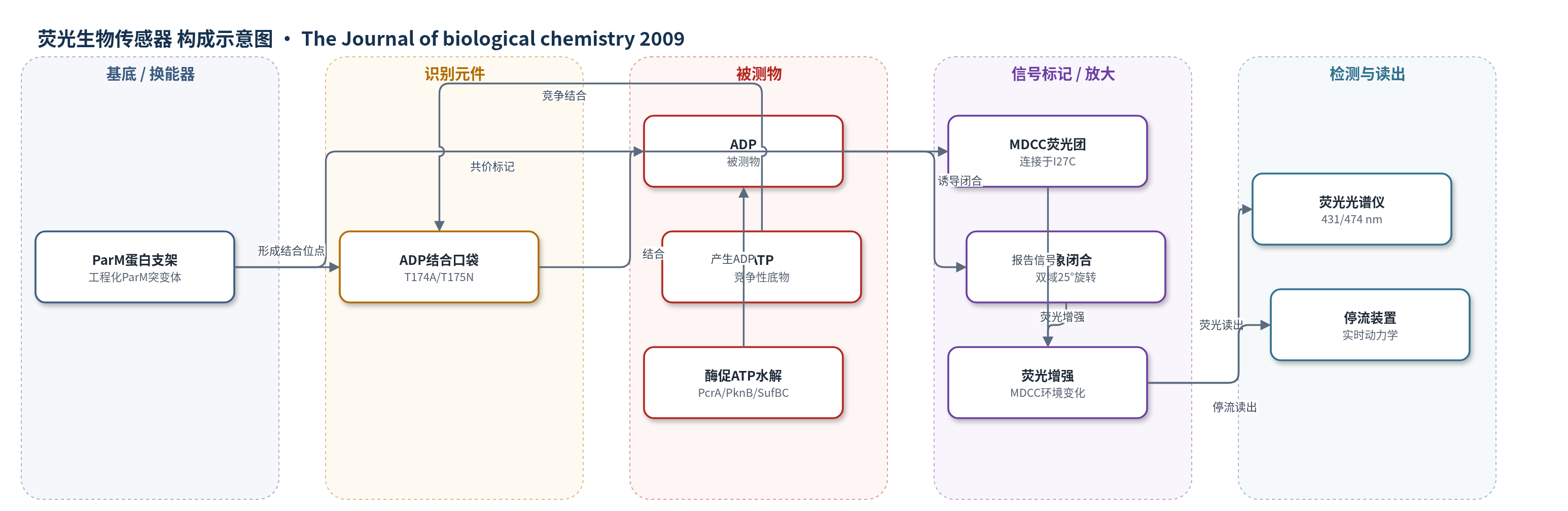
点击图片查看大图 · 依据论文自动绘制
传感器类型
荧光生物传感器
检测对象
ADP(adenosine diphosphate, ADP);样品基质:体外酶促反应缓冲液(含 ATP、Mg2+、酶及底物,如 PcrA/dT20、PknB/Rv1827、SufBC)
检测原理
MDCC-ParM 中 I27C 共价连接 MDCC。ADP 进入 ParM 核苷酸结合口袋后,诱导两个结构域相对旋转约25°,裂隙闭合,使 MDCC 微环境改变,荧光增强约3.5倍。T174A/T175N 突变削弱 γ-磷酸结合,使 ATP 解离常数约212 μM,比 ADP 的0.46 μM 弱约460倍,从而在 ATP 存在下选择性检测 ADP。K33A 阻止成丝并降低 ATPase 活性,避免传感器消耗 ATP。荧光强度与 ADP 浓度在亚微摩尔至约10 μM 范围近似线性,需按不同 ATP 背景校准;荧光光谱仪或停流装置实时读出。
检测灵敏度
Kd(ADP): 0.46 μM;Kd(ATP): 212 μM;ATP/ADP Kd ratio: 460;F+/F- (ADP): 3.5;ka: 0.65 μM^-1 s^-1;kd: 0.19 s^-1;校准斜率: 0.305、0.283、0.252 μM^-1(0、20、40 μM ATP 背景);线性范围: 亚微摩尔至约10 μM(作者估计)
效应效果
该传感器对 ADP 相对 ATP 选择性高,ATP/ADP Kd 比值约460,ATP Kd 212 μM,高 ATP 背景限制灵敏度;GDP 可竞争结合(Kd 4.4 μM)但仅1.2倍荧光,可能干扰。单组分体系仅需 Mg2+,干扰低。响应快,ka 0.65 μM^-1 s^-1,20 μM 蛋白时上限约13 s^-1,高浓度可达约100 s^-1,优于联酶、Riboreporter 和抗体法。用于 PcrA 测得 Km 1.6 μM、kcat 13.7 s^-1;PknB 测得 Km(Rv1827) 20 μM、kcat 4.7 min^-1,Km(ATP) 7.5 μM、kcat 4.9 min^-1;SufBC 中 Pi 释放 0.070 s^-1、ADP 释放 0.050 s^-1。
传感器的构成
- 识别/换能蛋白:工程化 ParM 突变体(ParM His6/I27C/K33A/T174A/T175N/C287A),提供 ADP 结合口袋并在 ADP 结合时发生构象闭合
- 荧光信号标记:MDCC(N-[2-(1-maleimidyl)ethyl]-7-diethylaminocoumarin-3-carboxamide),共价连接于 I27C,ADP 结合后荧光增强
- 选择性突变:T174A/T175N,削弱 γ-磷酸结合,提高 ADP 对 ATP 选择性
- 抗聚合突变:K33A,阻止 ParM 成丝并降低 ATPase 活性
- 纯化标签:C 端 His6,用于镍螯合亲和层析纯化
中文摘要
几乎所有细胞过程都需要 ATP,激酶和 ATP 水解酶均通过裂解末端磷酸释放 ADP。尽管 ATP 水解是生物系统中最基本的反应之一,目前直接测量酶促 ATP 转化的方法有限。本文报道了一种用于 ADP 的无试剂生物传感器,可实时检测酶促产生的 ADP。该传感器以细菌肌动蛋白同源物 ParM 为蛋白支架,在核苷酸结合位点边缘连接单一荧光团二乙氨基香豆素(MDCC),使 ADP 结合与荧光强度增加 >3.5 倍相耦合。标记 ParM 变体对 ADP 具有高亲和力(0.46 μM)和快速信号响应,响应速率由 ADP 结合速率控制(0.65 μM^-1 s^-1)。通过突变活性位点氨基酸降低 ATP 亲和力,实现对三磷酸核苷 >400 倍的区分;另一突变使最终传感器不形成丝状体,因而 ATPase 活性极低。在两种不同 ATPase 和一种蛋白激酶的实时动力学实验中,证明了 N-[2-(1-maleimidyl)ethyl]-7-diethylaminocoumarin-3-carboxamide(MDCC)-ParM 作为 ADP 敏感探针的广泛适用性。
英文摘要
Nearly every cellular process requires the presence of ATP. This is reflected in the vast number of enzymes like kinases or ATP hydrolases, both of which cleave the terminal phosphate from ATP, thereby releasing ADP. Despite the fact that ATP hydrolysis is one of the most fundamental reactions in biological systems, there are only a few methods available for direct measurements of enzymatic-driven ATP conversion. Here we describe the development of a reagentless biosensor for ADP, the common product of all ATPases and kinases, which allows the real-time detection of ADP, produced enzymatically. The biosensor is derived from a bacterial actin homologue, ParM, as protein framework. A single fluorophore (a diethylaminocoumarin), attached to ParM at the edge of the nucleotide binding site, couples ADP binding to a >3.5-fold increase in fluorescence intensity. The labeled ParM variant has high affinity for ADP (0.46 mum) and a fast signal response, controlled by the rate of ADP binding to the sensor (0.65 microm(-1)s(-1)). Amino acids in the active site were mutated to reduce ATP affinity and achieve a >400-fold discrimination against triphosphate binding. A further mutation ensured that the final sensor did not form filaments and, as a consequence, has extremely low ATPase activity. The broad applicability of N-[2-(1-maleimidyl)ethyl]-7-diethylaminocoumarin-3-carboxamide (MDCC)-ParM as a sensitive probe for ADP is demonstrated in real-time kinetic assays on two different ATPases and a protein kinase.