组成图示
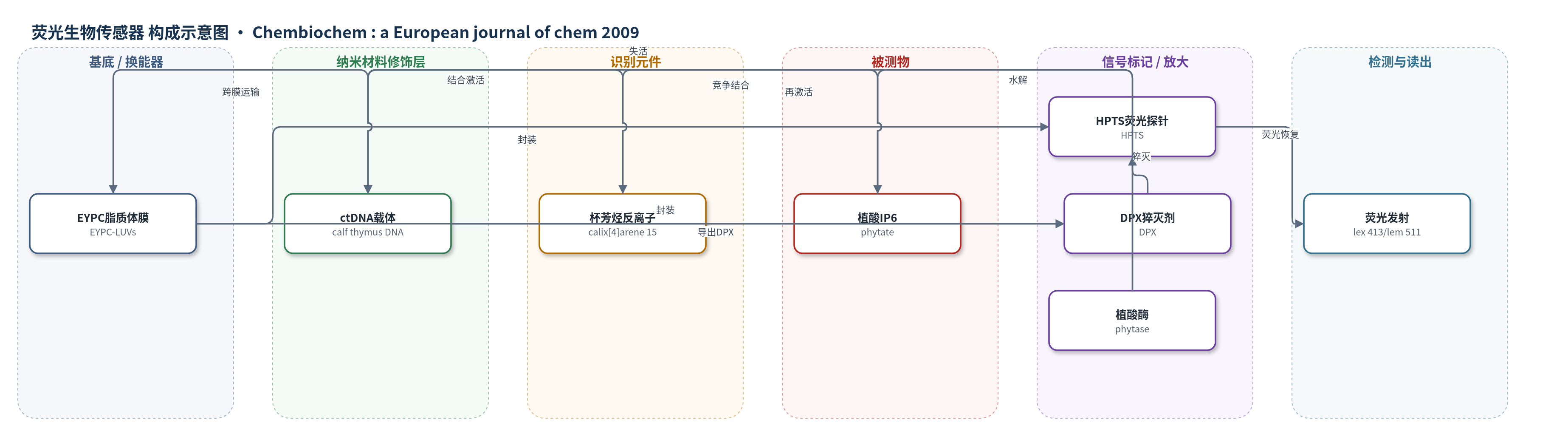
点击图片查看大图 · 依据论文自动绘制
传感器类型
荧光生物传感器
检测对象
植酸(phytate, IP6),样品基质:杏仁提取物(almond extracts)、缓冲液/脂质体体系
检测原理
两亲性反离子(如calix[4]arene 15或DG)与ctDNA形成膜活性复合物,作为阳离子载体进入EYPC-LUVs并介导膜内DPX跨膜导出。膜内HPTS与DPX距离较近时荧光被猝灭;DPX导出后二者距离增加,HPTS荧光恢复,形成可定量信号。植酸(IP6)作为竞争性阴离子与calixarene反离子结合,使DNA-反离子复合物失活,抑制DPX导出,荧光降低;植酸酶水解植酸后,反离子重新激活DNA载体,荧光恢复。因此信号强度随植酸浓度升高而降低,可用IC50或剂量-响应曲线定量植酸或植酸酶活性。
检测灵敏度
未报告LOD、线性范围、灵敏度斜率或相关系数;植酸失活IC50: 450±30 nM(原文作nm)
效应效果
体系具有阳离子选择性:U形管中ctDNA-DG复合物可运输番红O和DPX,不运输CF或HPTS。植酸能竞争性失活DNA-杯芳烃复合物,完全脱磷酸肌醇不能,说明识别依赖磷酸基团。杏仁提取物可显著失活复合物,植酸酶处理后失活能力基本消除,表明抑制主要来自植酸;测得植酸含量25±1 mg/g,预期21 mg/g。与CPP传感器相比,DNA体系对植酸更敏感(IC50=450±30 nM,CPP为5.4±1.1 mM),但低于合成孔(45±5 nM)。原文未报告长期稳定性、RSD或加标回收率,作者认为可用于复杂基质和多分析物膜基传感。
传感器的构成
- 脂质体膜基底:EYPC-LUVs(egg yolk phosphatidylcholine large unilamellar vesicles),提供脂质双分子层并封装报告离子。
- 膜内荧光报告离子:HPTS(8-hydroxy-1,3,6-pyrenetrisulfonate),阴离子荧光探针,用于发射信号。
- 膜内阳离子猝灭剂:DPX(p-xylene-bis-pyridinium bromide),与HPTS形成荧光猝灭对,随跨膜运输改变距离。
- 聚阴离子载体:ctDNA(calf thymus DNA),作为弱碱性聚阴离子,与反离子形成膜活性复合物。
- 两亲性反离子激活剂:calix[4]arene 15或DG(dodecylguanidinium),与ctDNA结合并介导阳离子跨膜运输。
- 被测物/竞争性失活剂:phytate(IP6),竞争性结合反离子激活剂,使DNA载体失活。
- 再激活酶:phytase,水解植酸,恢复DNA-反离子复合物活性。
- 荧光读出:HPTS emission(lex 413 nm, lem 511 nm),随DPX导出/植酸浓度变化。
中文摘要
本文报道两亲性反离子可激活牛胸腺DNA(ctDNA),使其在体相氯仿膜和脂质双分子层膜中作为阳离子载体。作者以U形管实验证明ctDNA与十二烷基胍(DG)等反离子激活剂形成的复合物能选择性运输番红O和DPX等阳离子,而不运输CF和HPTS等阴离子。在EYPC大单层脂质体中,利用HPTS/DPX荧光猝灭体系显示,ctDNA-DG复合物可进入完整脂质体并介导阳离子导出,引起荧光恢复;内部聚赖氨酸捕获实验进一步证明其非破坏性跨膜摄取。系统比较多种铵盐、胍盐、烷基、芳基和杯芳烃反离子,发现强两亲性、烷基或杯[4]芳烃尾部和胍基有利于激活。以植酸(IP6)为竞争性失活底物、植酸酶为再激活酶,实现了酶活检测和杏仁提取物中植酸的荧光测定,测得植酸含量为25±1 mg/g,预期21 mg/g。结果表明DNA-反离子复合物可作为刺激响应阳离子载体、酶检测器和生物传感器。
英文摘要
We report that amphiphilic counterions can enable DNA to act as cation carrier, enzyme detector and biosensor. Calf thymus DNA is used as example throughout the study. Evaluation of a series of counterion activators suggests that strong amphiphilicity, alkyl or calix[4]arene tails and guanidinium cations give best results, whereas weak amphiphilicity, bola-amphiphilicity, planar aryl tails and ammonium cations are less satisfactory for various reasons. In the U-tube, DNA-counterion complexes can carry cations such as safranin O or p-xylene-bis-pyridinium bromide (DPX) across bulk chloroform membranes, whereas anions such as carboxyfluorescein (CF) and (8-Hydroxy-1,3,6-pyrenetrisulfonate (HPTS) are not transported. Uptake of DNA-counterion complexes into intact vesicles is demonstrated by DNA trapping experiments with internal polylysine. Comparison of results from different assays suggests that DNA-counterion complexes act as cation carriers under mild conditions, whereas pore formation and lysis dominate at higher concentrations. Applicability of DNA-counterion transporters for the detection of enzyme activity is demonstrated with phytate as an inactivating substrate and phytase as a reactivating enzyme. Compatibility with biosensing is exemplified with the fluorometric monitoring of phytate levels in almond extracts. The conceptual significance of these findings is briefly discussed, as are promising perspectives such as the application of DNA chemistry to multianalyte sensing in fluorogenic vesicles.