组成图示
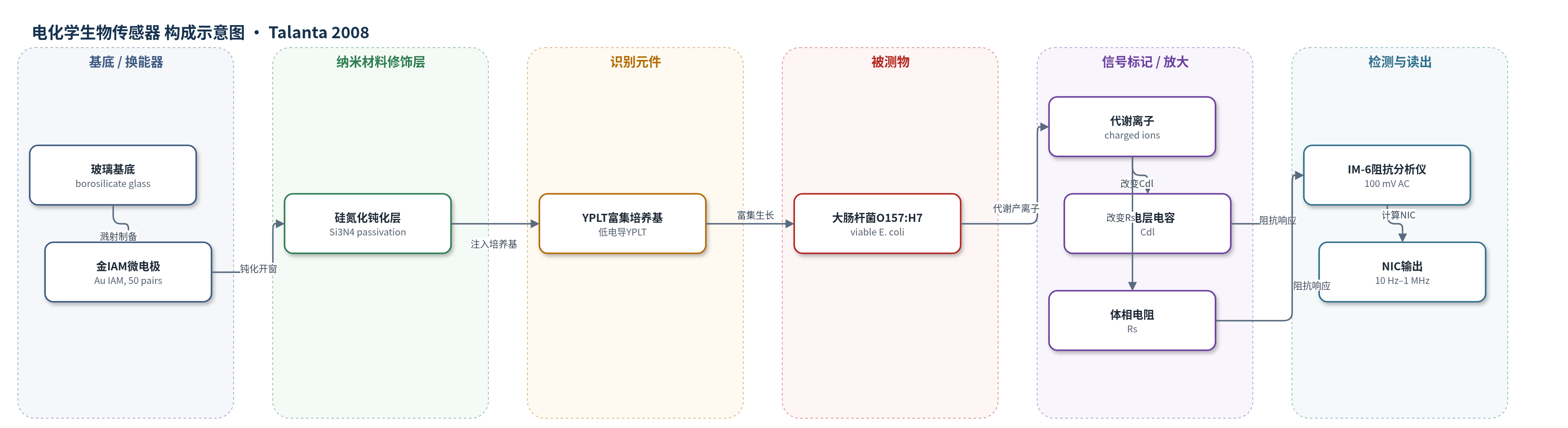
点击图片查看大图 · 依据论文自动绘制
传感器类型
电化学生物传感器
检测对象
大肠杆菌O157:H7(Escherichia coli O157:H7),样品基质为低电导YPLT富集培养基(酵母–蛋白胨–乳糖–TMAO培养基)
检测原理
该传感器采用间接阻抗微生物学原理,不在电极表面固定抗体或适配体。活的大肠杆菌O157:H7在低电导YPLT培养基中富集生长,代谢将乳糖、酵母提取物、蛋白胨和TMAO等弱带电底物转化为高带电离子,如TMAO被还原为三甲胺阳离子、乳糖代谢产酸,使介质离子浓度升高。离子浓度升高一方面增大电极–溶液界面双电层电容Cdl,另一方面降低体相介质电阻Rs。双IAM微电极在10 Hz–1 MHz交流电场下测量阻抗:低频区主要由Cdl主导,高频区主要由Rs主导。初始菌浓度越高,代谢越快,阻抗下降越快,检测时间越短。双IAM上下两个活性区增大离子检测面积,提高灵敏度。最终通过阻抗幅值、相位Bode图和NIC变化读出。
检测灵敏度
线性范围: 8.0–8.2 × 10^8 CFU mL−1;检测时间方程: TD = −1.73 log N0 + 14.62;R^2 = 0.93
效应效果
双IAM较单IAM阻抗变化提高37%–61%。生长16 h后Rs由33.96±3.1 Ω降至22.59±1.8 Ω,Cdl由155.0±11.2 nF升至227.2±10.1 nF。1 MHz下6–8 h NIC最大变化30.5%,高于10 Hz的7.8%。检测时间随初始浓度升高缩短:8.0至8.2×10^8 CFU/mL对应14.7至0.8 h。流动池可拆卸重复使用;作者认为可用选择性培养基或抗体偶联磁性微珠提高特异性,适用于便携式细菌监测。
传感器的构成
- 基底/换能器电极:硼硅酸盐玻璃(borosilicate glass)基底,100 Å钛钨合金(Ti-W)粘附层和1000 Å金(Au)IAM电极,用于阻抗换能。
- 电极钝化层:硅氮化物(Si3N4)顶层,钝化总线并开窗暴露IAM活性区。
- 微电极阵列:双IAM芯片,各50对指状Au电极(指宽15 μm、长4.96 mm、间距15 μm),上下相对形成双检测区。
- 流动池密封层:硅橡胶垫圈(silicon rubber gasket,厚250 μm),中心5 mm×5 mm窗口形成检测腔并隔离上下IAM。
- 流体接口:1 mm进/出口孔与Nanoport接头,连接注射泵管路,实现样品注入和流动。
- 检测介质:低电导YPLT培养基(酵母提取物10 g/L、蛋白胨5 g/L、乳糖3.3 g/L、TMAO 5.0 g/L),用于E. coli O157:H7富集并产生离子信号。
- 识别/特异性层:无表面固定识别元件;本实验未使用抗体/适配体,检测基于细菌代谢改变介质离子浓度,特异性可借助选择性培养基或免疫磁分离(文中提出)。
- 信号读出:IM-6阻抗分析仪与IM-6/THALES软件,施加100 mV交流电位,测量10 Hz–1 MHz阻抗幅值和相位,计算NIC。
中文摘要
本研究开发了一种基于双互指阵列微电极(IAM)的流动池阻抗生物传感器,用于在低电导富集培养基中检测活的大肠杆菌O157:H7。该流动池结构简单,无需复杂微加工,可拆卸清洗并重复使用;其独特之处在于流动池上下表面均嵌入IAM芯片,从而提高阻抗测量灵敏度。大肠杆菌O157:H7在流动池外的低电导酵母–蛋白胨–乳糖–TMAO(YPLT)培养基中富集生长,随后在流动池内进行阻抗测量。等效电路分析表明,细菌生长引起的阻抗变化主要来自双电层电容和体相介质电阻,二者均随培养基中离子浓度变化而变化;细菌代谢将弱带电底物转化为高带电离子,使离子浓度升高。该传感器在14.7 h和0.8 h富集生长后分别检测到8.0和8.2×10^8 CFU/mL的大肠杆菌O157:H7。检测时间TD与初始菌浓度N0呈对数线性关系:TD=−1.73 log N0+14.62,R^2=0.93。与单IAM流动池相比,双IAM流动池在10 Hz–1 MHz范围内阻抗变化提高37%–61%。该装置可用于细菌生长及其代谢物的灵敏检测。
英文摘要
Double interdigitated array microelectrodes (IAM)-based flow cell was developed for an impedance biosensor to detect viable Escherichia coli O157:H7 cells after enrichment in a growth medium. This study was aimed at the design of a simple flow cell with embedded IAM which does not require complex microfabrication techniques and can be used repeatedly with a simple assembly/disassembly step. The flow cell was also unique in having two IAM chips on both top and bottom surfaces of the flow cell, which enhances the sensitivity of the impedance measurement. E. coli O157:H7 cells were grown in a low conductivity yeast-peptone-lactose-TMAO (YPLT) medium outside the flow cell. After bacterial growth, impedance was measured inside the flow cell. Equivalent circuit analysis indicated that the impedance change caused by bacterial growth was due to double layer capacitance and bulk medium resistance. Both parameters were a function of ionic concentration in the medium, which increased during bacterial growth due to the conversion of weakly charged substances present in the medium into highly charged ions. The impedance biosensor successfully detected E. coli O157:H7 in a range from 8.0 to 8.2x10(8)CFUmL(-1) after an enrichment growth of 14.7 and 0.8h, respectively. A logarithmic linear relationship between detection time (T(D)) in h and initial cell concentration (N(0)) in CFUmL(-1) was T(D)=-1.73logN(0)+14.62, with R(2)=0.93. Double IAM-based flow cell was more sensitive than single IAM-based flow cell in the detection of E. coli O157:H7 with 37-61% more impedance change for the frequency from 10Hz to 1MHz. The double IAM-based flow cell can be used to design a simple impedance biosensor for the sensitive detection of bacterial growth and their metabolites.