组成图示
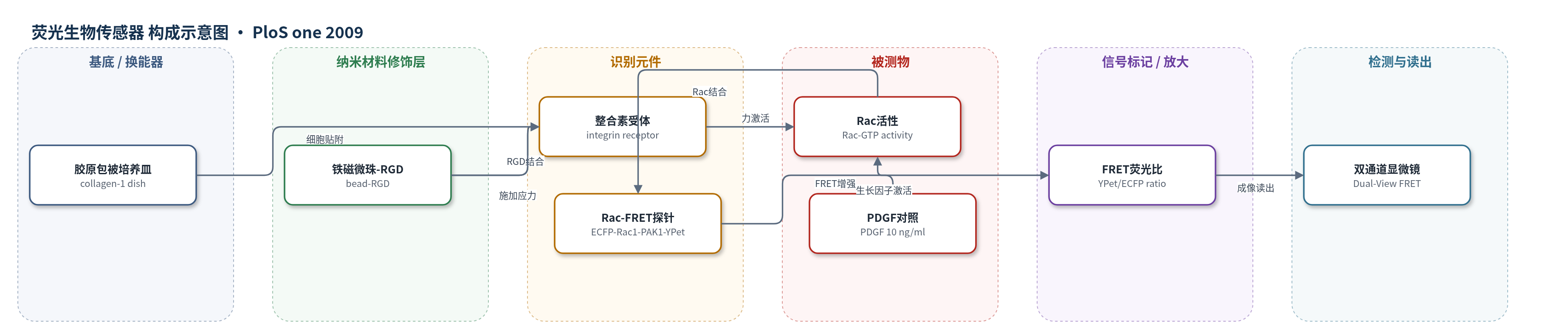
点击图片查看大图 · 依据论文自动绘制
传感器类型
荧光生物传感器
检测对象
Rac GTPase 活性(Rac GTPase activity,Rac-GTP);样品基质:活人气道平滑肌细胞(HASM)及Src/Yes/Fyn三敲除小鼠胚胎成纤维细胞(SYF2/2 MEF)胞质/细胞周边
检测原理
检测基于遗传编码FRET生物传感器。RGD肽包被的铁磁微珠结合细胞表面整合素,在垂直磁场中产生旋转剪切应力;应力经细胞骨架和膜结构传递至膜结合Rac,使Rac由GDP态转为GTP态并发生构象变化,从而结合PAK1。Rac1与PAK1结合使ECFP供体与YPet受体靠近,FRET效率升高。Dual-View系统同时采集ECFP和YPet发射,计算YPet/ECFP发射比;比值升高表示Rac激活。该过程无酶催化放大,但通过FRET比增强和细胞周边环形区域平均提高信噪比。激活依赖应力大小和细胞骨架完整性,阈值约8.8–17.5 Pa,17.5 Pa下可在300 ms内出现。
检测灵敏度
未报告LOD、线性范围、灵敏度斜率或相关系数;原文报告:stress threshold for Rac activation was between 8.8 and 17.5 Pa;activated within 300 ms
效应效果
选择性方面,突变体RacN17对应力和PDGF均无FRET响应;转铁蛋白或多聚赖氨酸包被磁珠不能激活Rac,说明依赖整合素结合。Src抑制剂PP1(10 μM,1 h)或SYF2/2 MEF不阻断应力诱导Rac激活,而PDGF诱导激活依赖Src。MbCD(10 mM,15 min)提取胆固醇后激活仍发生,提示脂筏非依赖。Rac抑制剂NSC23766可完全阻断;blebbistatin(50 μM)、cytochalasin D(1 μg/ml)、colchicine(10 μM)破坏细胞骨架后激活消失。17.5 Pa下Rac在<300 ms激活,PDGF(10 ng/ml)约30 s后激活。作者认为该方法可扩展至活细胞其他分子。
传感器的构成
- 细胞基底/培养表面:胶原-1(collagen-1)包被培养皿,提供细胞贴附与力学环境
- 力学换能/施加装置:铁磁微珠(ferromagnetic beads,约4 μm)表面修饰Arg-Gly-Asp(RGD)肽,结合整合素并传递旋转剪切应力
- 识别/传感元件:遗传编码Rac生物传感器pRaichu-Rac/RacCT,由ECFP、Rac1、柔性连接子、PAK1和YPet组成,识别Rac-GTP构象
- 信号标记/换能元件:ECFP(增强青色荧光蛋白,供体)与YPet(黄色荧光蛋白变体,受体)通过FRET产生可测荧光比
- 阴性对照识别元件:突变体RacN17生物传感器(pc’-Rac(N17)-YPet),用于验证Rac特异性
- 样品基质/细胞环境:人气道平滑肌细胞(HASM)或Src/Yes/Fyn三敲除小鼠胚胎成纤维细胞(SYF2/2 MEF),胞质/细胞周边Rac活性
- 光学读出系统:Leica倒置显微镜、Dual-View双通道成像、CFP/YPet FRET滤光片组和CCD相机,输出YPet/ECFP发射比
中文摘要
机械力对维持人体各组织器官功能至关重要,但机械力如何在细胞和分子水平转导为生化活性仍不清楚。本研究采用磁扭转细胞力学技术,通过经跨膜黏附分子整合素结合到细胞表面的磁珠,对活人气道平滑肌细胞施加局部机械应力。利用荧光共振能量转移(FRET)方法量化小GTP酶Rac的时空激活:以ECFP为供体、YPet为受体,通过二者荧光强度比反映Rac活性。结果显示,施加应力可在300 ms内诱导细胞周边Rac快速激活;而血小板源性生长因子(PDGF)诱导的Rac激活明显延迟,约30 s后才出现。转染Rac突变体RacN17,或用转铁蛋白、多聚赖氨酸包被磁珠时,均无应力诱导的Rac激活。已知PDGF诱导的Rac激活依赖Src活性,但Src抑制剂PP1预处理或Src基因敲除均不影响应力诱导的Rac激活。此外,用甲基-β-环糊精提取胆固醇消除脂筏后,应力诱导的Rac激活仍发生,提示该过程不依赖脂筏。进一步证据表明,Rac激活依赖施加应力大小和细胞骨架完整性。结果提示机械力诱导的Rac激活快速、直接且不依赖Src,整合素介导的机械力信号通路可能与生长因子通路存在根本差异。
英文摘要
It is well known that mechanical forces are crucial in regulating functions of every tissue and organ in a human body. However, it remains unclear how mechanical forces are transduced into biochemical activities and biological responses at the cellular and molecular level. Using the magnetic twisting cytometry technique, we applied local mechanical stresses to living human airway smooth muscle cells with a magnetic bead bound to the cell surface via transmembrane adhesion molecule integrins. The temporal and spatial activation of Rac, a small guanosine triphosphatase, was quantified using a fluorescent resonance energy transfer (FRET) method that measures changes in Rac activity in response to mechanical stresses by quantifying intensity ratios of ECFP (enhanced cyan fluorescent protein as a donor) and YPet (a variant yellow fluorescent protein as an acceptor) of the Rac biosensor. The applied stress induced rapid activation (less than 300 ms) of Rac at the cell periphery. In contrast, platelet derived growth factor (PDGF) induced Rac activation at a much later time (>30 sec). There was no stress-induced Rac activation when a mutant form of the Rac biosensor (RacN17) was transfected or when the magnetic bead was coated with transferrin or with poly-L-lysine. It is known that PDGF-induced Rac activation depends on Src activity. Surprisingly, pre-treatment of the cells with specific Src inhibitor PP1 or knocking-out Src gene had no effects on stress-induced Rac activation. In addition, eliminating lipid rafts through extraction of cholesterol from the plasma membrane did not prevent stress-induced Rac activation, suggesting a raft-independent mechanism in governing the Rac activation upon mechanical stimulation. Further evidence indicates that Rac activation by stress depends on the magnitudes of the applied stress and cytoskeletal integrity. Our results suggest that Rac activation by mechanical forces is rapid, direct and does not depend on Src activation. These findings suggest that signaling pathways of mechanical forces via integrins might be fundamentally different from those of growth factors.