组成图示
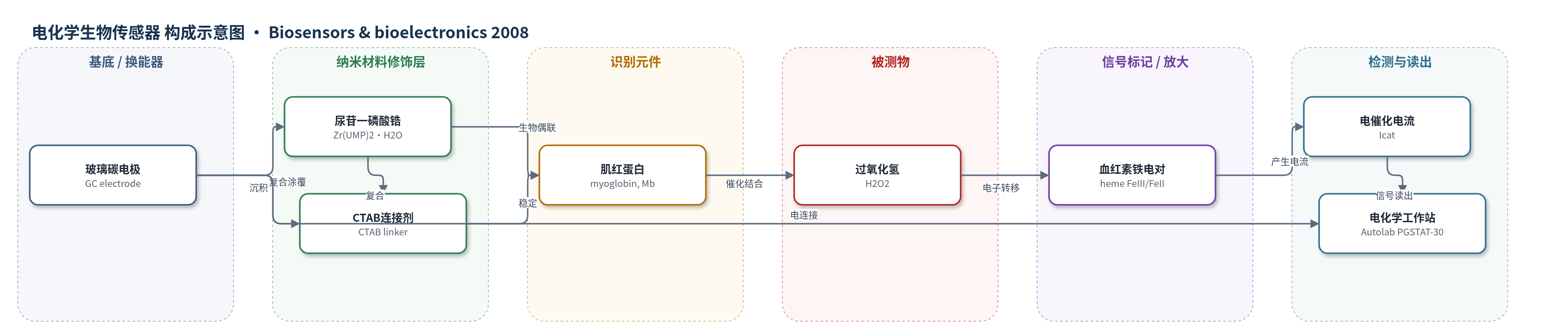
点击图片查看大图 · 依据论文自动绘制
传感器类型
电化学生物传感器
检测对象
过氧化氢(H2O2);样品基质:0.1 M 磷酸盐缓冲液(pH 7.0)
检测原理
Mb 通过 Zr(UMP)2·H2O 多孔纳米颗粒与 CTAB 偶联固定在 GC 电极表面,保持天然构象并实现血红素 FeIII/FeII 与电极间的直接电子转移。H2O2 扩散进入膜内,被 Mb 血红素铁催化还原,Mb FeIII 被还原为 FeII 后与 H2O2 反应,电子经血红素中心传递至电极,产生阴极催化电流 Icat。Icat 随 H2O2 浓度增加先线性增大后趋于饱和,符合 Michaelis–Menten 动力学。无外源电子介质,信号直接来自 Mb 直接电化学与生物电催化。
检测灵敏度
LOD: 1.52 μM;线性范围: 3.92–180.14 μM;灵敏度斜率: 2.36(Icat = −0.59 + 2.36[H2O2]);表观Km: 196.1 μM
效应效果
传感器在 0.1 M 磷酸盐缓冲液中检测 H2O2,线性范围 3.92–180.14 μM,LOD 1.52 μM,表观 Km 196.1 μM,低于多数其他 Mb 膜报道值。稳定性方面,4 ℃ 储存 30 天 CV 峰高仅下降约 8%,20–30 次循环伏安中 Mb 脱附不超过 5%,H2O2 催化活性 20 天内基本保持。重现性:4.00–175.00 μM H2O2 五次平行测定回收率 91.26–106.08%,RSD 0.59–3.23%。O2 饱和时 Mb 催化 O2 还原生成 H2O2,阴极峰正移约 40 mV,Ic/Id 为 86,提示需除氧或考虑 O2 干扰。作者认为该无介质传感器具有低检出限、高酶活性和良好重现性,可作第三代生物传感器或生物反应器基础。
传感器的构成
- 基底/换能器电极:玻璃碳电极(GC electrode),抛光后作为工作电极,提供电子转移界面。
- 纳米材料修饰层:尿苷一磷酸锆(Zr(UMP)2·H2O)多孔纳米颗粒,作为 Mb 生物偶联基质,提供亲水微环境并促进直接电子转移。
- 识别/生物催化元件:马心肌红蛋白(myoglobin, Mb),血红素蛋白,催化 H2O2 还原并实现直接电子转移。
- 连接/稳定剂:十六烷基三甲基溴化铵(CTAB),作为 linker/surfactant,辅助复合膜形成并稳定 Mb。
- 信号标记物:无外源标记物(mediator-free),Mb 血红素 FeIII/FeII 直接电子转移产生电流信号。
- 电子供体/底物:过氧化氢(H2O2),被 Mb 催化还原并提供电子转移信号。
中文摘要
在温和条件下首次合成尿苷一磷酸锆(Zr(UMP)2·H2O)多孔纳米颗粒,并将其用于肌红蛋白(Mb)生物偶联以实现直接电子转移。紫外-可见光谱和共振拉曼光谱表明,Zr(UMP)2·H2O 膜中的 Mb 保持与天然态相似的二级结构。Mb–Zr(UMP)2·H2O 偶联膜修饰玻璃碳(GC)电极后,呈现清晰、准可逆循环伏安峰,反映 Mb 血红素 FeIII/FeII 电对的直接电子转移。基于 Mb 纳米偶联物对底物的良好生物电催化性能,开发了一种无介质 H2O2 生物传感器。H2O2 检测线性范围为 3.92–180.14 μM,表观 Michaelis–Menten 常数(Km)和基于信噪比 3 的检出限分别为 196.1 μM 和 1.52 μM,均低于其他 Mb 膜报道值。该传感器具有优异稳定性、长寿命(超过 20 天)和良好重现性。
英文摘要
Porous nano-granule of zirconium uridine monophosphate, Zr(UMP)2.H2O is, for the first time, synthesized under mild experimental conditions and applied to the bioconjugation of myoglobin (Mb) to realize its direct electron transfer. UV-vis and resonance Raman spectroscopies prove that Mb in the Zr(UMP)2.H2O film maintains its secondary structure similar to the native state. The conjugation film of the Mb-Zr(UMP)2.H2O on the glassy carbon (GC) electrode gives a well-defined and quasi-reversible cyclic voltammogram, which reflects the direct electron transfer of the heme Fe III/Fe II couple of Mb. On the basis of the satisfying bioelectrocatalysis of the nano-conjugation of Mb and genetic substrate, a kind of mediator-free biosensor for H2O2 is developed. The linear range for H2O2 detection is estimated to be 3.92-180.14 microM. The apparent Michaelis-Menten constant (Km) and the detection limit based on the signal-to-noise ratio of 3 are found to be 196.1 microM and 1.52 microM, respectively. Both the apparent Michaelis-Menten constant and the detection limit herein are much lower than currently reported values from other Mb films. This kind of sensor possesses excellent stability, long-term life (more than 20 days) and good reproducibility.