组成图示
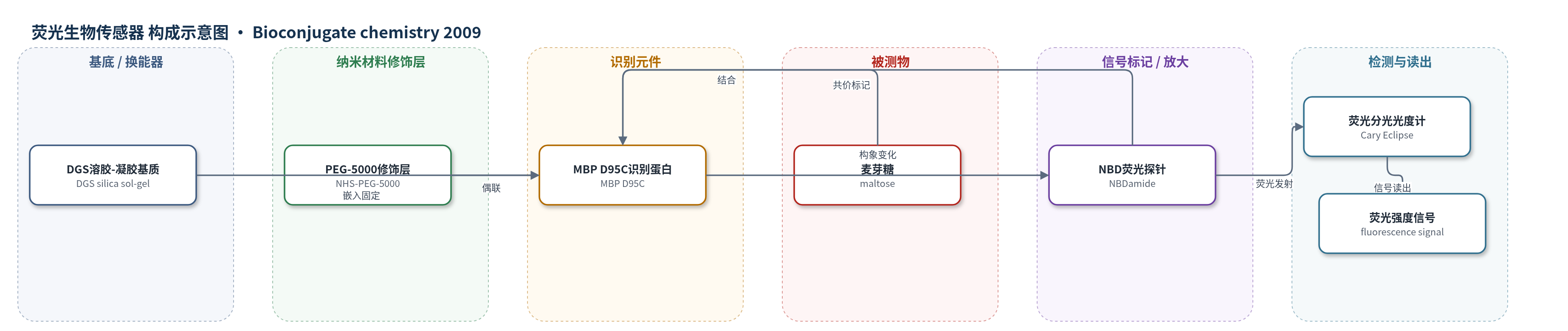
点击图片查看大图 · 依据论文自动绘制
传感器类型
荧光生物传感器
检测对象
麦芽糖(maltose);样品基质:5 mM磷酸盐缓冲液(phosphate buffer,pH 7.0)/DGS溶胶-凝胶薄膜
检测原理
该传感器基于构象依赖荧光机制。MBP D95C的D95C位点共价连接环境敏感荧光探针NBDamide;未结合麦芽糖时,NBD与Tyr171羟基形成氢键,荧光较弱。麦芽糖进入DGS溶胶-凝胶基质并与MBP结合后,蛋白铰链区发生弯曲/旋转,使NBD与Tyr171的氢键接触被破坏,探针微环境极性/氢键状态改变,NBD发射强度增强。PEG-5000共价修饰增加蛋白水化并减少二氧化硅壁的空间作用,使固定后荧光响应增强。信号通过480 nm激发、发射最大波长稳态荧光读出,荧光强度随麦芽糖浓度升高而增加,可用结合等温线拟合得到表观解离常数。
检测灵敏度
未报告LOD、线性范围、灵敏度斜率或相关系数;报告Kd: 5 µM(溶液)、~22 µM(DGS溶胶-凝胶)
效应效果
溶液中PEG化与未PEG化MBP-NBD荧光响应无显著差异,均4.5倍增强,PEG化Kd为5 µM,平衡无明显滞后。固定于DGS溶胶-凝胶后,PEG化传感器麦芽糖饱和荧光增强2.8倍,未PEG化为2.4倍;PEG化荧光强度约提高10%,NBD发射最大红移5 nm。0–2 mM麦芽糖滴定显示两者Kd均约22 µM。固定后响应变慢,约20 min达50%信号强度,PEG化与否无差异,归因于麦芽糖在DGS基质中扩散。传感器4 °C下至少稳定2个月。作者认为该方法首次将PBP生物传感器嵌入聚合基质并保留环境敏感探针信号响应,可推广至构象依赖型生物传感器。
传感器的构成
- 识别元件:工程化大肠杆菌麦芽糖结合蛋白MBP D95C(periplasmic binding protein, PBP),识别麦芽糖并发生铰链弯曲构象变化
- 信号标记物:NBDamide(N,N′-dimethyl-N-(iodoacetyl)-N′-(7-nitrobenz-2-oxa-1,3-diazol-4-yl)ethylenediamine,IANBDamide/NBD),环境敏感荧光探针,共价连接MBP D95C半胱氨酸,麦芽糖结合后氢键变化导致荧光增强
- 蛋白修饰层:NHS-PEG-5000(poly(ethylene glycol)-5000,PEG-5000),共价连接MBP赖氨酸,增加蛋白水化并减少蛋白-二氧化硅基质空间相互作用
- 固定基质:二甘油硅烷DGS(diglycerylsilane)溶胶-凝胶二氧化硅(silica sol-gel),中性pH缩合形成介孔二氧化硅薄膜/单体,嵌入蛋白并允许麦芽糖扩散
- 样品介质:5 mM磷酸盐缓冲液(phosphate buffer,pH 7.0),用于预水化和麦芽糖滴定
- 读出装置:Varian Cary Eclipse荧光分光光度计(spectrofluorometer)配板读器和偏振片,480 nm激发并检测发射最大波长荧光强度
中文摘要
本文报道了一种将麦芽糖生物传感器固定于二氧化硅溶胶-凝胶中的稳健方法。该传感器由工程化麦芽糖周质结合蛋白(PBP)与对环境敏感荧光探针NBDamide共价偶联构成。作者以二甘油硅烷(DGS)为前驱体构建介孔二氧化硅溶胶-凝胶,将麦芽糖生物传感器嵌入其中,并测量其配体报告荧光性质。结果表明,在DGS衍生二氧化硅基质中,该生物传感器仍保留麦芽糖依赖的荧光传感能力,且具有微摩尔级亲和力,与溶液中自由蛋白一致。进一步将MBP-NBD共轭物与聚乙二醇-5000(PEG-5000)共价偶联,可促进蛋白周围水分子保留并降低二氧化硅基质与蛋白之间的空间效应。PEG化不显著影响蛋白在溶液中的信号响应;固定于DGS聚合物后,与未PEG化蛋白相比,荧光强度出现一致增加。据作者所知,这是首次成功将PBP生物传感器嵌入聚合基质并保留环境敏感探针信号响应的方法,该固定策略可推广至其他构象依赖型生物传感器。
英文摘要
A robust method to immobilize a maltose biosensor is described using an engineered maltose periplasmic binding protein (PBP) covalently coupled to NBDamide, an environmentally sensitive fluorophore. A mesoporous silica sol-gel derived from diglycerylsilane (DGS) was constructed to embed the maltose biosensor, and the ligand reporting fluorescence properties were measured. When sequestered in the DGS-derived silica matrix, the biosensor retained maltose-dependent fluorescence sensing capability with micromolar affinity, which is consistent with the protein free in solution. The MBP-NBD conjugate was further modified by covalent conjugation with poly(ethylene glycol)-5000 (PEG) to promote the retention of water molecules around the protein and to reduce possible steric effects between the silica matrix and protein. Bioconjugation with PEG molecules does not significantly affect the signaling response of the protein in solution. When immobilized in the DGS polymer, a consistent increase in fluorescence intensity was observed as compared to the protein not functionalized with PEG. To our knowledge, this report presents the first successful method to embed a PBP biosensor in a polymerized matrix and retain signaling response using an environmentally sensitive probe. The immobilization method presented here should be easily adaptable to all conformation-dependent biosensors.