组成图示
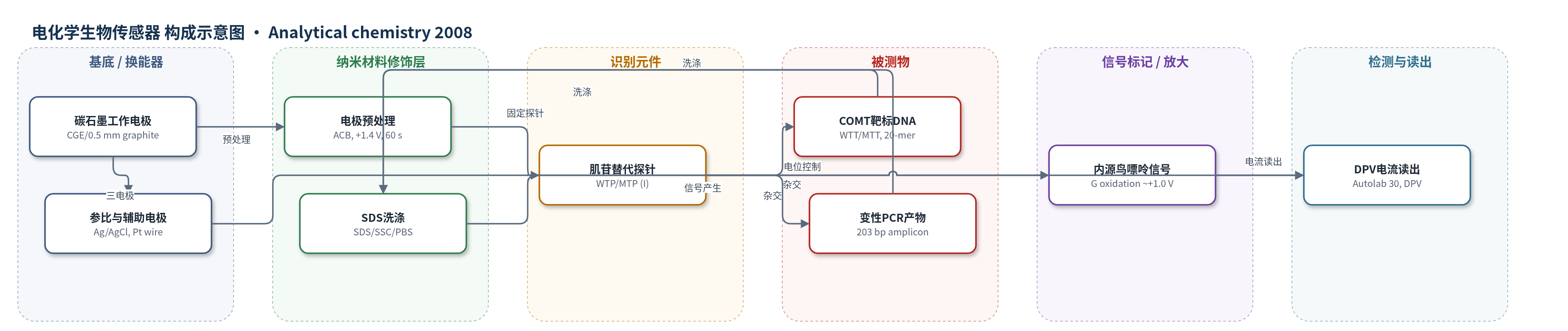
点击图片查看大图 · 依据论文自动绘制
传感器类型
电化学生物传感器
检测对象
COMT Val108/158Met 单核苷酸多态性(SNP)/COMT 基因型(Val/Val-H/H、Val/Met-H/L、Met/Met-L/L),样品基质为 PCR 扩增子(203 bp COMT 基因片段,变性 PCR 产物)
检测原理
该传感器为无标记电化学基因传感器。方法1将含鸟嘌呤的 COMT 靶标寡核苷酸(WTT/MTT)吸附于 CGE,杂交前 G 暴露,DPV 在约 +1.0 V 产生较强氧化峰;与肌苷替代探针(WTP/MTP)杂交后,G 与互补 C 配对,氧化可及性下降,G 氧化峰降低。方法2将无 G 的肌苷替代探针固定于 CGE,杂交前几乎无 G 信号;当含 G 的互补靶标或变性 PCR 产物杂交后,G 暴露,氧化峰出现或增强。信号大小反映杂交程度和靶标浓度,SDS/SSC 洗涤去除非互补与错配吸附,提高选择性。
检测灵敏度
LOD: 2.44 pmol 靶序列(30 µL 样品,S/N = 3)
效应效果
传感器可区分互补、非互补和单碱基错配序列。优化条件下,靶标浓度 RSD 为 7.7%,探针杂交 RSD 为 3.2%;重复测量 RSD 分别为杂交 15.5%、错配 7.5%、非互补 5.0%,WTP/WTT 杂交 3.1%,WT 探针对 MT 靶标 6.5%。真实 PCR 扩增子分析 RSD 约 19%。使用 0.01% SDS 洗涤 5 min 后搅拌 PBS 30 s,互补/单碱基错配区分率约 100%。靶标平均信号约为非互补的 3 倍、单碱基错配的 2 倍。检测限为 30 µL 样品中 2.44 pmol 靶序列(S/N=3),40 min 完成真实样品检测,可作为 RFLP 的无标记替代方法。
传感器的构成
- 工作电极/换能器:一次性碳石墨电极(CGE,0.5 mm graphite lead),提供导电表面并检测鸟嘌呤氧化电流
- 参比/辅助电极:Ag/AgCl 参比电极与铂丝辅助电极,组成三电极体系用于 DPV 测量
- 电极预处理:0.50 M 醋酸缓冲液(ACB,含 20 mM NaCl,pH 4.8)中 +1.4 V 处理 60 s,清洁/活化碳表面
- 识别元件(方法1):含鸟嘌呤 COMT 靶标寡核苷酸(WTT/MTT,20-mer),湿吸附固定于 CGE 作为杂交靶序列
- 识别元件(方法2):肌苷替代 COMT 捕获探针(WTP/MTP,20-mer,I 替代 G),湿吸附固定于 CGE 作为识别探针
- 杂交/洗涤介质:PBS(pH 7.4,含 20 mM NaCl)用于固定与杂交;SDS(0.01%–5%)和 SSC 洗涤液去除非特异吸附
- 信号标记物:无外源标记,利用 DNA 中内源鸟嘌呤(G)在约 +1.0 V 的氧化峰作为电化学信号
- 检测读出:Autolab 30 电化学分析系统与 GPES 软件,采用 DPV 扫描 +0.75 至 +1.40 V 读取 G 氧化电流
中文摘要
精神疾病具有多基因和多因素遗传背景,儿茶酚-O-甲基转移酶(COMT)基因 Val108/158Met 单核苷酸多态性与精神分裂症、酒精依赖、双相障碍和强迫症等相关。本文报道一种基于 DNA 杂交的一次性电化学 DNA 生物传感器,用于检测 PCR 扩增子中 COMT 常见功能多态性,且不使用外源标记。该传感器采用一次性碳石墨电极(CGE)和差分脉冲伏安法(DPV),利用短合成寡核苷酸和 203 bp PCR 扩增子,在约 +1.0 V 处监测探针与靶标杂交后鸟嘌呤氧化信号的变化。COMT 特异性寡核苷酸通过简单吸附法以两种模式固定:含鸟嘌呤靶标固定或肌苷替代探针固定。通过控制表面覆盖优化杂交,并用非互补及单碱基错配 DNA 评价选择性。鸟嘌呤信号降低或出现可简化步骤、缩短检测时间。使用十二烷基硫酸钠(SDS)洗涤减少非特异结合。真实 PCR 样品可区分野生型、突变型和杂合基因型。检测限(S/N=3)为 30 µL 样品中 2.44 pmol 靶序列。
英文摘要
Psychiatric disorders are common and complex diseases that show polygenic and multifactorial heredity. A single nucleotide polymorphism (Val108/158Met) in the catechol-O-methyl transferase (COMT) gene is related to many psychiatric disorders such as schizophrenia, alcoholism, bipolar disorder, and obsessive-compulsive disorder. Schizophrenia is a complex disorder and a single nucleotide polymorphism (Val108/158Met) at the COMT gene is related to schizophrenia susceptibility. A novel hybridization-based disposable electrochemical DNA biosensor for the detection of a common functional polymorphism in the COMT gene from polymerase chain reaction (PCR) amplicons has been described without using an external label. This developed technology combined with a disposable carbon graphite electrode and differential pulse voltammetry was performed by using short synthetic oligonucleotides and PCR amplicons in length 203 bp to measure the change of guanine oxidation signal obtained at approximately +1.0 V after DNA hybridization between probe and target (synthetic target or denatured PCR samples). COMT-specific oligonucleotides were immobilized onto the carbon surface with a simple adsorption method in two different modes: (a) Guanine-containing targets were attached or (b) inosine-substituted probes were attached onto an electrode. By controlling the surface coverage of the target DNA, the hybridization event between the probes and their synthetic targets or specific PCR products was optimized. The wild-type or polymorphic allele-specific probes/targets were also interacted with an equal amount of noncomplementary and one-base mismatch-containing DNAs in order to measure the sensor selectivity. The decrease or appearance in the intrinsic guanine signal simplified the detection procedure and shortened the assay time because protocol eliminates the label-binding step. The nonspecific binding effects were minimized by using sodium dodecyl sulfate with different washing methods. The Val108/158Met COMT genotype detection were performed with real samples containing wild-type (healthy controls), polymorphic (mutant type), and heterozygous PCR products. The detection limit (S/N = 3) of the biosensor was 2.44 pmol of target sequence in the 30-muL samples. Analytical performance of the sensor is described, along with future prospects.