组成图示
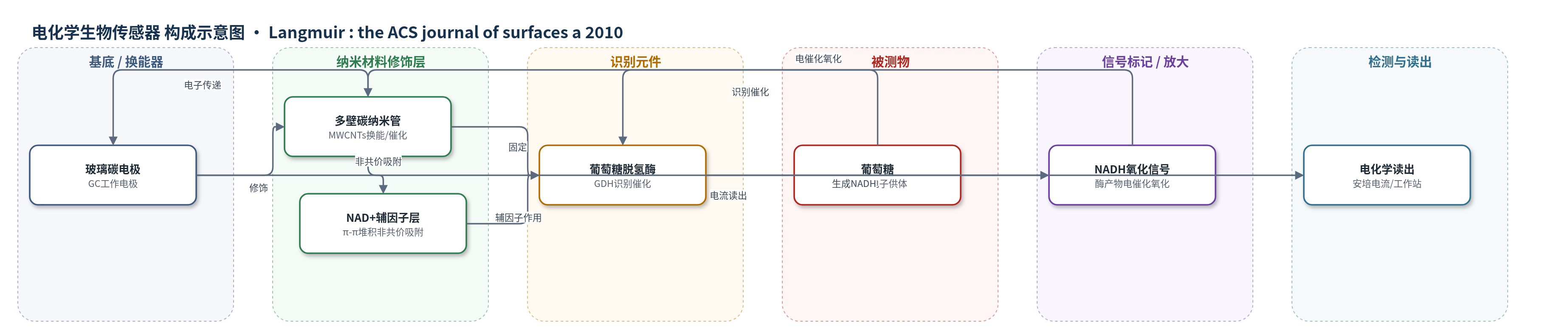
点击图片查看大图 · 依据论文自动绘制
传感器类型
电化学生物传感器
检测对象
葡萄糖(glucose);样品基质:0.10 M 磷酸盐缓冲液(pH 7.0)
检测原理
传感器以GDH为识别元件,以非共价固定于MWCNTs表面的NAD+为辅因子。葡萄糖进入电极表面后,被GDH催化氧化,同时NAD+被还原为NADH。由于NAD+通过腺嘌呤与MWCNTs的π-π堆积稳定吸附,无需在缓冲液中额外添加NAD+。生成的NADH在MWCNTs表面发生电催化氧化,电子经MWCNTs传递至玻璃碳电极,形成安培电流。MWCNTs兼具电子换能器、辅因子载体和NADH电催化剂功能,使葡萄糖氧化电位接近NADH氧化电位并低于裸碳电极,从而提高响应。电流随葡萄糖浓度增加而增大,实现电化学检测。
检测灵敏度
LOD: 4.81 μM (S/N = 3);线性范围: 10–300 μM (0.01–0.30 mM);灵敏度: 0.474 nA/μM;线性方程: I/nA = 11.7 + 0.474C/μM;γ = 0.997
效应效果
在不含NAD+的0.10 M磷酸盐缓冲液(pH 7.0)中,传感器对葡萄糖产生明显电流响应,线性范围为10–300 μM,检出限4.81 μM(S/N=3),灵敏度0.474 nA/μM,线性系数γ=0.997。NAD+在MWCNTs上的吸附稳定,连续50次循环伏安扫描后+0.20 V处峰电流基本不变;空白测量17次的标准偏差为0.76 nA。与表1中其他脱氢酶基葡萄糖传感器相比,该传感器的线性范围和检出限具有竞争力。论文未报告选择性、抗干扰、实际样品加标回收率或与ELISA/HPLC/qPCR的直接对比。作者强调该方法避免复杂合成,可推广至其他脱氢酶电化学生物传感器和生物燃料电池。
传感器的构成
- 基底电极:玻璃碳电极(GC),作为工作电极基底并提供电子传导
- 纳米修饰层:多壁碳纳米管(MWCNTs),非共价负载NAD+,作为电子换能器、NAD+载体和NADH电催化剂
- 辅因子层:NAD+,通过腺嘌呤与MWCNTs的π-π堆积非共价吸附,作为GDH辅因子
- 识别元件:葡萄糖脱氢酶(GDH),特异性催化葡萄糖氧化
- 固定/交联层:牛血清白蛋白(BSA)与1%戊二醛(glutaraldehyde),混合并交联固定GDH
- 电子供体:葡萄糖(glucose),酶促氧化底物,电子经NAD+/NADH传递至电极
中文摘要
本研究报道了一种简便方法,通过氧化型β-烟酰胺腺嘌呤二核苷酸(NAD+)腺嘌呤基团与多壁碳纳米管(MWCNTs)之间的π-π堆积作用,将NAD+非共价固定于MWCNTs表面,构建NAD+/MWCNT复合作为集成脱氢酶电化学生物传感器的电子换能器。X射线光电子能谱和循环伏安结果表明,NAD+稳定吸附于MWCNTs上。以葡萄糖脱氢酶(GDH)为模型识别单元,在不含NAD+的磷酸盐缓冲液中,葡萄糖可在GDH/NAD+/MWCNT修饰电极上被氧化,且氧化电位接近MWCNT修饰电极上NADH的氧化电位,但比裸玻璃碳电极上NADH氧化电位更负。结果表明,固定于MWCNTs上的NAD+可高效充当脱氢酶辅因子;MWCNTs同时作为电子换能器、NAD+载体和NADH电催化剂。所制GDH/NAD+/MWCNT葡萄糖传感器在10–300 μM范围内电流与葡萄糖浓度线性相关,检出限为4.81 μM(S/N=3)。该策略为开发集成脱氢酶电化学生物传感器和生物燃料电池提供了简便通用途径。
英文摘要
This study describes a facile approach to the preparation of integrated dehydrogenase-based electrochemical biosensors through noncovalent attachment of an oxidized form of beta-nicotinamide adenine dinucleotide (NAD(+)) onto carbon nanotubes with the interaction between the adenine subunit in NAD(+) molecules and multiwalled carbon nanotubes (MWCNTs). X-ray photoelectron spectroscopic and cyclic voltammetric results suggest that NAD(+) is noncovalently attached onto MWCNTs to form an NAD(+)/MWCNT composite that acts as the electronic transducer for the integrated dehydrogenase-based electrochemical biosensors. With glucose dehydrogenase (GDH) as a model dehydrogenase-based recognition unit, electrochemical studies reveal that glucose is readily oxidized at the GDH/NAD(+)/MWCNT-modified electrode without addition of NAD(+) in the phosphate buffer. The potential for the oxidation of glucose at the GDH/NAD(+)/MWCNT-modified electrode remains very close to that for NADH oxidation at the MWCNT-modified electrode, but it is more negative than those for the oxidation of glucose at the MWCNT-modified electrode and for NADH oxidation at a bare glassy carbon electrode. These results demonstrate that NAD(+) molecules stably attached onto MWCNTs efficiently act as the cofactor for the dehydrogenases. MWCNTs employed here not only serve as the electronic transducer and the support to confine NAD(+) cofactor onto the electrode surface, but also act as the electrocatalyst for NADH oxidation in the dehydrogenase-based electrochemical biosensors. At the GDH/NAD(+)/MWCNT-based glucose biosensor, the current is linear with the concentration of glucose being within a concentration range from 10 to 300 microM with a limit of detection down to 4.81 microM (S/N = 3). This study offers a facile and versatile approach to the development of integrated dehydrogenase-based electrochemical devices, such as electrochemical biosensors and biofuel cells.