组成图示
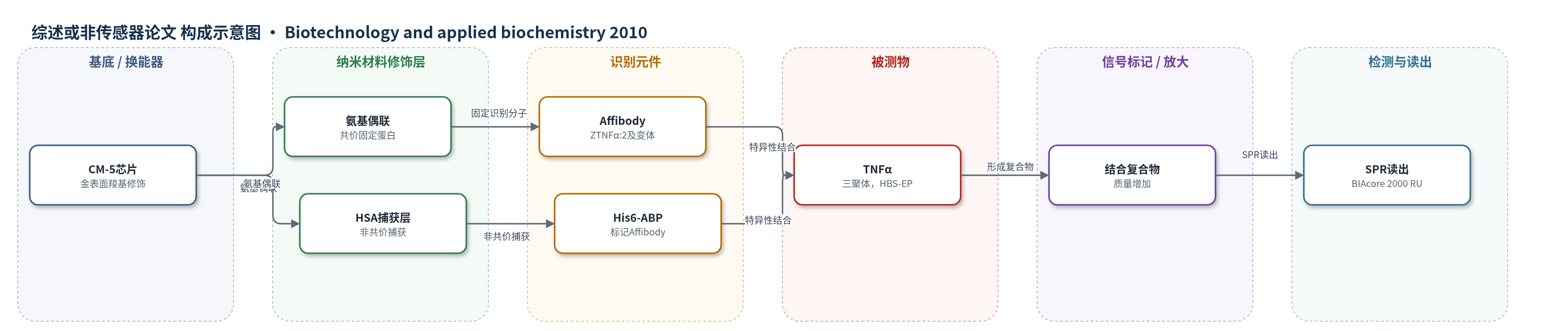
点击图片查看大图 · 依据论文自动绘制
传感器类型
综述或非传感器论文
检测对象
肿瘤坏死因子α(TNFα,三聚体),重组蛋白溶液(HBS-EP 缓冲液)
检测原理
该分析采用表面等离子共振(SPR)原理。Affibody 识别分子通过氨基偶联化学共价固定于 CM-5 传感器芯片表面,或以 His6-ABP 标签非共价捕获于 HSA 涂层芯片上;未反应羧基用乙醇胺失活以降低非特异结合。当含 TNFα 的 HBS-EP 缓冲液流过芯片时,TNFα 与固定化 Affibody 特异性结合,界面质量增加引起局部折射率变化,使 SPR 共振角发生偏移,BIAcore 2000 将其转换为相对单位(RU)响应。平衡响应随 TNFα 浓度升高而增大,可用四参数方程拟合表观解离常数 Kd;停止注入后复合物解离,响应下降,解离相反映 off-rate。该过程无酶或核酸放大,信号直接来自结合质量变化。
检测灵敏度
原文未报告 LOD、线性范围、灵敏度斜率或相关系数。
效应效果
该研究主要评价 PCA 选择系统而非传感器检测性能。系统对 IPTG 诱导水平、亲和力和选择压力敏感:约 10–50 μM IPTG 时生长速率差异显著,100 μM 以上趋于饱和;325 min 时最高诱导组细胞密度约为最低组 3 倍。三克隆混合物选择 200 min 后,96 个测序克隆中 94 个为高亲和变体,富集率 98%。约 10^7 Affibody 库经预选择和两轮液体选择后,第一轮获得 47 个不同克隆,P5 占 25%。BIAcore 分析显示成熟变体 Kd 为 0.23–0.84 nM,优于祖先 ZTNFα:2 的 1.93 nM,最高提高约 8 倍,且解离速率降低。作者认为该方法可用于蛋白工程和高亲和结合分子筛选。
传感器的构成
- 基底/换能器:CM-5 传感器芯片(金表面羧基修饰),用于 SPR 质量响应换能
- 表面化学修饰:氨基偶联化学(amine coupling),共价固定 Affibody 或 HSA
- 捕获层:HSA 涂层,非共价捕获 His6-ABP 标记 Affibody
- 识别元件:Affibody 分子(ZTNFα:2 及成熟变体),特异性结合 TNFα
- 封闭/失活:乙醇胺(ethanolamine)失活未反应羧基,降低非特异结合
- 信号读出:BIAcore 2000 SPR 仪器,以相对单位(RU)记录结合与解离响应
中文摘要
本文报道了一种基于达尔文生存选择的 Affibody 分子亲和力成熟策略。作者利用 β-内酰胺酶蛋白片段互补分析(PCA)系统,在大肠杆菌周质中通过目标蛋白与库成员结合驱动 β-内酰胺酶活性重建,使具有 TNFα 结合能力的克隆获得在含氨苄青霉素选择培养基中的生长优势。研究首先考察了 IPTG 诱导水平、相互作用亲和力和选择压力对系统响应的影响,发现诱导水平在约 10–50 μM 时系统对亲和力差异最敏感,而高诱导水平会导致饱和。随后,以初始亲和力约 2 nM 的 TNFα 结合 Affibody ZTNFα:2 为祖先分子,构建约 10^7 规模的第二代 Affibody 库,经半固体培养基预选择去除非结合克隆后,再进行两轮液体培养竞争选择。结果显示,选择后富集的变体对 TNFα 的亲和力最高提高约 8 倍。BIAcore 生物传感器分析表明,亲和力改善主要来源于解离速率常数降低。
英文摘要
The introduction of different methodologies for the construction and screening of complex protein libraries has provided powerful means in protein engineering for the development of molecules with desired traits. A challenge faced in many situations is to adapt a given methodology for efficient and rapid identification of the most interesting variants present in a library. In the present study, the concept of Darwinian selection based on a growth advantage for clones having the desired trait has been investigated. Using a beta-lactamase-based PCA (protein fragment complementation assay), affinity maturation of a TNFalpha (tumour necrosis factor alpha)-binding Affibody molecule with an initial 2 nM affinity for the target has been performed. Initial characterization of the PCA system, based on the affinity-driven reconstitution of beta-lactamase activity in the periplasm of cells harbouring a library member showing affinity for a co-expressed target protein, showed that the system was responsive to promoter induction level, interaction affinity and applied selection pressure. Using combinatorial protein engineering principles, a 107 library of second-generation Affibody molecules was constructed and subjected to selection of improved variants by library growth in liquid culture. The results show that, after a pre-selection step on semi-solid medium to eliminate non-binding variants, present in the majority, two rounds of selection in liquid culture resulted in an enrichment for binders showing up to 8-fold higher affinity for the TNFalpha target than the ancestral variant. Biosensor analyses showed that the major factor for the improved affinity could be attributed to reduced off-rate constants.