组成图示
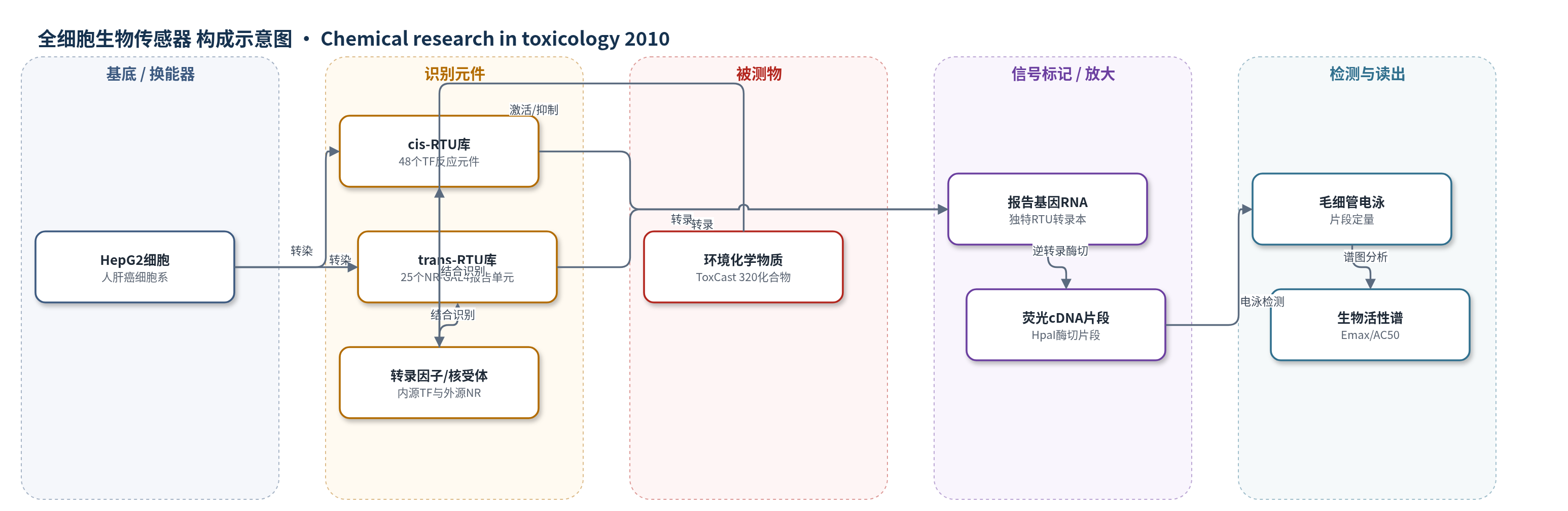
点击图片查看大图 · 依据论文自动绘制
传感器类型
全细胞生物传感器
检测对象
环境化学物质(environmental chemicals,含农药活性成分 pesticide active ingredients、内分泌干扰物 endocrine disruptors、氧化应激诱导物 oxidative stress inducers 等);样品基质:DMSO 溶解后在 HepG2 细胞培养液/培养基中暴露。
检测原理
环境化学物进入 HepG2 细胞后,直接结合核受体配体结合域或改变内源转录因子状态,构成识别事件。被激活的转录因子结合 cis-RTU 中的顺式反应元件,或 NR-GAL4 嵌合体结合 5X-UAS-TATA 启动子,驱动各自独特报告基因转录,使 RNA 产量随化合物浓度升高而增加。随后提取总 RNA,用荧光标记引物逆转录为 cDNA,HpaI 酶切产生各 RTU 特有片段,毛细管电泳定量片段峰面积,得到 Emax 和 AC50。报告基因转录将单一分子结合事件放大为多个 RNA 分子,均相毛细管电泳实现多路复用读出。
检测灵敏度
相关系数:R^2 = 0.67(PXR/PXRE);R^2 = 0.53(ER/ERE、PPAR/PPRE);R^2 = 0.58(RARα/DR5);R^2 = 0.5(NRF2 与总体活性)
效应效果
对 ToxCast 320 库 23,360 个组合产生 1,923 个显著命中(8.2%),中位命中 6;PXRE 最活跃(234 个命中,225 个化合物)。三重复整体一致性 >99%,命中一致性 87%;独立双份一致性 >96%。CIS 与 TRANS 同靶点显著相关:PXR/PXRE R^2=0.67,ER/ERE R^2=0.53,PPAR/PPRE R^2=0.53,RARα/DR5 R^2=0.58;NRF2 与总体活性 R^2=0.5。与体内终点建立 133 个显著关联,PPARα 对大鼠肝肿瘤 RR=9.9(p<0.01,特异性 99%),PPARγ RR=6.6(p<0.01,敏感性 83%)。可用于毒性通路标志物与预测建模。
传感器的构成
- 细胞换能器:HepG2 人肝癌细胞系,提供内源转录因子表达与细胞代谢背景,作为生物传感平台。
- 顺式识别层:48 个人类转录因子顺式调控反应元件报告转录单元(cis-RTU)质粒库,用于检测内源转录因子活性。
- 反式识别层:25 个核受体(NR)反式报告转录单元(trans-RTU)质粒库,含 NR 配体结合域-GAL4 DNA 结合域嵌合体及 5X-UAS-TATA 启动子报告序列,用于检测外源核受体活性。
- 信号标记层:报告基因转录产物 RNA,经荧光标记引物逆转录为 cDNA,并以 HpaI 酶切生成各 RTU 独特片段。
- 样品刺激层:ToxCast 320 环境化学物质库(309 个唯一结构,多为农药活性成分),以 DMSO 溶解并梯度稀释后暴露细胞。
- 质量控制层:MTT 四氮唑比色法用于细胞毒性预筛,确定最大耐受浓度(MTC)以选择检测浓度。
中文摘要
环境化学物暴露会增加人类和野生动物疾病负担,但现有毒性评价方法通量低、成本高,难以评估缺乏毒性数据的现有化学物或在早期预测其效应。在美国环保署 ToxCast 项目背景下,作者评价了一种新型细胞生物传感器系统 Factorial,用于快速、高通量评估化合物对基因调控网络的影响。该系统将顺式调控转录因子报告构建体库与反式调控核受体报告构建体库相结合,并采用高度均相检测方法,可同时评估多路复用转录因子活性。研究定量评价了 309 种环境化学物对 25 个核受体和 48 个转录因子反应元件的影响,建立了生物活性谱。结果显示,核受体及其反应元件之间转录因子活性具有协调性;氧化应激标志物 Nrf2 活性与化学物的总体非特异性活性高度相关。此外,研究识别出与体内毒性终点相关的分子靶标,这些靶标可作为潜在毒性通路生物标志物,并为体内毒性预测建模提供输入。
英文摘要
Exposure to environmental chemicals adds to the burden of disease in humans and wildlife to a degree that is difficult to estimate and, thus, mitigate. The ability to assess the impact of existing chemicals for which little to no toxicity data are available or to foresee such effects during early stages of chemical development and use, and before potential exposure occurs, is a pressing need. However, the capacity of the current toxicity evaluation approaches to meet this demand is limited by low throughput and high costs. In the context of EPA's ToxCast project, we have evaluated a novel cellular biosensor system (Factorial (1) ) that enables rapid, high-content assessment of a compound's impact on gene regulatory networks. The Factorial biosensors combined libraries of cis- and trans-regulated transcription factor reporter constructs with a highly homogeneous method of detection enabling simultaneous evaluation of multiplexed transcription factor activities. Here, we demonstrate the application of the technology toward determining bioactivity profiles by quantitatively evaluating the effects of 309 environmental chemicals on 25 nuclear receptors and 48 transcription factor response elements. We demonstrate coherent transcription factor activity across nuclear receptors and their response elements and that Nrf2 activity, a marker of oxidative stress, is highly correlated to the overall promiscuity of a chemical. Additionally, as part of the ToxCast program, we identify molecular targets that associate with in vivo end points and represent modes of action that can serve as potential toxicity pathway biomarkers and inputs for predictive modeling of in vivo toxicity.