组成图示
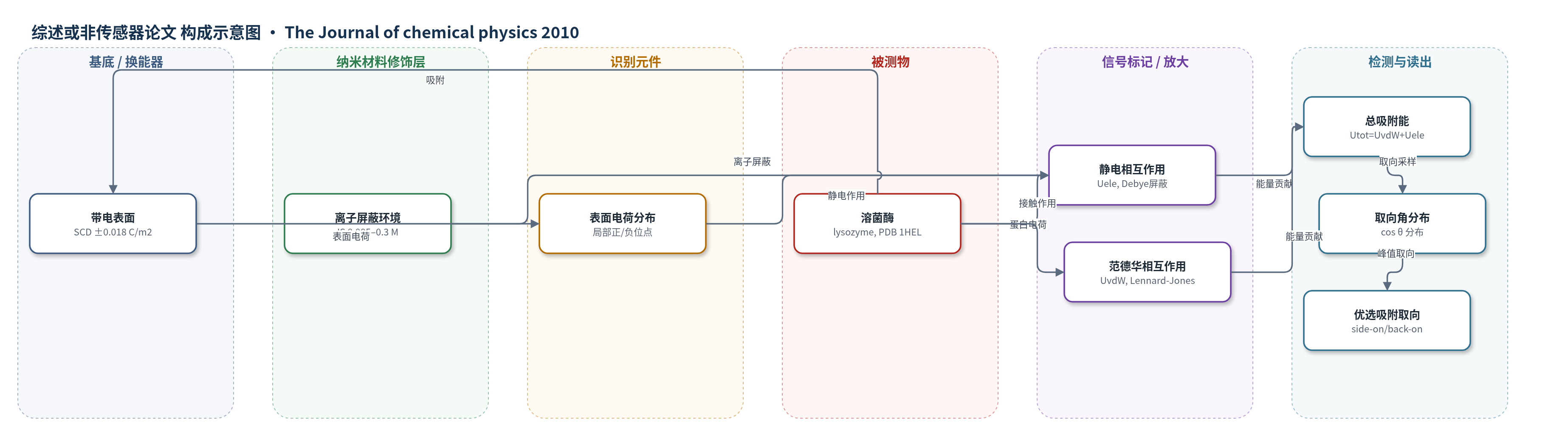
点击图片查看大图 · 依据论文自动绘制
传感器类型
综述或非传感器论文
检测对象
溶菌酶(lysozyme);模拟水溶液/离子强度环境(IS 0.005–0.3 M)
检测原理
本文并非传感检测,而是采用并行退火蒙特卡洛(PTMC)模拟溶菌酶在带电表面的吸附取向。溶菌酶以联合残基粗粒化模型表示,在表面附近进行平移和旋转采样;总势能由Lennard-Jones范德华项和距离依赖介电静电项组成。多个温度副本按Metropolis准则交换构型,以克服局部能量极小并采样完整构型空间。离子强度通过Debye长度屏蔽静电相互作用,改变静电与范德华贡献比例。取向角cosθ用于表征蛋白偶极方向与表面法线夹角,能量最低或取向分布峰值对应优势取向。低离子强度下静电主导,负表面侧向取向占优;高离子强度下范德华主导,背向取向占优;正表面因蛋白表面电荷非均匀和离子屏蔽也可吸附。
检测灵敏度
原文未报告LOD、线性范围、灵敏度斜率或相关系数。
效应效果
PTMC相比串行MC可避免陷入局部极小,并在单次模拟中获得取向分布。静电主导时取向分布较窄,有利于均匀取向;范德华主导时分布较宽。模拟与实验一致:负表面低离子强度下侧向取向占优,IS=0.005 M时侧向占比99.97%,IS=0.02 M时91.04%;IS升至0.1 M和0.3 M时背向占比分别为95.71%和97.83%。正表面低IS不吸附;IS=0.1 M时upper back-on占91.47%,IS=0.3 M时bottom end-on占62.07%、lower back-on占33.23%。结果与赖氨酸标记、云母吸附活性位点朝外及层厚实验相符。作者认为该方法可用于指导生物传感器和生物材料中蛋白取向设计。
传感器的构成
- 基底/换能器:不适用(未报道传感器基底或电极)
- 纳米材料修饰层:不适用(未报道纳米修饰层)
- 识别元件:不适用(未报道抗体/适配体等识别元件)
- 信号标记物:不适用(未报道信号标记物)
- 封闭剂:不适用(未报道封闭剂)
- 电子供体:不适用(未报道电子供体)
- 模拟对象:溶菌酶(lysozyme,PDB 1HEL),用于蛋白-表面吸附取向模拟
中文摘要
本文提出并行退火蒙特卡洛(PTMC)算法,用于在单次模拟中准确、高效地识别吸附在表面上的蛋白的全局最低能量取向。以溶菌酶为模型蛋白,研究其在带电表面上的吸附取向。结果表明,溶菌酶可较容易地吸附在负电荷表面上,并呈现“侧向”(side-on)和“背向”(back-on)两种取向。当静电相互作用占主导时,溶菌酶倾向于以侧向方式吸附,其活性位点朝向侧面,这与静电作用决定吸附取向的实验结果一致。随着离子强度升高,范德华相互作用贡献逐渐增大,背向取向成为优势取向,此时活性位点朝外,符合静电与范德华共同决定取向的实验观察。尽管溶菌酶整体带正电,但由于其表面电荷分布不均匀以及溶液中离子的屏蔽效应,它仍可在正电荷表面上以“端向”(end-on)和背向方式吸附。PTMC方法为生物传感器和生物材料中蛋白表面取向的预测提供了有效途径。
英文摘要
In this work, the parallel tempering Monte Carlo (PTMC) algorithm is applied to accurately and efficiently identify the global-minimum-energy orientation of a protein adsorbed on a surface in a single simulation. When applying the PTMC method to simulate lysozyme orientation on charged surfaces, it is found that lysozyme could easily be adsorbed on negatively charged surfaces with "side-on" and "back-on" orientations. When driven by dominant electrostatic interactions, lysozyme tends to be adsorbed on negatively charged surfaces with the side-on orientation for which the active site of lysozyme faces sideways. The side-on orientation agrees well with the experimental results where the adsorbed orientation of lysozyme is determined by electrostatic interactions. As the contribution from van der Waals interactions gradually dominates, the back-on orientation becomes the preferred one. For this orientation, the active site of lysozyme faces outward, which conforms to the experimental results where the orientation of adsorbed lysozyme is co-determined by electrostatic interactions and van der Waals interactions. It is also found that despite of its net positive charge, lysozyme could be adsorbed on positively charged surfaces with both "end-on" and back-on orientations owing to the nonuniform charge distribution over lysozyme surface and the screening effect from ions in solution. The PTMC simulation method provides a way to determine the preferred orientation of proteins on surfaces for biosensor and biomaterial applications.