组成图示
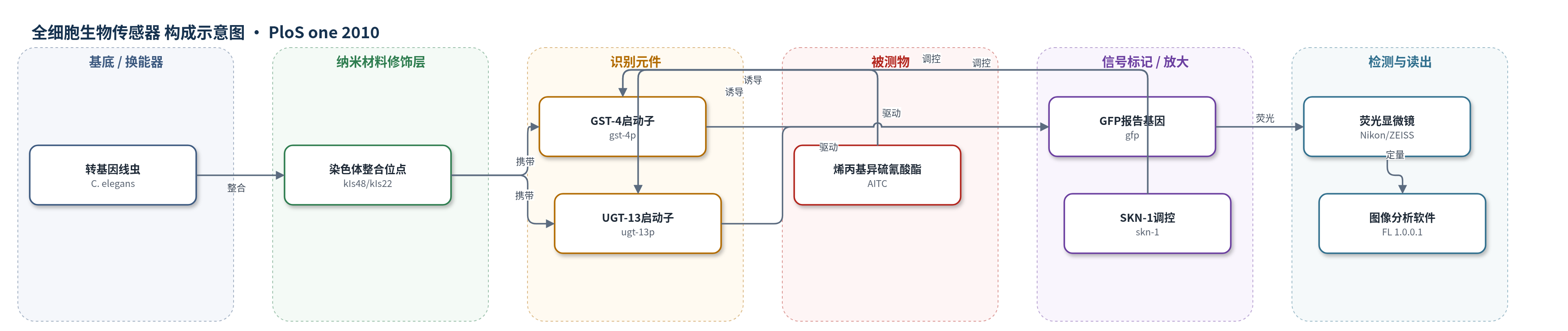
点击图片查看大图 · 依据论文自动绘制
传感器类型
全细胞生物传感器
检测对象
烯丙基异硫氰酸酯(allyl isothiocyanate, AITC);样品基质:NGM 琼脂平板/线虫暴露体系
检测原理
该线虫生物传感器以转基因 C. elegans 为传感单元,将 gst-4 或 ugt-13 启动子与 gfp 报告基因融合并染色体整合。AITC 作为亲电性异硫氰酸酯进入线虫后,激活内源应激/解毒信号通路,尤其是 SKN-1(Nrf2 同源转录因子)介导的转录调控,使 gst-4p 或 ugt-13p 转录活性升高。启动子激活驱动下游 GFP 表达,GFP 荧光强度随 AITC 浓度增加而增强;原文报告在 100 mM 及以上 AITC 时 GST-4 报告信号显著升高,UGT-13 报告信号自 500 mM 起升高。荧光显微镜成像后由 FL 1.0.0.1 软件定量,从而将化学物诱导 GST/UGT 的生物学事件转换为可测量的荧光信号。
检测灵敏度
未报告
效应效果
MJCU049 染色体整合稳定,可被丙烯酰胺诱导。AITC 在 100 mM–1 mM 诱导 GST-4 与 UGT-13,未降低寿命或繁殖力;2 mM 时寿命和后代数下降。10 mM 百草枯下,AITC 使平均寿命较 0 mM 组延长 6.98%(100 mM)、6.38%(500 mM)、11.6%(1 mM)。200 mM 胡桃醌中,0 mM 组 2、4、6 h 存活率 60.5%、40.5%、28.4%,1 mM AITC 组为 76.0%、67.7%、67.7%。作者认为其快速、廉价、简便,可用于发现与评价功能食品成分及有害化学物。
传感器的构成
- 基底/换能器:转基因秀丽隐杆线虫(C. elegans)品系 MJCU049 与 MJCU050,作为活体传感平台,整体表达报告基因并响应化学物暴露。
- 识别元件:gst-4 启动子(gst-4p)或 ugt-13 启动子(ugt-13p),位于转基因上游,响应 AITC/氧化应激诱导的转录调控。
- 信号标记物:绿色荧光蛋白(GFP)报告基因,融合于启动子下游,其表达量反映 GST-4 或 UGT-13 诱导水平。
- 遗传整合层:染色体整合位点 kIs48(V 连锁群)与 kIs22(III 连锁群),使 gst-4p::gfp 或 ugt-13p::gfp 稳定遗传。
- 辅助构建元件:共注射质粒 pDP#MM016B,用于转基因共注射与筛选。
- 样品基质:NGM 琼脂平板(含 E. coli OP50)或 S 培养基,用于线虫培养、AITC 暴露与氧化应激测试。
- 读出装置:荧光显微镜/激光扫描共聚焦显微镜(Nikon SMZ800、ZEISS Axiovert 200)及图像分析软件 FL 1.0.0.1,定量 GFP 荧光信号。
中文摘要
亲电性外源物与氧化应激内源产物可诱导谷胱甘肽S-转移酶(GSTs)等II期解毒酶,从而清除内外应激;在不产生不良反应的前提下诱导II期酶可能有助于延缓衰老并维持健康。本文以山葵功能成分烯丙基异硫氰酸酯(AITC)为候选食品成分,检验其能否诱导GST而不损害动物生命。作者构建 gst::gfp 融合基因并转化秀丽隐杆线虫(C. elegans),建立线虫生物传感器,用于监测GST诱导。结果显示,AITC可诱导GST表达,并赋予线虫对多种氧化应激的耐受性;同时提供证据表明转录因子SKN-1参与调控AITC诱导的GST表达。研究展示了线虫生物传感器在发现和评价具有抗衰老或健康益处的功能食品物质及化学品中的应用价值。
英文摘要
BACKGROUND: Electrophilic xenobiotics and endogenous products from oxidative stresses induce the glutathione S-transferases (GSTs), which form a large family within the phase II enzymes over both animal and plant kingdoms. The GSTs thus induced in turn detoxify these external as well as internal stresses. Because these stresses are often linked to ageing and damage to health, the induction of phase II enzymes without causing adverse effects would be beneficial in slowing down ageing and keeping healthy conditions.
METHODOLOGY/PRINCIPAL FINDINGS: We have tested this hypothesis by choosing allyl isothiocyanate (AITC), a functional ingredient in wasabi, as a candidate food ingredient that induces GSTs without causing adverse effects on animals' lives. To monitor the GST induction, we constructed a gst::gfp fusion gene and used it to transform Caenorhabditis elegans for use as a nematode biosensor. With the nematode biosensor, we found that AITC induced GST expression and conferred tolerance on the nematode against various oxidative stresses. We also present evidence that the transcription factor SKN-1 is involved in regulating the GST expression induced by AITC.
CONCLUSIONS/SIGNIFICANCE: We show the applicability of the nematode biosensor for discovering and evaluating functional food substances and chemicals that would provide anti-ageing or healthful benefits.