组成图示
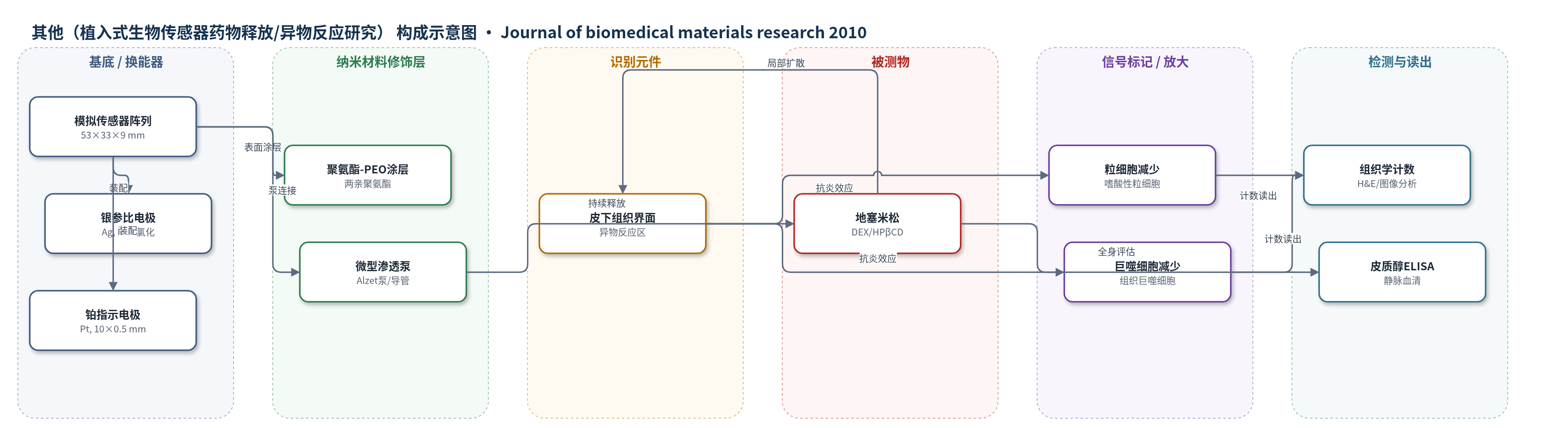
点击图片查看大图 · 依据论文自动绘制
传感器类型
其他(植入式生物传感器药物释放/异物反应研究)
检测对象
皮质醇(cortisol,静脉血清);粒细胞/嗜酸性粒细胞(granulocytes/eosinophils,皮下组织);巨噬细胞(macrophages,皮下组织)
检测原理
地塞米松(DEX)先溶于2-羟丙基-β-环糊精(HPβCD),由微型渗透泵经导管输送至模拟传感器表面,再缓慢扩散进入皮下组织。糖皮质激素与局部炎症细胞中的糖皮质激素受体结合,抑制粒细胞(尤其嗜酸性粒细胞)和巨噬细胞的募集、存活及细胞因子释放,从而降低组织-传感器界面的异物反应强度。局部效应以H&E染色切片中100 μm×100 μm视野的细胞计数作为读出;全身效应则通过下丘脑-垂体-肾上腺轴负反馈评估:若DEX进入循环,内源性皮质醇分泌受抑,静脉血清皮质醇经ELISA下降。低剂量时局部细胞减少而血清皮质醇不变,提示效应局限于植入附近。
检测灵敏度
未报告
效应效果
28天持续皮下释放DEX后,总剂量≤0.1 mg/kg(0.05–0.10 mg/kg)在植入点2 mm和17 mm处均显著降低粒细胞(主要为嗜酸性粒细胞)计数,远处300–400 mm组织无变化;巨噬细胞计数仅在高剂量2 mm处显著低于无DEX/远处对照。低剂量组28天血清皮质醇平均5.15±0.75 μg/dL,与基线7.25±1.1 μg/dL无显著差异;高剂量组降至0.6±0.19 μg/dL(p=0.045 vs 基线,p=0.009 vs 低剂量组)。作者认为该剂量可实现局部抗炎/抗纤维化而不引起全身皮质醇抑制,有望延长植入式葡萄糖传感器寿命。
传感器的构成
- 基底/换能器阵列:53 mm×33 mm×9 mm 模拟葡萄糖传感器阵列(mock biosensor array),作为植入载体与电极平台
- 参比电极:银(Ag)圆盘,直径13 mm,经FeCl氯化处理,提供电化学参比
- 指示电极:四个铂(Pt)电极,暴露尺寸10 mm×0.5 mm,用于独立传感
- 表面涂层:含聚环氧乙烷(PEO)基团的两亲聚氨酯(amphipathic polyurethane),允许O2和葡萄糖透过并接触皮下组织
- 药物释放装置:微型渗透泵(Alzet osmotic pump,200 μL或2 mL)与导管,将DEX或生理盐水持续释放至传感器表面
- 药物/载体:地塞米松(DEX)溶于2-羟丙基-β-环糊精(HPβCD),经导管在组织界面缓慢释放
中文摘要
长期植入的生物传感器常在植入后1–2个月因胶原富集包囊形成而灵敏度下降。糖皮质激素可减少胶原沉积,但长期全身给药副作用明显。作者假设极低速率释放强效糖皮质激素地塞米松(dexamethasone, DEX)可在植入部位产生局部抗炎作用而不引起全身效应,并以静脉血清皮质醇水平作为全身暴露指标。研究在猪皮下植入模拟葡萄糖传感器阵列,通过微型渗透泵在28天内持续释放不同剂量DEX,并对植入部位附近及远处组织进行组织学分析。结果显示,28天总剂量约0.1 mg/kg的DEX可一致减少植入局部粒细胞(主要为嗜酸性粒细胞)和巨噬细胞数量,而远处组织细胞数不变;该剂量未抑制血清皮质醇,提示低速率DEX释放可实现局部抗炎而无明显全身效应。
英文摘要
Chronically implanted biosensors typically lose sensitivity 1-2 months after implantation, due in large part to the development of a collagen-rich capsule that prevents analytes of interest from reaching the biosensor. Corticosteroids are likely candidates for reducing collagen deposition but these compounds have many serious side effects when given over a prolonged period. One method of assessing whether or not locally released corticosteroids have a systemic effect is to measure cortisol concentrations in venous serum. We hypothesized that a very low release rate of the potent corticosteroid, dexamethasone, would lead to a localized anti-inflammatory effect without systemic effects. We found that reduction in subcutaneous granulocytes (primarily eosinophils), and to a lesser extent, reduction of macrophages served as a good local indicator of the steroid effect. When released over a 28-day period, a total dexamethasone dose of < or =0.1 mg/kg led to a consistent reduction in the number of granulocytes and macrophages found in the local vicinity of the implant without a reduction of these cells at distant tissue locations. The lack of suppression of serum cortisol with these doses confirmed that low-release rates of dexamethasone can lead to consistent local anti-inflammatory effects without distant, systemic effects. (c) 2010 Wiley Periodicals, Inc. J Biomed Mater Res, 2010.