组成图示
点击图片查看大图 · 依据论文自动绘制
传感器类型
综述或非传感器论文
检测对象
未明确检测分析物;酶活性测定底物:三丁甘油酯(tributyrin),样品基质:阿拉伯胶稳定三丁甘油酯水乳液。
检测原理
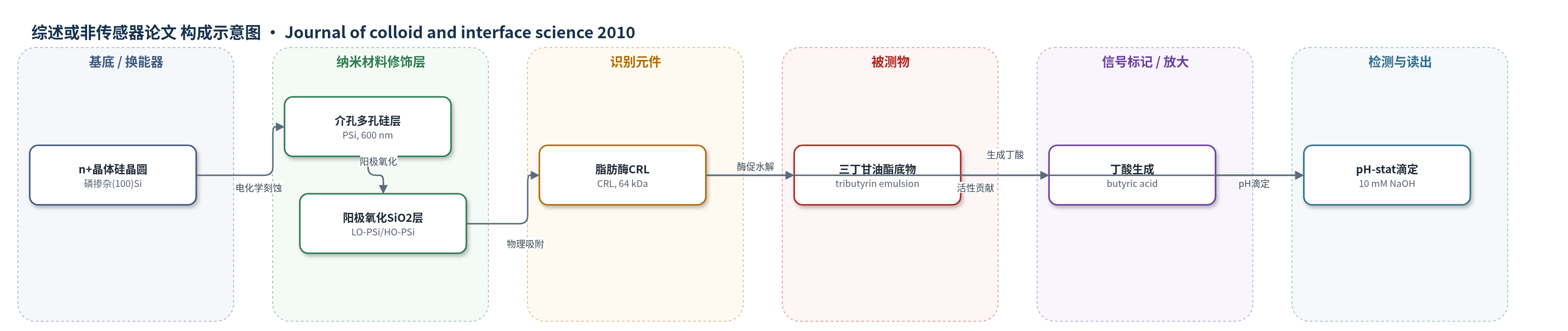
n+型晶体硅经电化学刻蚀形成介孔PSi,再经阳极氧化生成可控SiO2层。LO-PSi(2 V)较疏水,HO-PSi(10 V)较亲水,分别通过疏水作用或静电/偶极作用吸附CRL。CRL进入PSi孔内,其疏水表面与LO-PSi界面作用可诱导活性位点附近lid打开,改变负载与构象。固定化CRL催化三丁甘油酯水解生成丁酸,pH-stat用10 mM NaOH维持pH 7.0,NaOH消耗速率对应酶活性(LU)。负载增加使总活性上升,但过高负载造成扩散限制,催化效率下降。潜在传感中,丁酸生成引起的pH或界面电荷变化可随甘油三酯底物浓度改变,但本文未实现完整传感读出。
检测灵敏度
未报告LOD、线性范围、灵敏度斜率或相关系数。
效应效果
LO-PSi负载140 mg/g,HO-PSi为47 mg/g;Langmuir参数LO-PSi Lmax=140 mg/g、KL=1920 mg/dm3,HO-PSi Lmax=47 mg/g、KL=496 mg/dm3。HO-PSi负载在pH 4–6增加、pH 6–7恒定、pH 7.5下降;最大活性在pH 4,pH 5为折中。活性随负载升至平台,LO-PSi最大活性更高;最大催化效率在HO-PSi 2.57 mg/g和LO-PSi 15.8 mg/g,HO-PSi效率更高。pH 5、5 °C保存2周可接受,5周失活;2周后HO-PSi活性更高。未报告选择性、RSD或回收率。
传感器的构成
- 基底/换能器电极:n+磷掺杂(100)晶体硅晶圆(Si,电阻率3-7×10^-3 Ω cm),经电化学刻蚀形成多孔硅,作为半导体基质与潜在换能器。
- 多孔硅纳米结构:介孔多孔硅(PSi)层,厚度约600 nm,BET比表面积361 m2/g,孔径3.7 nm及5–20 nm,提供高比表面积和酶吸附空间。
- 表面氧化修饰层:阳极氧化生成的SiO2层,LO-PSi(2 V)较疏水、HO-PSi(10 V)较亲水,用于稳定Si–H表面并调控酶吸附。
- 识别/催化元件:Candida rugosa脂肪酶(CRL,Amano AY),物理吸附于PSi孔内,催化三丁甘油酯水解。
- 读出/检测方式:pH-stat滴定法(Mettler 718 Stat Titrino,10 mM NaOH维持pH 7.0),通过丁酸生成量测定酶活性;未使用封闭剂、信号标记物或电子供体。
中文摘要
本文报道了n+型介孔多孔硅(PSi)层的制备与表征,最终目标是利用该材料的半导体性质构建生物传感器。PSi晶圆作为酶吸附基质,具有约360 m2/g的高比表面积和5–20 nm的孔径。新鲜PSi通过受控阳极氧化稳定,制备了两种氧化水平样品:氧化至2 V的低氧化PSi(LO-PSi)和氧化至10 V的高氧化PSi(HO-PSi)。两者均用于吸附Candida rugosa脂肪酶(CRL)。结果表明,LO-PSi的酶负载量显著高于HO-PSi,分别为140 mg/g和47 mg/g。不同氧化电压改变了PSi表面的疏水–亲水平衡,从而影响脂肪酶吸附的物理相互作用。LO-PSi的高负载使固定化生物催化剂具有更高活性,但催化效率较低。两种固定化酶在pH 5缓冲液、5 °C保存条件下,2周内具有可接受的稳定性。
英文摘要
In this work, we present the synthesis and characterization of n(+)-type porous silicon (PSi) layers. Our final aim is the fabrication of a biosensor that exploits the semiconductive properties of this material. PSi wafers were used as a matrix for enzyme adsorption. These wafers, as a result of their porous nanostructure, had a high surface area (360 m(2)/g) and pore size in the range 5-20 nm. The freshly prepared PSi was stabilized through controlled anodic oxidation. Two classes of samples differing for the level of oxidation were prepared. The first class was oxidized up to 2V (LO-PSi), whereas the second class was oxidized up to 10 V (HO-PSi). Both samples were used for the adsorption of Candida rugosa lipase. A significantly higher loading was ascertained for LO-PSi (140 mg/g) compared to HO-PSi (47 mg/g). The different hydrophobic-hydrophilic balance of the PSi surfaces induced by the different oxidation voltage affects the physical interactions that address the adsorption process of the lipase. The higher loading achieved with the LO-PSi resulted in a higher activity of the immobilized biocatalyst but in a lower catalytic efficiency. The two biocatalysts showed an acceptable stability toward storage (pH 5 buffer solution at 5 °C) within 2 weeks.