组成图示
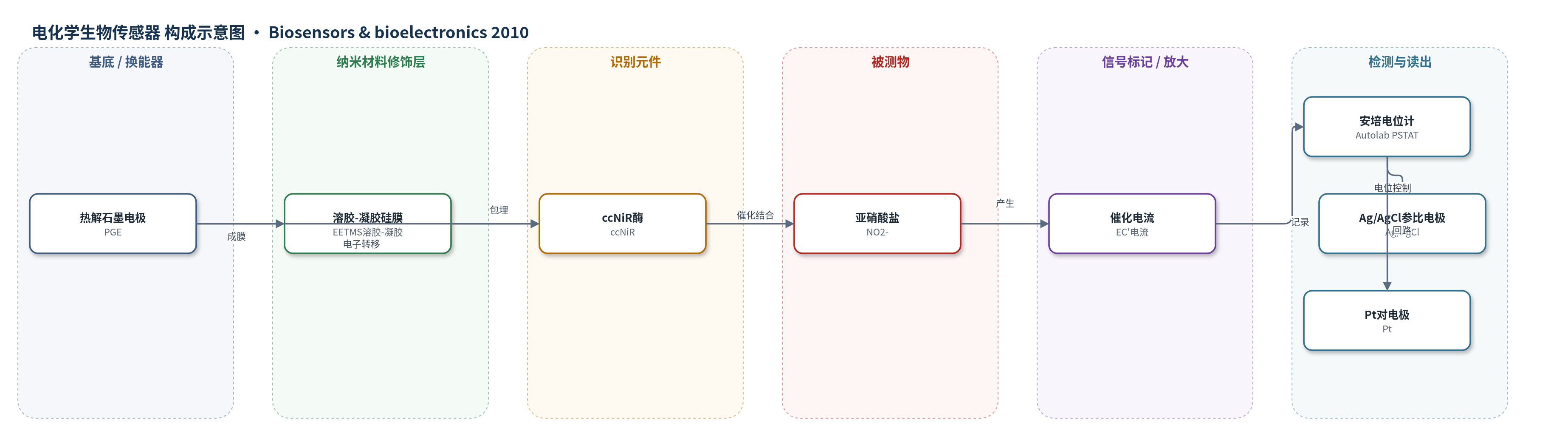
点击图片查看大图 · 依据论文自动绘制
传感器类型
电化学生物传感器
检测对象
亚硝酸盐(nitrite, NO2−);样品基质:淡水/地表水(freshwaters/surface waters)
检测原理
ccNiR包埋于EETMS溶胶-凝胶多孔硅膜中,UV-Vis和共振拉曼表明血红素结构保持完整。在热解石墨电极表面,ccNiR通过直接电子转移(DET)与电极交换电子,无需氧化还原介体。施加负电位(如-0.9 V vs Ag/AgCl)时,电极将电子传递给ccNiR的催化血红素,ccNiR催化NO2−发生六电子还原生成NH4+。底物结合催化位点引发EC'型电催化过程,产生与NO2−浓度成正比的催化电流。溶胶-凝胶膜允许小分子NO2−扩散并保护酶,同时抑制干扰物。安培法记录稳态电流,电流随NO2−浓度增加而增大,在0.25–50 μM范围内线性。
检测灵敏度
LOD: 120 nM;线性范围: 0.25–50 μM;灵敏度: 430 ± 23 mA M−1 cm−2;Icat/Ic: 6.6 ± 1.1
效应效果
该传感器对NO3−无催化响应;SO3^2−在高浓度下仅产生-2.5%抑制;NH4+无影响;NH2OH使响应增加1.2%,显著低于其他ccNiR体系。4℃ Tris-HCl缓冲液(pH 7.6)保存时,前两周线性范围和灵敏度保持>90%,30天后剩15%,残余活性可维持至6个月。电极制备间灵敏度变化<11%。实际地表水样品A、B经标准加入法测定(n=3,两个电极),结果分别为2.12±0.14 μM和11.47±0.26 μM,与比色法(2.13 μM和11.44 μM)相近,准确度高。LOD 120 nM低于欧盟饮用水限值2.2 μM。作者认为该非介导体系易制备、选择性和稳定性好,适用于淡水亚硝酸盐检测。
传感器的构成
- 基底/换能器电极:热解石墨电极(PGE,pyrolytic graphite electrode),直径4 mm,作为工作电极,提供直接电子转移界面
- 溶胶-凝胶修饰层:2-(3,4-epoxycyclohexyl)-ethyltrimethoxysilane(EETMS)与乙醇、盐酸、水按225:1 H2O:EETMS摩尔比形成溶胶,在PGE上成胶,形成多孔疏水硅玻璃网络
- 识别/生物催化元件:脱硫弧菌细胞色素c亚硝酸盐还原酶(ccNiR,cytochrome c nitrite reductase),包埋于溶胶-凝胶网络中,催化亚硝酸盐六电子还原为氨
- 支撑电解质/反应介质:0.05 M Tris-HCl缓冲液(pH 7.6)含0.1 M KCl,提供离子导电环境并维持酶活性
- 参比电极:Ag/AgCl电极,用于电位控制
- 对电极:Pt电极,完成三电极电化学回路
- 信号读出:Autolab PSTAT 12电位计与GPES软件,安培法在-0.9 V vs Ag/AgCl记录催化电流
中文摘要
本文提出一种用于复杂样品中亚硝酸盐检测的新型非介导电化学生物传感器。该器件基于脱硫弧菌(Desulfovibrio desulfuricans)来源的细胞色素c亚硝酸盐还原酶(ccNiR),该酶具有高转换数和异相电子转移速率。不同于以往使用多种氧化还原介体的策略,本研究利用ccNiR与热解石墨(PG)表面相互作用时可直接产生电化学响应的能力。为实现该生物电极的分析应用,将蛋白质成功包埋于溶胶-凝胶法制备的多孔硅玻璃中。在亚硝酸盐存在下,ccNiR/溶胶-凝胶/PG电极迅速呈现催化电流,表明被包埋的ccNiR分子通过直接电子转移被还原。这一结果具有重要意义,因为蛋白质分子被限制在非导电硅网络内,且体系中不存在任何介体或电子中继。在最佳条件下,最低可检测浓度为120 nM,灵敏度为430 mA M−1 cm−2,线性范围为0.25–50 μM,响应可稳定保持两周。采用标准加入法对淡水样品中的亚硝酸盐进行分析,结果准确度高。
英文摘要
In this paper we propose the construction of a new non-mediated electrochemical biosensor for nitrite determination in complex samples. The device is based on the stable and selective cytochrome c nitrite reductase (ccNiR) from Desulfovibrio desulfuricans, which has both high turnover and heterogeneous electron transfer rates. In opposition to previous efforts making use of several redox mediators, in this work we exploited the capacity of ccNiR to display a direct electrochemical response when interacting with pyrolytic graphite (PG) surfaces. To enable the analytical application of such bioelectrode the protein was successfully incorporated within a porous silica glass made by the sol-gel process. In the presence of nitrite, the ccNiR/sol-gel/PG electrode promptly displays catalytic currents indicating that the entrapped ccNiR molecules are reduced via direct electron transfer. This result is noteworthy since the protein molecules are caged inside a non-conductive silica network, in the absence of any mediator species or electron relay. At optimal conditions, the minimum detectable concentration is 120 nM. The biosensor sensitivity is 430 mA M(-1) cm(-2) within a linear range of 0.25-50 microM, keeping a stable response up to two weeks. The analysis of nitrites in freshwaters using the method of standard addition was highly accurated.