组成图示
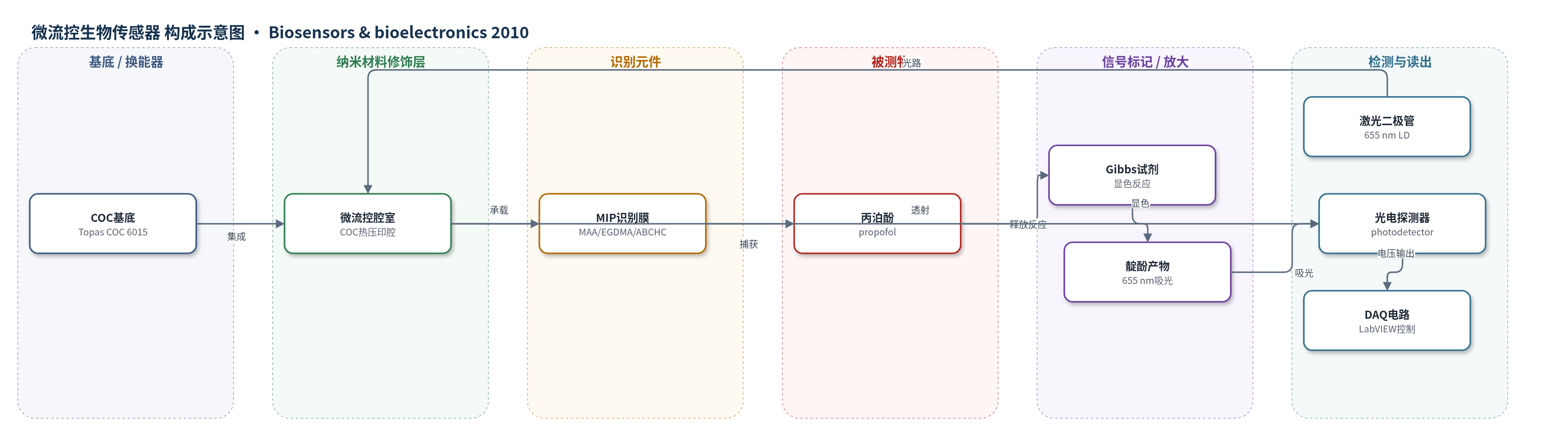
点击图片查看大图 · 依据论文自动绘制
传感器类型
微流控生物传感器
检测对象
丙泊酚(propofol,2,6-diisopropylphenol);样品基质:甲醇溶液(实验),血液/血浆(预期,需过滤血细胞)
检测原理
样品中的丙泊酚随微流控通道进入检测腔,片上MIP膜通过形状与功能基团互补的印迹空腔选择性结合并富集丙泊酚。60 s后移除样品液,注入由Gibbs试剂、碳酸氢盐缓冲液和甲醇组成的显色试剂;被MIP捕获的丙泊酚释放,其酚羟基在碱性条件下与醌亚胺反应生成靛酚,使溶液在655 nm处产生吸光。655 nm激光二极管发出的光穿过检测腔,光电探测器记录透射光电压;无MIP参考腔用于扣除试剂本底。丙泊酚浓度越高,捕获并参与显色的量越多,靛酚吸光越强,电压降越大,从而在0.25–10 ppm内线性响应。
检测灵敏度
LOD: 0.25 ppm;线性范围: 0.25–10 ppm;灵敏度: 6.47 mV/(ppm mm2)
效应效果
该芯片对丙泊酚具有较高选择性:MIP对NIP的特异性结合达456%,对COC基底为685%,印迹因子为456%;结合容量0.0075 μg/mm2,结合亲和力KD=17.289 μmol/L。系统可在60 s内完成检测,0.25–10 ppm线性,灵敏度6.47 mV/(ppm mm2)。与传统UV–vis分光光度计相比,微流控芯片能精确控制样品与显色试剂混合、实时监测响应,并避免手动加样误差;与LC、HPLC、GC–MS相比,其体积小、成本低、响应快,适合临床快速监测丙泊酚浓度。文中未报告RSD、稳定性或实际血样回收率。
传感器的构成
- 基底:COC(Topas COC 6015)塑料晶圆,提供高透光、低吸水、耐溶剂的微流控芯片基底
- 微流控结构:热压印与热键合形成的COC微通道和100 μm深检测腔/参考腔,用于输送样品与试剂
- 识别层:MIP膜(25 μm),由丙泊酚模板、MAA、EGDMA、ABCHC经UV聚合和甲醇洗脱形成,选择性捕获丙泊酚
- 参考层:无MIP的参考腔,用于扣除背景与试剂本底信号
- 显色标记:Gibbs试剂(2,6-二氯醌亚胺盐酸盐)、碳酸氢盐缓冲液和甲醇,与丙泊酚酚羟基反应生成靛酚,在655 nm产生吸光/颜色变化
- 光学读出:655 nm激光二极管、光电探测器、控制电路和DAQ,检测透射光电压变化并换算浓度
中文摘要
本文报道了一种用于光学检测麻醉药丙泊酚的一次性微流控生物芯片,其片上集成了分子印迹聚合物(MIP)生物传感器。目前医院检测丙泊酚主要依赖液相色谱(LC)、高效液相色谱(HPLC)和气相色谱–质谱(GC–MS),这些仪器体积大、成本高且不易普及。该工作开发并表征了一种新型塑料微流控生物芯片,用于快速检测丙泊酚。模板分子印迹聚合物被集成到微流控芯片中,丙泊酚与显色试剂反应后在655 nm波长下进行光学检测。实验结果表明,片上MIP生物传感器的灵敏度为6.47 mV/(ppm mm2),MIP对非印迹聚合物(NIP)的特异性结合可达456%,系统检测限为0.25 ppm,线性检测范围为0.25–10 ppm。该一次性微流控生物芯片在丙泊酚的分离与传感中表现出优异性能,与传统大型仪器相比具有体积小、灵敏度高、选择性好、成本低和响应快等优势。
英文摘要
This paper presents a disposable microfluidic biochip with on-chip molecularly imprinted biosensors for optical detection of anesthetic propofol. So far, the methods to detect anesthetic propofol in hospitals are liquid chromatography (LC), high-performance liquid chromatography (HPLC), and gas chromatography-mass spectroscopy (GC-MS). These conventional instruments are bulky, expensive, and not ease of access. In this work, a novel plastic microfluidic biochip with on-chip anesthetic biosensor has been developed and characterized for rapid detection of anesthetic propofol. The template-molecule imprinted polymers were integrated into microfluidic biochips to be used for detecting anesthetic propofol optically at 655 nm wavelength after the reaction of propofol with color reagent. Experimental results show that the sensitivity of the microfluidic biochip with on-chip molecularly imprinted polymers (MIPs) biosensor is 6.47 mV/(ppm mm(2)). The specific binding of MIP to non-imprinted polymer (NIP) is up to 456%. And the detection limit of the microsystem is 0.25 ppm with a linear detection range from 0.25 to 10 ppm. The disposable microfluidic biochip with on-chip anesthetic biosensor using molecularly imprinted polymers presented in this work showed excellent performance in separation and sensing of anesthetic propofol molecules. While compared to large-scale conventional instruments, the developed microfluidic biochips with on-chip MIP biosensors have the advantages of compact size, high sensitivity, high selectivity, low cost, and fast response.