组成图示
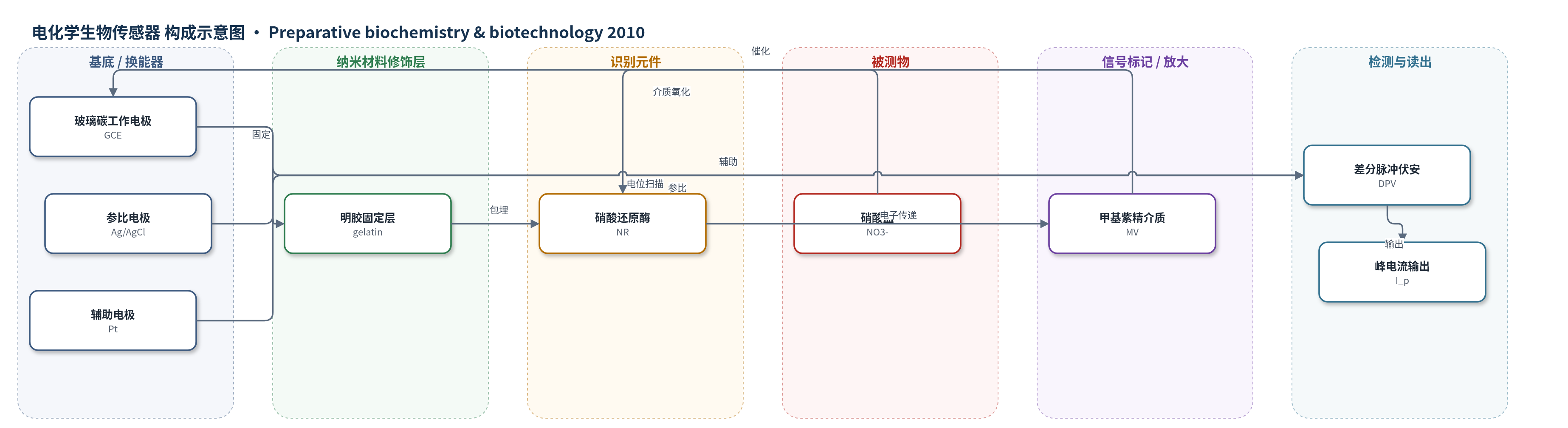
点击图片查看大图 · 依据论文自动绘制
传感器类型
电化学生物传感器
检测对象
硝酸盐(nitrate, NO3-);样品基质:饮用水、矿泉水、环境水样及加工肉制品(萨拉米、pastrami、香肠)
检测原理
该传感器以玻璃碳电极为工作电极,明胶固定层中包埋大肠杆菌硝酸还原酶(NR)。在 50 mM 磷酸盐缓冲液(pH 7.5、35 ℃)和氮气除氧条件下,NR 催化硝酸盐(NO3-)还原为亚硝酸盐(NO2-),酶内部电子经甲基紫精(MV)穿梭传递至电极表面。差分脉冲伏安(DPV)扫描时,MV 的氧化/还原峰电流随 NO3- 浓度升高而增大,从而实现定量。该方法利用酶反应的特异性和 MV 介导电子转移,无需直接电子转移,信号与硝酸盐浓度在 5.0–90.0×10^-9 mol/L 范围内呈线性关系。
检测灵敏度
LOD: 2.2 × 10^-9 M;线性范围: 5.0–90.0 × 10^-9 M;LOQ: 5.79 × 10^-9 M;响应时间: 10 s
效应效果
该传感器对硝酸盐具有选择性,实际水样和肉制品中结果与参考方法一致。饮用水和矿泉水样品中,生物传感器法回收率为 90.4%–107.4%,参考法为 91.0%–107.0%;加工肉制品中,生物传感器法 CV 为 2.08%–3.89%,参考法为 2.76%–9.87%,重现性更优。4 ℃保存 24 和 48 h 后响应无显著变化;在 4.7×10^-8 mol/L 下 RSD 为 1.22%(n=7)。方法检出限达纳摩尔级,响应快,无需昂贵复杂仪器,适用于饮用水、矿泉水和肉制品中硝酸盐的食品安全监测。
传感器的构成
- 基底电极:玻璃碳电极(GCE),经氧化铝抛光和超声清洗,作为电子转导工作电极
- 生物识别/催化层:大肠杆菌硝酸还原酶(NR),催化硝酸盐还原并提供特异性识别
- 固定化基质:明胶(gelatin),与 NR 混合形成凝胶层,固定酶并允许底物扩散
- 交联固定层:戊二醛(glutaraldehyde, GA),交联明胶和酶,提高固定层稳定性
- 电子介质:甲基紫精(methyl viologen, MV),作为电子穿梭在酶与电极间传递电子
- 缓冲环境:磷酸盐缓冲液(PB, 50 mM, pH 7.5),维持酶活性并控制离子强度
- 电化学检测系统:Ag/AgCl 参比电极、铂辅助电极与 Metrohm 694 VA Processor,进行差分脉冲伏安(DPV)检测
中文摘要
本研究报道了一种基于硝酸还原酶(NR,EC 1.9.6.1)的电化学生物传感器方法,用于食品和水中硝酸盐的特异性测定。该传感器以甲基紫精(methyl viologen)作为氧化还原介质,通过检测与硝酸盐浓度相关的介质氧化峰电流实现定量。研究对酶的固定化条件及工作条件进行了优化,结果表明该方法对水样和加工肉制品中的硝酸盐具有选择性和灵敏度。在优化条件下,传感器对硝酸盐的动态范围为 5.0–90.0×10^-9 mol/L,响应时间为 10 s;检出限(LOD)和定量限(LOQ)分别为 2.2×10^-9 mol/L 和 5.79×10^-9 mol/L。为避免记忆效应,重复性实验采用新鲜制备的传感器进行,在 4.7×10^-8 mol/L 硝酸盐浓度下相对标准偏差(RSD)为 1.22%(n=7)。该方法可用于饮用水、矿泉水及肉制品中硝酸盐水平的快速检测。
英文摘要
This study describes a novel biosensor method for specific determination of nitrate in food and water samples by using nitrate reductase (NR) (EC 1.9.6.1) biosensor based on the detection of oxidation peak current of redox mediator, methyl viologen, related to nitrate concentration. The method was shown to be selective and sensitive to determine the nitrate levels of water samples and processed meat samples. Immobilization procedure and also working conditions of the biosensor were optimized. Dynamic range attained with this method was established as (5.0-90.0 x 10(-9) M) for nitrate concentration with a 10 s response time. Limit of detection (LOD) and quantification (LOQ) of the biosensor were calculated as 2.2 x 10(-9) M and 5.79 x 10(-9) M, respectively. Reproducibility experiments was established on repetitive measurements by using a freshly prepared biosensor for avoiding the memory effect. The RSD was calculated as 1.22% at a nitrate concentration of 4.7 x 10(-8) M (n = 7).