组成图示
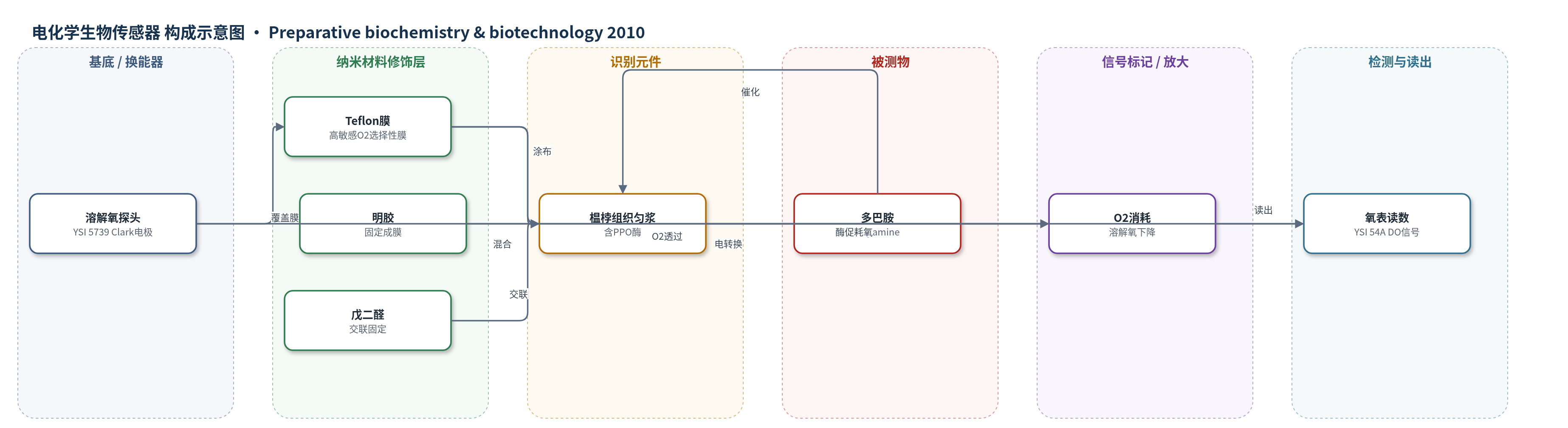
点击图片查看大图 · 依据论文自动绘制
传感器类型
电化学生物传感器
检测对象
多巴胺(dopamine, DA);样品基质:磷酸盐缓冲液标准溶液、商业药物制剂 Giludop
检测原理
传感器以 Clark 型溶解氧电极为换能器,Teflon 膜上固定含多酚氧化酶(PPO)的榅桲组织匀浆。多巴胺扩散进入生物活性层后,被 PPO 催化氧化为多巴胺醌并生成水,该反应消耗溶解氧。由于酶促反应速率与多巴胺浓度相关,溶液中溶解氧下降量与多巴胺浓度成正比。YSI 54A 氧表通过检测 DO 探头电流/溶解氧变化实现安培式读出,并按标准曲线定量。该体系未使用额外信号放大,主要依靠 PPO 催化和氧电极高灵敏度。
检测灵敏度
线性范围: 5×10^-3–2×10^-1 mM(5 µM–200 µM)
效应效果
0.1 mM 多巴胺连续测定 8 次,变异系数 5.95%,重复性良好。操作稳定性:8 h 内活性保持约 50%;储存稳定性:7 d 基本保持,28 d 损失 14.3%,42 d 保留约 60%。选择性:100 mM 酚、儿茶酚、焦没食子酸、8-羟基喹啉、1-萘酚分别干扰 92.3%、84.6%、84.6%、46.1%、23%,对酚类有交叉反应,但作者认为药物筛查影响有限。Giludop 药物样品平均回收率约 100%,可作快速筛查工具。
传感器的构成
- 换能器/基底:YSI 5739 溶解氧探头(Clark 型氧电极),检测溶解氧变化
- 气体选择性膜:高敏感 Teflon 膜(0.0005 in),O-ring 固定,SDS 预处理降低表面张力,允许 O2 透过
- 生物活性层:榅桲组织匀浆(含多酚氧化酶 PPO, E.C. 1.14.18.1),催化多巴胺氧化并消耗 O2
- 固定成膜材料:明胶(gelatin, Type 3, 225 Bloom),与组织匀浆混合形成稳定生物层
- 交联剂:戊二醛(glutaraldehyde, 2.5% v/v),交联固定 PPO 与明胶
- 工作介质:50 mM 磷酸盐缓冲液(pH 7.5),提供反应环境
中文摘要
多巴胺是一种广泛存在于动物体内的激素和神经递质,在临床上可用于调节交感神经系统,但因不能透过血脑屏障,常以前体左旋多巴治疗帕金森病等。本文报道了一种基于榅桲(Cydonia vulgaris)组织匀浆的多巴胺生物传感器。传感器以 Clark 型溶解氧电极为换能器,将含多酚氧化酶(PPO)的榅桲组织匀浆与明胶混合后涂覆于 Teflon 膜表面,并用戊二醛交联固定。通过优化组织匀浆用量、明胶和戊二醛比例、温度及 pH,在 50 mM 磷酸盐缓冲液(pH 7.5)、35 °C 条件下获得最佳响应。传感器对多巴胺的线性范围为 5 µM–200 µM,并考察了重复性、操作稳定性和储存稳定性,最后用于商业药物样品中多巴胺含量的测定。
英文摘要
Dopamine is a hormone and neurotransmitter occurring in a wide variety of animals, including both vertebrates and invertebrates. Chemically, it is a phenethylamine. Dopamine can be supplied as a medication that acts on the sympathetic nervous system, producing effects such as increased heart rate and blood pressure. However, since dopamine cannot cross the blood-brain barrier, dopamine given as a drug does not directly affect the central nervous system. To increase the amount of dopamine in the brains of patients with diseases such as Parkinson's disease and Dopa-Responsive Dystonia, L-DOPA (levodopa), which is the precursor of dopamine, can be given because it can cross the blood-brain barrier. In this study, a biosensor based on quince tissue homogenate was constructed for determination of dopamine. For the best results, some optimization studies such as the amount of quince tissue homogenate, gelatin and glutaraldehyde percentage, optimum temperature and pH were carried out. A linear range from 5 microM to 200 microM dopamine was obtained. Moreover, repeatability, and operational and storage stability of the biosensor were determined. Finally, the biosensor was applied to a real drug sample for the determination of dopamine content.