组成图示
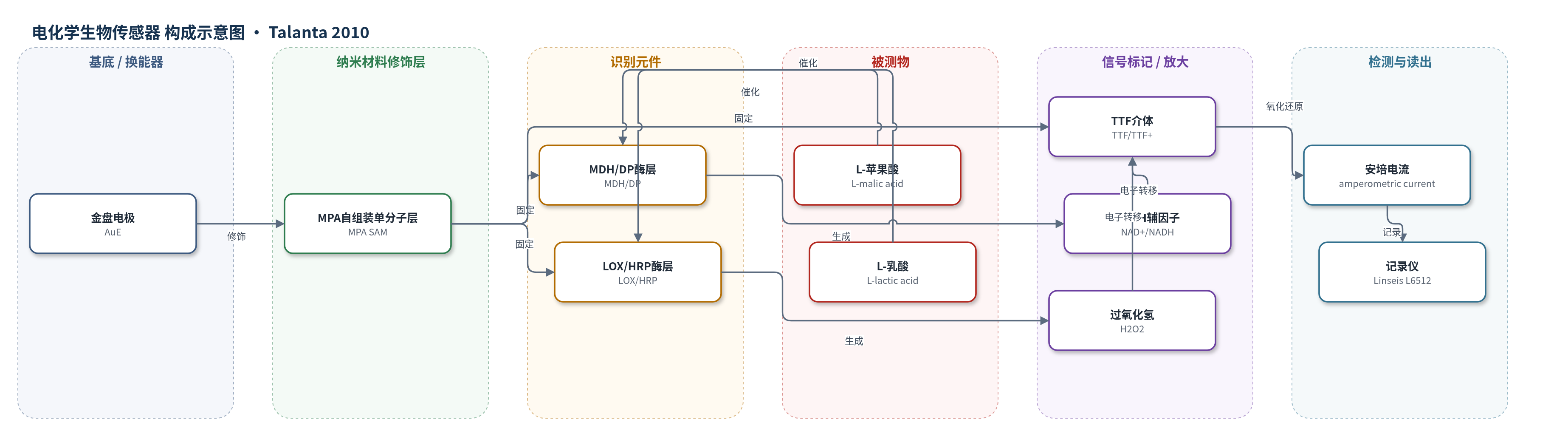
点击图片查看大图 · 依据论文自动绘制
传感器类型
电化学生物传感器
检测对象
L-苹果酸(L-malic acid)、L-乳酸(L-lactic acid);样品基质:合成酒、商业葡萄酒
检测原理
该传感器基于双酶级联与氧化还原介体安培检测。MDH/DP体系中,L-苹果酸在MDH催化下氧化为草酰乙酸,同时NAD+还原为NADH;DP催化NADH将电子传递给TTF+,生成TTF,TTF在+100 mV被电化学氧化,产生阳极电流。LOX/HRP体系中,L-乳酸在LOX催化下与O2反应生成丙酮酸和H2O2;HRP催化H2O2氧化TTF生成TTF+,TTF+在−50 mV被电化学还原,产生阴极电流。TTF作为介体加速酶-电极电子转移,透析膜包埋防止酶和介体泄漏。稳态电流随底物浓度增加而增大,并在高浓度下趋于酶饱和。
检测灵敏度
MDH/DP:LOD: 5.2 × 10⁻⁷ M;线性范围: 5.2 × 10⁻⁷ to 2.0 × 10⁻⁵ M;Slope: (1583 ± 75) μA M−1;r = 0.998;LOX/HRP:LOD: 4.2 × 10⁻⁷ M;线性范围: 4.2 × 10⁻⁷ to 2.0 × 10⁻⁵ M;Slope: (2711 ± 190) μA M−1;r = 0.998
效应效果
传感器选择性高,乙醇、甘油、糖和有机酸无明显干扰,仅抗坏血酸有响应但酒中含量低。重复性良好:同一传感器10次校准斜率RSD为5.8%(苹果酸)和10.4%(乳酸),5.0×10−6 M稳态电流RSD为2.0%和6.3%;不同传感器斜率RSD为6.5%和8.3%。MDH/DP连续使用7天保持90%灵敏度,10天降至50%;LOX/HRP使用5天保持91%,1周约50%。稳态响应时间分别为167 s和32 s。MLF监测中与商品酶法试剂盒r=0.996;商业葡萄酒中r为0.996和0.988,无基质效应,同一传感器可完成近500次测定,适合低成本快速现场监测。
传感器的构成
- 基底/换能器电极:金盘电极(AuE,直径约3 mm),提供电子转导与安培信号输出。
- 修饰层:3-巯基丙酸(MPA)自组装单分子层(SAM),修饰金表面,降低蛋白变性并提高稳定性。
- 识别/催化元件:L-苹果酸脱氢酶(MDH)与二氢吡啶辅酶脱氢酶(DP)或L-乳酸氧化酶(LOX)与辣根过氧化物酶(HRP),催化被测酸转化。
- 信号介体:四硫富瓦烯(TTF),介导酶反应产物与电极间的电子转移,产生安培电流。
- 包埋固定层:透析膜(10K MWCO),覆盖电极表面,物理包埋酶与TTF,防止泄漏。
- 辅因子/反应物:NAD+(MDH/DP体系)或溶解氧(LOX/HRP体系),参与酶促反应并维持信号产生。
中文摘要
本文报道了用于测定L-苹果酸和L-乳酸的整合型安培生物传感器。分别将L-苹果酸脱氢酶(MDH)与二氢吡啶辅酶脱氢酶(DP),或L-乳酸氧化酶(LOX)与辣根过氧化物酶(HRP)共固定化,并与四硫富瓦烯(TTF)介体负载于3-巯基丙酸(MPA)自组装单分子层(SAM)修饰的金电极上,用透析膜包埋。TTF在+100 mV(vs. Ag/AgCl)的氧化和TTF+在−50 mV的还原分别用于监测两种酸的酶促反应。优化后,同一传感器及不同传感器均具良好重复性,无需清洗电极。MDH/DP连续使用7天保持90%灵敏度,LOX/HRP使用5天保持91%。线性范围分别为5.2×10−7–2.0×10−5 M和4.2×10⁻⁷–2.0×10⁻⁵ M,检出限分别为5.2×10⁻⁷ M和4.2×10⁻⁷ M。传感器选择性高,无明显干扰,并用于监测合成酒中苹果酸乳酸发酵,结果与商品酶法试剂盒良好相关。
英文摘要
Integrated amperometric biosensors for the determination of L-malic and L-lactic acids were developed by coimmobilization of the enzymes L-malate dehydrogenase (MDH) and diaphorase (DP), or L-lactate oxidase (LOX) and horseradish peroxidase (HRP), respectively, together with the redox mediator tetrathiafulvalene (TTF), on a 3-mercaptopropionic acid (MPA) self-assembled monolayer (SAM)-modified gold electrode by using a dialysis membrane. The electrochemical oxidation of TTF at +100mV (vs. Ag/AgCl), and the reduction of TTF(+) at -50mV were used for the monitoring of the enzyme reactions involved in L-malic and L-lactic acid determinations, respectively. Experimental variables concerning the biosensors composition and the detection conditions were optimized for each biosensor. Good relative standard deviation values were obtained in both cases for the measurements carried out with the same biosensor, with no need of cleaning or pretreatment of the bioelectrodes surface, and with different biosensors constructed in the same manner. After 7 days of continuous use, the MDH/DP biosensor still exhibited 90% of the original sensitivity, while the LOX/HRP biosensor yielded a 91% of the original response after 5 days. Calibration graphs for L-malic and L-lactic were obtained with linear ranges of 5.2x10(-7) to 2.0x10(-5) and 4.2x10(-7) to 2.0x10(-5)M, respectively. The calculated detection limits were 5.2x10(-7) and 4.2x10(-7)M, respectively. The biosensors exhibited a high selectivity with no significant interferences. They were applied to monitor malolactic fermentation (MLF) induced by inoculation of Lactobacillus plantarum CECT 748(T) into a synthetic wine. Samples collected during MLF were assayed for L-malic and L-lactic acids, and the results obtained with the biosensors exhibited a very good correlation when plotted against those obtained by using commercial enzymatic kits.