组成图示
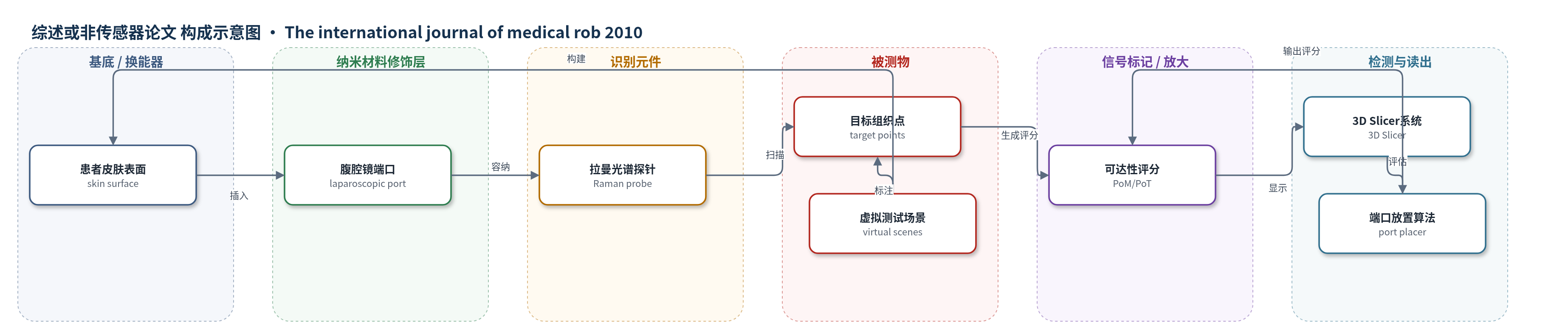
点击图片查看大图 · 依据论文自动绘制
传感器类型
综述或非传感器论文
检测对象
癌变组织(cancerous tissue)、正常组织(healthy tissue);样品基质:体内组织(in vivo tissue)
检测原理
本文不报道新的传感检测原理,而是以拉曼光谱探针为对象评估腹腔镜端口放置。拉曼探针通过激光激发组织分子振动,获得拉曼光谱,用于区分癌变组织与正常组织;其采集区域通常小于150 µm,且受最大入射角和工作距离限制。虚拟系统中,端口位置决定探针能否以直线到达目标点、是否与组织碰撞、以及入射角是否在垂直方向45°以内。满足三项约束的目标点计为可达,系统统计可达点数,并计算相对最大可达点数的百分比(PoM)和相对全部目标点数的百分比(PoT),以此评价端口位置质量。
检测灵敏度
—
效应效果
20名受试者完成50个虚拟场景,平均PoM为57–78%。自动端口放置算法平均比受试者高10–25%。分场景看,受试者比算法低:基线0–19%、复杂目标表面6–25%、大范围目标表面6–35%、复杂皮肤表面0–93%、遮挡场景5–43%。单场景95%置信区间通常约10–20%,个体跨场景约15%,说明端口选择质量在场景间和个体间均不稳定。作者认为可通过训练、反馈或自动增强改善端口放置,提高生物传感器数据采集质量。
传感器的构成
- 传感器类型:拉曼光谱探针(Raman spectroscopic probe),原文未给出具体材料构成
- 虚拟探针模型:Raman probe 三维尺寸模型,用于模拟探针长度与可达性
- 端口通道:腹腔镜端口(laparoscopic port),作为传感器进入体内的固定入口
中文摘要
本研究评估受试者为体内生物传感器使用而放置腹腔镜端口(port)的能力。由于生物传感器存在最大入射角、工作距离和有限采集区域等物理限制,端口位置直接影响能否到达目标组织并获取高质量数据。作者将端口放置评分算法集成到图像引导手术系统 3D Slicer 中,构建包含皮肤、目标器官和拉曼探针尺寸模型的虚拟测试场景,模拟不同手术条件。20 名受试者在 50 个场景中用鼠标选择皮肤上的端口位置,系统根据探针长度、碰撞检测和入射角是否小于 45° 判断目标点是否可达,并计算可达目标点比例。结果显示,自动端口放置算法的平均得分一致高于受试者约 10–25%,且受试者在不同场景和个体间表现不稳定。作者认为可通过训练或人机增强改善生物传感器端口放置。
英文摘要
BACKGROUND: We conducted a study of participants' abilities to place a laparoscopic port for in vivo biosensor use. Biosensors have physical limitations that make port placement crucial to proper data collection. A new port placement algorithm enabled evaluation of port locations, using segmented patient data in a virtual environment.
METHODS: Port placement scoring algorithms were integrated into an image-guided surgery system. Virtual test scenes were created to evaluate various scenarios encountered during biosensor use. Participants were scored based on their ability to choose a port location from which points of interest could be scanned with a biosensor. Participants' scores were also compared to those of a port placement algorithm.
RESULTS: The port placement algorithm consistently outscored participants by 10-25%. Participants were inconsistent from trial to trial and from participant to participant.
CONCLUSION: Port placement for biosensor procedures could be improved through training or augmentation.