组成图示
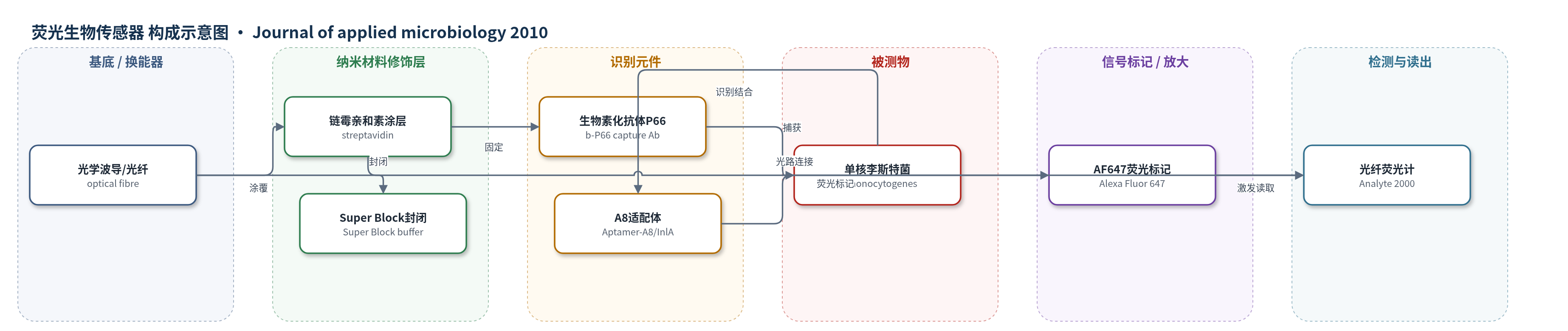
点击图片查看大图 · 依据论文自动绘制
传感器类型
荧光生物传感器
检测对象
单核细胞增生李斯特菌(Listeria monocytogenes, L. monocytogenes);样品基质:TBS 纯培养菌悬液、即食肉制品(牛肉/鸡肉/火鸡肉)SEL 或 Fraser 富集液
检测原理
传感器以光纤/光学波导为换能器,表面经链霉亲和素固定生物素化抗体 P66,形成捕获层。样品中 L. monocytogenes 被 P66 捕获后,其表面 InlA 与 AF647 标记的 A8 适配体特异性结合,形成抗体–菌体–适配体夹心结构。由于适配体分子较小,AF647 可靠近光纤表面,被倏逝波激发产生荧光。捕获菌量越多,结合到表面的 AF-A8 越多,荧光强度越高,信号以 pA 形式由 Analyte 2000 读出。该体系未使用酶促或核酸扩增,主要依靠夹心识别和倏逝波荧光换能实现检测。
检测灵敏度
LOD: 1 × 10^3 CFU ml^-1
效应效果
传感器选择性良好:L. monocytogenes 纯培养信号 10893.8±1848.1 pA,与 E. coli、Salmonella 混合后 7149.6±736.5 pA,显著高于对照 1869.6±637.6 pA;非致病李斯特菌及其他菌接近背景。纯培养检测限 1×10^3 CFU/mL,优于此前抗体–抗体光纤传感器 4.3×10^3 CFU/mL。10^2 CFU/25 g 人工污染的即食牛肉、鸡肉和火鸡肉经 SEL 富集 18 h 后均可检出,信号分别为 5200、6800、6000 pA;Fraser 富集时牛肉和鸡肉无显著差异。PCR 验证一致,作者认为可用于食品中 L. monocytogenes 快速特异检测。
传感器的构成
- 基底/换能器:光学波导/光纤(optical waveguide/optical fibre),提供倏逝波并传输光信号
- 亲和修饰层:链霉亲和素(streptavidin),固定生物素化捕获抗体
- 封闭层:Super Block 封闭缓冲液,减少非特异结合
- 捕获抗体:生物素化多克隆抗李斯特菌抗体 P66(b-P66),捕获 L. monocytogenes
- 识别适配体:A8 适配体(Aptamer-A8),特异性识别菌体表面 InlA
- 荧光标记物:Alexa Fluor 647(AF647),标记 A8 作为报告荧光团
- 信号读出:Analyte 2000 光纤荧光计,检测荧光强度(pA)
中文摘要
本研究开发了一种抗体–适配体功能化光纤生物传感器,用于食品中单核细胞增生李斯特菌(Listeria monocytogenes)的特异性检测。研究以单链寡核苷酸适配体作为识别元件,利用其对目标分子的亲和力提高传感器特异性。针对李斯特菌侵袭素蛋白 internalin A(InlA)的适配体 A8 与抗体共同组成夹心检测体系:生物素化多克隆抗李斯特菌抗体 P66 固定在链霉亲和素涂层的光学波导表面用于捕获细菌,Alexa Fluor 647 标记的 A8 作为报告分子。该传感器可在纯培养及与其他细菌混合体系中,以约 10^3 CFU/mL 的浓度选择性检测致病性李斯特菌;并能在 18 h 富集后,从人工污染(初始接种 10^2 CFU/25 g)的即食牛肉、鸡肉和火鸡肉制品中成功检出 L. monocytogenes。结果表明,该传感器可作为食品中 L. monocytogenes 灵敏、特异检测的工具,并展示了适配体在光纤生物传感器平台上的新应用。
英文摘要
AIM: To develop antibody-aptamer functionalized fibre-optic biosensor for specific detection of Listeria monocytogenes from food products.
METHODS AND RESULTS: Aptamer, a single-stranded oligonucleotide ligand that displays affinity for the target molecule, was used in the assay to provide sensor specificity. Aptamer-A8, specific for internalin A, an invasive protein of L. monocytogenes, was used in the fibre-optic sensor together with antibody in a sandwich format for detection of L. monocytogenes from food. Biotinylated polyclonal anti-Listeria antibody, P66, was immobilized on streptavidin-coated optical waveguide surface for capturing bacteria, and Alexa Fluor 647-conjugated A8 was used as a reporter. The biosensor was able to selectively detect pathogenic Listeria in pure culture and in mixture with other bacteria at a concentration of approx. 10(3) CFU ml(-1). This sensor also successfully detected L. monocytogenes cells from artificially contaminated (initial inoculation of 10(2) CFU 25 g(-1) ) ready-to-eat meat products such as sliced beef, chicken and turkey after 18 h of enrichment.
CONCLUSION: Based on the data presented in this study, the antibody-aptamer functionalized fibre-optic biosensor could be used as a detection tool for sensitive and specific detection of L. monocytogenes from foods.
SIGNIFICANCE AND IMPACT OF THE STUDY: The study demonstrates feasibility and novel application of aptamer on fibre-optic biosensor platform for the sensitive detection of L. monocytogenes from food products.