组成图示
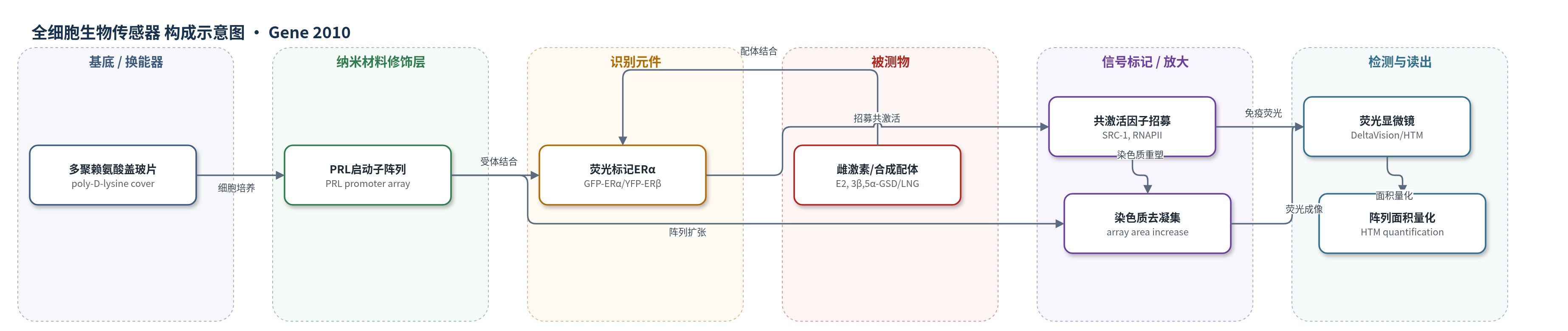
点击图片查看大图 · 依据论文自动绘制
传感器类型
全细胞生物传感器
检测对象
检测对象:雌二醇(E2)、他莫昔芬(TAM)、3β,5α-炔诺酮类衍生物(3β,5α-NET、3β,5α-LNG、3β,5α-GSD);样品基质:PRL-HeLa 细胞培养体系(DMEM/Opti-MEM 含去炭 FBS)
检测原理
该传感器以 PRL-HeLa 细胞中整合的 PRL 启动子/增强子阵列为响应区。荧光标记的 ERα 或 ERβ 作为识别元件,结合 E2 或合成配体后发生构象变化,并定位到 PRL 启动子 ER 结合位点。激动性配体促使 ER 招募内源共激活因子 SRC-1 和 RNA 聚合酶 II(RNAPII),引起局部染色质去凝集,使荧光标记的 PRL 阵列面积增大;拮抗剂他莫昔芬则导致阵列凝集、面积减小。信号通过 GFP/YFP 荧光及 SRC-1/RNAPII 免疫荧光成像读出,并用高通量显微镜(HTM)定量阵列面积和共定位程度,因此阵列面积随激动性配体浓度升高而增大,体现 ER 亚型选择性。
检测灵敏度
原文未报告 LOD、线性范围、灵敏度斜率或 R^2。
效应效果
该体系表现出明确的 ER 亚型选择性:3β,5α-GSD、3β,5α-LNG 等合成配体在 GFP-ERα 细胞中诱导与 E2 相似的阵列扩张和 SRC-1/RNAPII 招募,但在 YFP-ERβ 细胞中与溶剂对照无差异;E2 则对 ERα 和 ERβ 均有效。他莫昔芬处理使阵列凝集,RNAPII 从阵列位移,SRC-1 信号减少有限。实验以三次独立重复的均值±标准差表示,与溶剂对照比较 P<0.05,说明响应可重复且显著。作者认为该单细胞 PRL 阵列可高通量、直接可视化地评估新型 ER 亚型选择性配体,相比传统受体竞争或转录报告方法具有更直观、可成像和适合筛选的优势。
传感器的构成
- 细胞基底:多聚赖氨酸包被盖玻片(poly-D-lysine-coated cover slips/glass cover slips),提供细胞贴附与成像表面。
- 传感细胞平台:PRL-HeLa 细胞,稳定整合大鼠 PRL 启动子/增强子阵列(PRL-array),作为配体响应染色质/转录报告区。
- 识别元件:GFP-hERα 或 YFP-hERβ 融合蛋白(pEGFP-ERα/pEYFP-ERβ 瞬时转染),识别 E2 或合成配体并结合 PRL 启动子 ER 位点。
- 荧光标记层:GFP/YFP 荧光蛋白标记 ER,以及 SRC-1 与 RNAPII 免疫荧光(Alexa Fluor-555/Fluor-647),标记受体定位与转录共激活因子。
- 封闭与染色:5% 非脂干奶(nonfat dry milk)封闭,PBS 洗涤,DAPI 核染色,降低背景并标记细胞核。
- 读出平台:DeltaVision 复原显微镜与高通量显微镜(HTM, Cell Lab IC 100 Image Cytometer),采集 Z 系列并量化 PRL 阵列面积/共定位。
中文摘要
雌激素受体(ER)通过配体依赖方式招募共调节因子并改变染色质以激活转录。本研究利用稳定整合于 HeLa 细胞基因组的大鼠催乳素(PRL)启动子/增强子阵列(PRL-array,PRL-HeLa 细胞)这一新型哺乳动物启动子转录生物传感器,分析合成 A 环还原 19-去甲睾酮衍生物能否在单细胞水平可见地改变 ER 靶基因染色质构型。将表达 GFP-ERα 或 YFP-ERβ 的 PRL-HeLa 细胞用合成配体、雌二醇(E2)和他莫昔芬处理后,通过荧光成像与高通量显微镜量化阵列面积及共定位。结果显示,GFP-ERα 细胞中合成配体或 E2 均引起阵列面积浓度依赖性增加,天然与合成类固醇效应无显著差异,且 SRC-1 与 RNA 聚合酶 II(RNAPII)在阵列处共定位。YFP-ERβ 细胞中 E2 可产生类似 ERα 的阵列扩张,但合成配体处理与溶剂对照无差异。结果表明,A 环还原 19-去甲睾酮衍生物通过选择性结合 ERα 产生雌激素样染色质效应并招募转录因子。
英文摘要
Estrogen receptors (ER), members of the nuclear steroid receptor superfamily, act to activate transcription through ligand-dependent recruitment of coregulators and chromatin modifications. A series of synthetic A-ring reduced 19-nortestosterone-derived progestins has the capacity to selectively bind ERalpha for activated transcription, and to recruit coregulatory factors. In this study, we have analyzed the ability of synthetic 19-nortestosterone derivatives to visibly alter the configuration of ER-target gene chromatin using a novel mammalian promoter transcriptional biosensor (PRL-array) stably transfected into the genome of HeLa cells (PRL-HeLa cells). Results from synthetic steroid-treated cells expressing functional GFP-ERalpha or YFP-ERbeta chimeras were compared to those obtained with estradiol (E(2)) and the antiestrogen tamoxifen. In the presence of synthetic ligands or E(2) a concentration-dependent increase in area of the biosensor array was observed in GFP-ERalpha-expressing PRL-HeLa cells. No significant differences were found between the effects obtained with natural and synthetic steroids. Similarly, E(2) or synthetic steroids-treated PRL-HeLa cells also resulted in similar colocalization of SRC-1- and RNAPII-immunofluorescence at the array. YFP-ERbeta-expressing PRL-HeLa cells treated with E(2) showed increases in array area that were similar to ERalpha; however, treatment of YFP-ERbeta-expressing cells with synthetic ligands was indistinguishable from vehicle controls. These data indicate that A-ring reduced 19-nortestosterone derivatives have an estrogen-like effect on chromatin, including recruitment of transcription factors through selective interactions with ERalpha.