组成图示
点击图片查看大图 · 依据论文自动绘制
传感器类型
全细胞生物传感器
检测对象
玉米赤霉烯酮(zearalenone, ZEA);样品基质:完全培养基(CM)、最小培养基(MM)及农产品(作者主张)
检测原理
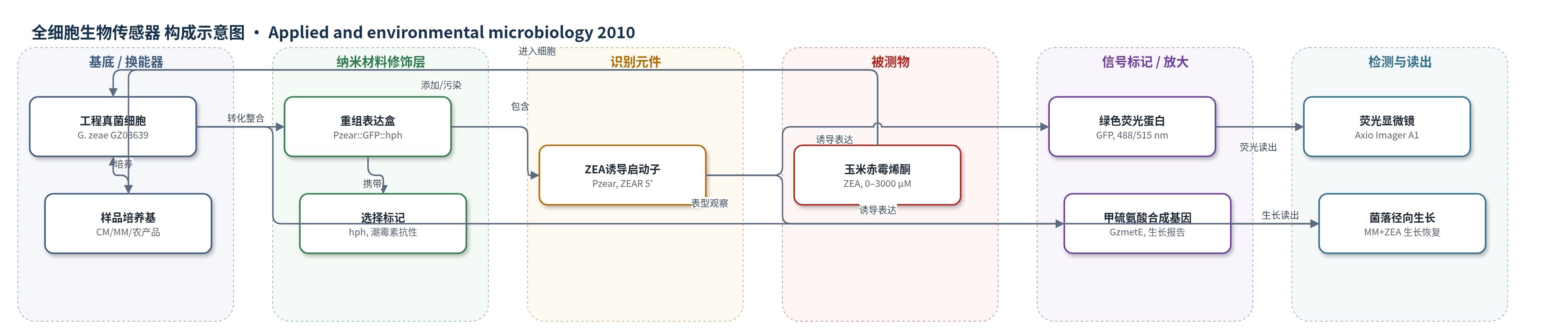
ZEA 进入工程化 Gibberella zeae 细胞后,激活 ZEA 响应信号通路,使 ZEA 诱导启动子 Pzear 启动转录。Pzear 可驱动 GFP 报告基因表达,GFP 荧光强度随 ZEA 浓度在 3–30 μM 范围内逐渐增强,超过 30 μM 后下降,并在 1 h 左右出现峰值后随时间减弱。另一分支中,Pzear 替换 GzmetE 启动子后,ZEA 诱导 GzmetE 转录,恢复甲硫氨酸合成,使甲硫氨酸营养缺陷型在最小培养基上恢复径向生长;无 ZEA 时不生长,3 μM 部分恢复,15–30 μM 接近野生型。该系统以全细胞基因表达作为生物放大,无需外加纳米材料或酶催化沉积,信号随 ZEA 暴露浓度和时间变化。
检测灵敏度
检测范围: 3 to 1,500 μM ZEA(原文:detection range of 3 to 1,500 μM ZEA);GFP 响应: 3 to 30 μM ZEA(>30 μM 下降)
效应效果
ZEA 使 ZEAR 表达升高超过 50 倍,1 h 后 Northern blot 信号显著增强,无 ZEA 对照未检出。GFP 在 3–30 μM ZEA 下增强,>30 μM 下降并随时间减弱;Pzear-GzmetE 突变体在无 ZEA 最小培养基上不生长,3 μM 部分恢复,15 和 30 μM 接近野生型。ZEA 不引起 G. zeae 菌丝形态缺陷,葡萄糖和蔗糖不抑制 ZEAR 表达;但 Pzear 转入 F. oxysporum 和 F. verticillioides 后 GFP 组成型表达,提示种属特异性。重组 G. zeae 检测范围为 3–1500 μM ZEA,可用于农产品 ZEA 污染检测和必需基因研究。未报告 RSD、回收率及与 ELISA/HPLC/qPCR 的对比。
传感器的构成
- 传感细胞/换能器:Gibberella zeae 菌株 GZ03639 或重组突变体 Δzear-gfp、Pzear-GzmetE,作为 ZEA 响应全细胞传感平台。
- 识别元件:ZEA 诱导启动子 Pzear(ZEAR 基因 5′ 上游 -838 至 -1 bp),响应 ZEA 并驱动下游报告基因转录。
- 报告信号标记物:绿色荧光蛋白 GFP(Pzear::GFP::hph 构建体),ZEA 诱导后产生可显微观察的荧光。
- 生长报告基因:GzmetE(甲硫氨酸合成必需基因),Pzear 控制其表达,ZEA 诱导后恢复甲硫氨酸营养缺陷型生长。
- 选择标记:hph(潮霉素磷酸转移酶),用于重组真菌转化子筛选。
- 样品基质/诱导环境:完全培养基 CM、最小培养基 MM 及农产品(作者主张),提供 ZEA 暴露与培养条件。
- 读出方式:荧光显微镜(DE/Axio Imager A1,激发 488 nm、发射 515/530 nm)或菌落径向生长观察。
中文摘要
镰刀菌属子囊菌 Gibberella zeae(无性态 Fusarium graminearum)是引起小麦、大麦、水稻和小麦穗腐/赤霉病的重要植物病原菌,可产生玉米赤霉烯酮(ZEA)等霉菌毒素。该文旨在鉴定可被 ZEA 诱导的启动子,以建立 G. zeae 条件基因表达系统。作者通过微阵列分析筛选到一个 ZEA 响应基因 ZEAR,其表达在 ZEA 处理后升高超过 50 倍;Northern blot 显示 ZEA 处理 1 h 后 ZEAR 转录本显著增加。将 ZEAR 启动子 Pzear 与 GFP 融合并转化 G. zeae 后,GFP 表达呈 ZEA 浓度依赖性增强。进一步用 Pzear 替换必需基因 GzmetE 的启动子,突变体在最小培养基上的生长依赖外源 ZEA 浓度,证明 GzMetE 表达可被 ZEA 诱导。这是首次报道 G. zeae 中的诱导型启动子,该系统可用于研究必需基因功能,并可能作为检测农产品中 ZEA 污染的生物传感器。
英文摘要
The ascomycete fungus Gibberella zeae is an important plant pathogen that causes fusarium head blight on small grains. Molecular studies of this fungus have been performed extensively to uncover the biological mechanisms related to pathogenicity, toxin production, and sexual reproduction. Molecular methods, such as targeted gene deletion, gene overexpression, and gene fusion to green fluorescent protein (GFP), are relatively easy to perform with this fungus; however, conditional expression systems have not been developed. The purpose of this study was to identify a promoter that could be induced by zearalenone (ZEA) for the development of a conditional expression system in G. zeae. Through microarray analysis, we isolated one zearalenone response gene (ZEAR) whose expression was increased more than 50 times after ZEA treatment. Northern blot analysis showed that the ZEAR transcript dramatically increased after 1 h of ZEA treatment. To determine the utility of the ZEAR promoter, called Pzear, in a conditional expression system, we transformed a Pzear::GFP fusion construct into G. zeae. Our data showed a ZEA concentration-dependent increase in GFP expression. We also replaced the promoter of G. zeae metE (GzmetE), an essential gene for methionine biosynthesis, with the Pzear promoter. The growth of the Pzear-GzmetE mutant on minimal medium was dependent on the ZEA concentration supplemented in the medium and showed that GzMetE expression was induced by ZEA. This study is the first report of an inducible promoter in G. zeae. Our system will be useful for the characterization of essential gene functions in this fungus through differential and ZEA-dependent gene expression. In addition, the Pzear promoter may be applicable as a biosensor for the detection of ZEA contamination in agricultural products.