组成图示
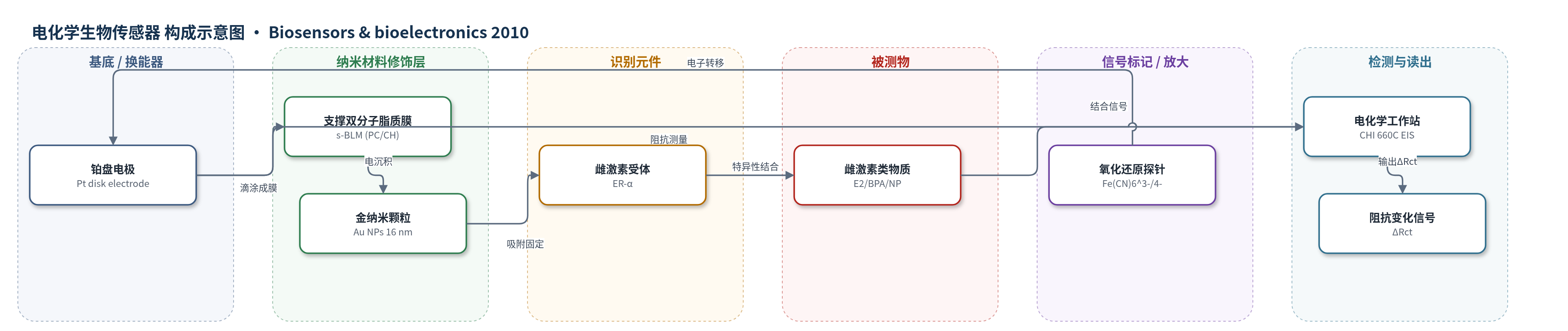
点击图片查看大图 · 依据论文自动绘制
传感器类型
电化学生物传感器
检测对象
17β-雌二醇(17β-estradiol, E2)、双酚A(bisphenol A, BPA)、壬基酚(4-nonylphenol, NP);样品基质:环境水样(长江、汉江水样)及工作缓冲液。
检测原理
该传感器以Pt电极为基底,s-BLM提供类脂膜环境,Au NPs作为纳米导体增强电子转移,ER-α固定于膜中作为识别元件。当雌激素类物质(E2、BPA、NP)与ER-α特异性结合时,受体发生构象变化并改变s-BLM界面性质,进而影响氧化还原探针[Fe(CN)6]4-/3-在电极表面的电子转移。EIS在0.22 V(vs. SCE)下测量电荷转移电阻Rct,结合前后ΔRct=Rct(ER-E)-Rct(ER)随雌激素浓度升高而增大。Au NPs通过提高膜导电性和生物相容性增强信号与稳定性,实现无酶、无放射性标记的直接阻抗检测。
检测灵敏度
17β-estradiol: LOD: 1 ng/L;线性范围: 5–150 ng/L;线性方程: ΔRct = 0.147[17β-estradiol] + 0.066;R^2 = 0.992。BPA: 线性范围: 6–180 μg/L。NP: 线性范围: 30–890 μg/L。
效应效果
传感器重现性良好,批内CV 4.6%,批间CV 8.9%。酚和铅(plumb)等干扰物对50 ng/L E2无明显干扰,RSD<9.6%。4℃干燥保存第2、4、8天响应为98%、91%、70%;PBS中2天内降至60%。无Au NPs时分别为97%、82%、55%和45%,说明Au NPs提高稳定性。与MCF-7法比较,长江Y1/Y2、汉江H1/H2水样EEQ为7.7/7.1、7.1/7.8、5.5/5.1、5.9/5.5 ng/L,P>0.05,RSD 1.5%–2.0%。作者认为其无需细胞培养,简便省时,可用于环境内分泌干扰物筛查。
传感器的构成
- 基底/换能器电极:铂盘电极(Pt disk electrode,直径1 mm),作为工作电极和电子换能基底
- 支撑双分子脂质膜:卵磷脂(PC)与胆固醇(CH)在正辛烷(n-octane)中形成s-BLM,滴涂于Pt表面并在0.1 M KCl中自发成膜,提供类脂膜微环境
- 金纳米颗粒修饰层:16 nm金纳米颗粒(Au NPs)通过s-BLM电化学沉积,作为纳米导体增强电子转移、提高灵敏度与稳定性
- 识别元件:重组人雌激素受体α(ER-α,0.3 nmol/mL)吸附固定于Au/s-BLM/Pt表面,与雌激素类物质特异性结合
- 氧化还原探针:铁氰化钾/亚铁氰化钾(K3[Fe(CN)6]/K4[Fe(CN)6])用于CV和EIS监测界面电子转移
- 工作缓冲液/氧化还原介质:10 mM K3[Fe(CN)6]/K4[Fe(CN)6]与0.1 M KCl,提供离子环境和氧化还原介质
中文摘要
针对环境中种类繁多的外源性雌激素筛查需求,本文开发了一种基于雌激素受体(ER)结合的电化学生物传感器,可直接检测雌激素类物质,无需放射性或酶标记化合物。该传感器通过将ER固定于金纳米颗粒(Au NPs)修饰的支撑双分子脂质膜(s-BLM)中构建,并用循环伏安法和阻抗谱表征修饰电极。结果表明,传感器对天然雌激素17β-雌二醇在5–150 ng/L范围内具有良好线性响应,检出限为1 ng/L;同时能以满意灵敏度和定量结果检测双酚A(BPA)和壬基酚(4-NP)等已知外源雌激素。Au NPs显著提高了传感器灵敏度和稳定性,传感器具有良好可靠性和重复性。水样雌激素活性检测结果与MCF-7细胞增殖法一致。
英文摘要
There is a growing demand for new technologies that are capable of screening the wide variety of xenoestrogens in environment. Here, a nanostructure electrochemical biosensor was developed to directly detect and screen estrogenic substances based on estrogen receptor (ER) binding without the use of radio- or enzyme-labeled compounds. The biosensor was fabricated by immobilization of ERs in supported bilayer lipid membrane (s-BLM) modified with Au nanoparticles, and the properties of the modified electrodes were characterized by cyclic voltammetry and impedance spectroscopy. The results indicated that the biosensor was able to detect the natural estrogen 17beta-estradiol with an acceptable linear correlation ranging from 5 to 150 ng/L and a detection limit of 1 ng/L. The biosensor could also detect other known xenoestrogens such as bisphenol A and 4-nonylphenol with satisfied sensitivity and quantitative results. The biosensor showed good reliability and repeatability, and the Au nanoparticles greatly enhanced the sensitivity and stability of the biosensor. Moreover, estrogenic activity of water samples determined by this biosensor was in good agreement with that determined by MCF-7 cell proliferation assay.