组成图示
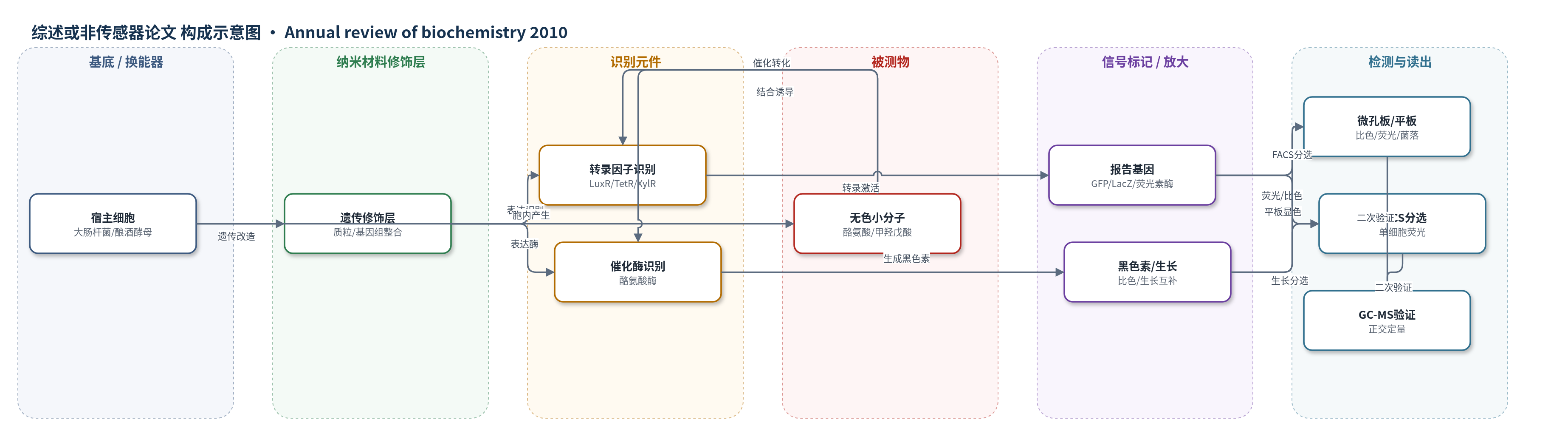
点击图片查看大图 · 依据论文自动绘制
传感器类型
综述或非传感器论文
检测对象
无色小分子(inconspicuous small molecules),包括L-酪氨酸(L-tyrosine)、甲羟戊酸(mevalonate)、林丹(lindane)、1,2,4-三氯苯(1,2,4-trichlorobenzene)、类胡萝卜素(lycopene/astaxanthin)、芳烃(toluene/benzene/xylene)等;样品基质为微生物培养物、发酵液、平板菌落或细胞悬液。
检测原理
综述所述全细胞小分子生物传感器将无色代谢物转化为可检测表型。识别事件可为转录因子结合小分子后激活或抑制启动子,或异源酶催化小分子发生多步转化。随后发生基因表达变化或有色/荧光产物积累,形成信号放大:转录放大使报告基因表达量随小分子浓度变化,酶促转化可生成黑色素等强比色产物,生长互补则将小分子产量与细胞生长率偶联。信号通过微孔板比色/荧光、平板菌落颜色、FACS单细胞荧光或生长选择读出,并可经GC-MS正交验证。不同系统呈现数字或模拟转移函数,灵敏度、动态范围和线性范围决定筛选能力。
检测灵敏度
原文未报告统一LOD与R^2。具体报告值:酪氨酸荧光筛选可区分低至50 mg·L−1,线性范围0.05–0.5 g·L−1 tyrosine;甲羟戊酸全细胞传感器可区分10%产量差异(95%置信度);表1转录因子系统:PLuxR-LuxR 灵敏度(napp) 1.6、动态范围500倍、线性检测范围0.5–10 nM;PLtetO-1-TetR 灵敏度(napp) 10.43、动态范围2535倍、线性检测范围≈0–4.5 nM;PLlacO-1-LacR 灵敏度(napp) 1.14、动态范围620倍、线性检测范围0.01–1 mM;PBAD-AraC 灵敏度(napp) 0.43、动态范围5.5倍、线性检测范围0.08–20 mM。
效应效果
综述比较不同方法通量:色谱通常低于10^3,微孔板约10^5,平板可达10^6,FACS可达10^8–10^9,生长选择受培养规模限制。酪氨酸催化生物传感器筛选21,000个转座子敲除菌落,两轮五天选出30株,其中dnaQ和ygdT敲除分别提高L-酪氨酸产量57%和71%。甲羟戊酸全细胞传感器可区分10%产量差异(95%置信度),平板仅区分生产者与非生产者。FACS可富集80–5000倍、0.5%–1.0%高荧光细胞,但假阳性较高,需二次验证;虾青素FACS可分辨260 μg/g干重差异,筛选效率较平板提高5倍。作者主张转录因子全细胞生物传感器是未来高通量筛选方向。
传感器的构成
- 宿主细胞基底:E. coli 或 S. cerevisiae 全细胞,作为代谢与信号换能载体
- 遗传修饰层:质粒或基因组整合元件,携带转录因子/酶基因与报告基因,实现异源表达
- 识别元件:转录因子-启动子对(LuxR-PluxR、TetR-PTet、XylR-Ppu/Ppo/Pps、LacR-PlacO、AraC-PBAD)或异源酶(酪氨酸酶),识别/转化小分子
- 信号标记物:报告基因或产物(GFP、LacZ/β-半乳糖苷酶、荧光素酶、黑色素、生长表型),将小分子浓度转为可读信号
- 被测物输入:无色小分子(L-tyrosine、mevalonate、lindane、1,2,4-trichlorobenzene、carotenoids、aromatics等),由生产菌株产生或外源添加
- 读出层:微孔板比色/荧光、平板菌落颜色、FACS单细胞荧光、GC-MS正交验证,完成信号采集
中文摘要
代谢工程用于高价值小分子过量生产,依赖定向进化提高产量。多数目标小分子无色且难以直接筛选。本文综述高通量比色、荧光和生长偶联筛选技术的发展,实现无色小分子检测。首先概述标准定向进化流程中文库构建、转化和筛选的通量限制,并基于小分子检测通量和灵敏度建立筛选与选择阶梯。随后深入分析已证明的小分子检测筛选与选择方法,重点介绍体内生物传感器检测方法,减少或消除体外检测操作并提高通量。文章以大肠杆菌和酿酒酵母为模型宿主,讨论类胡萝卜素、酪氨酸、甲羟戊酸等例子,并比较微孔板、平板、FACS和生长互补选择。最后展望未来,聚焦转录因子检测系统作为微生物天然小分子检测模式。
英文摘要
Metabolic engineering for the overproduction of high-value small molecules is dependent upon techniques in directed evolution to improve production titers. The majority of small molecules targeted for overproduction are inconspicuous and cannot be readily obtained by screening. We provide a review on the development of high-throughput colorimetric, fluorescent, and growth-coupled screening techniques, enabling inconspicuous small-molecule detection. We first outline constraints on throughput imposed during the standard directed evolution workflow (library construction, transformation, and screening) and establish a screening and selection ladder on the basis of small-molecule assay throughput and sensitivity. An in-depth analysis of demonstrated screening and selection approaches for small-molecule detection is provided. Particular focus is placed on in vivo biosensor-based detection methods that reduce or eliminate in vitro assay manipulations and increase throughput. We conclude by providing our prospectus for the future, focusing on transcription factor-based detection systems as a natural microbial mode of small-molecule detection.