组成图示
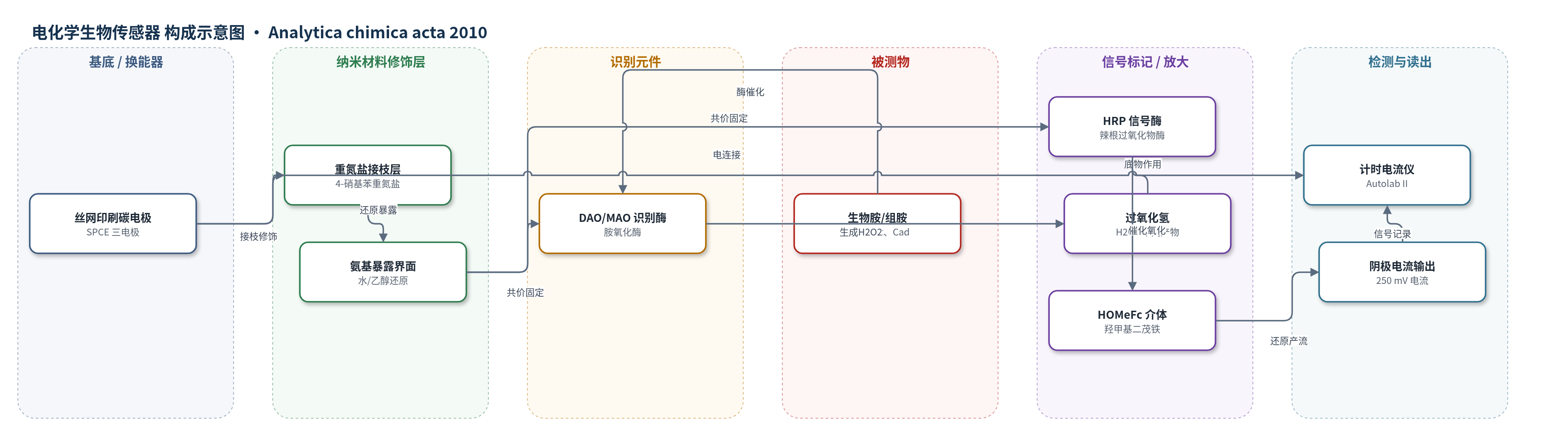
点击图片查看大图 · 依据论文自动绘制
传感器类型
电化学生物传感器
检测对象
生物胺(biogenic amines, BA):组胺(histamine, His)、腐胺(putrescine, Put)、尸胺(cadaverine, Cad)、酪胺(tyramine, Tyr)、色胺(tryptamine, Trypt)、精胺(spermine, Spm)、亚精胺(spermidine, Spd);样品基质:盐腌鳀鱼提取液(fish samples)
检测原理
生物胺(BA)进入传感器后,被共价固定的 DAO 或 MAO 识别并催化氧化脱氨,生成相应醛、氨和过氧化氢(H2O2)。HRP 以 H2O2 为底物,催化介体羟甲基二茂铁(HOMeFc)发生氧化还原循环,使氧化态 HOMeFc 在碳工作电极上于 250 mV(vs 丝网印刷 Ag/AgCl)被还原,产生阴极电流。由于每个 BA 分子可经 DAO/MAO 生成 H2O2,再由 HRP 循环转化多个 HOMeFc 分子,形成双酶级联信号放大;电流响应随 BA 浓度增加而增大。低电位测量避免直接氧化 H2O2 所需高电位带来的背景电流和干扰,提高选择性。
检测灵敏度
LOD/检测能力: 0.18 ± 0.01 μM(DAO/HRP);0.40 ± 0.04 μM(MAO/HRP,α = 0.05,β = 0.005);线性范围: 0.2–1.6 μM(DAO/HRP,His);0.4–2.4 μM(MAO/HRP,His);灵敏度: 19.68、17.09、16.25、15.63、19.08 nA μM−1(DAO/HRP);32.77、32.03、33.09、26.72、26.57 nA μM−1(MAO/HRP);R^2 = 0.990、0.997、0.996、0.997、0.997(DAO/HRP);0.999、0.997、0.996、0.999、0.991(MAO/HRP)
效应效果
传感器制备重现性良好,DAO/HRP 与 MAO/HRP 灵敏度 RSD 分别为 10% 和 11%。DAO/HRP 第 5 次校准后保持 60% 灵敏度,MAO/HRP 第 3 次后低于 40%。DAO/HRP 对 Put 响应 100%,Cad 95%,His 80%,Tyr、Spm、Spd 73%,Trypt 23%。盐腌鳀鱼样品测得组胺当量 [11.5 ± 1.4] μM(RSD 7.5%);加标样品总浓度 41.0 μM,测得 [40.8 ± 7.8] μM,平均回收率 99.6%(RSD 7.7%)。相比先前 >600 mV 的单酶丝网印刷传感器,本方法在 250 mV 工作,干扰更低,适合食品生物胺快速筛查。
传感器的构成
- 基底/换能器电极:丝网印刷碳电极(SPCE),含碳工作电极、碳辅助电极和 Ag/AgCl 参比电极,提供三电极电化学检测平台
- 表面预处理:机械打磨与循环伏安活化(2 至 −2 V,100 mM KCl),清洁并活化碳工作电极表面
- 界面修饰层:4-硝基苯重氮四氟硼酸盐(N2C6H4NO2BF4)电接枝层,经水/乙醇还原暴露氨基,用于共价连接酶
- 识别元件:二胺氧化酶(DAO)或单胺氧化酶(MAO),催化生物胺氧化脱氨生成 H2O2
- 信号酶:辣根过氧化物酶(HRP),催化 H2O2 与介体反应,实现电流信号放大
- 共价偶联剂:N-羟基琥珀酰亚胺(NHS)和 EDC,促进氨基与酶表面羧基形成酰胺键
- 信号介体:羟甲基二茂铁(HOMeFc),在低电位被还原产生可测阴极电流
- 缓冲/支持电解质:50 mM 磷酸盐 + 100 mM KCl(pH 9.3),维持酶活性与离子强度
中文摘要
本文报道了基于单胺氧化酶(MAO)/辣根过氧化物酶(HRP)和二胺氧化酶(DAO)/HRP 的一次性生物传感器,采用丝网印刷碳电极测定生物胺(BA)。酶通过羟基琥珀酰亚胺(NHS)和碳二亚胺(EDC)共价固定于先前用芳基重氮盐修饰的碳工作电极上。检测通过测量介体羟甲基二茂铁(HOMeFc)在低电位(相对于丝网印刷 Ag/AgCl 参比电极 250 mV)下还原产生的阴极电流实现。采用实验设计方法优化了酶固定条件及影响计时电流响应的主要变量。在最优条件下,对一次性生物传感器进行了表征:DAO/HRP 和 MAO/HRP 传感器对组胺的线性响应范围分别为 0.2–1.6 μM 和 0.4–2.4 μM。传感器制备重现性良好,灵敏度相对标准偏差分别为 10% 和 11%。检测能力分别为 0.18±0.01 μM(DAO/HRP)和 0.40±0.04 μM(MAO/HRP,α=0.05,β=0.005),并分析了传感器对不同生物胺的响应。最后,将所开发传感器应用于鱼样中总胺含量的测定。
英文摘要
This work reports monoamine oxidase (MAO)/horseradish peroxidase (HRP) and diamine oxidase (DAO)/horseradish peroxidase (HRP) based biosensors using screen-printed carbon electrodes for the determination of biogenic amines (BA). The enzymes have been covalently immobilized onto the carbon working electrode, previously modified by an aryl diazonium salt, using hydroxysuccinimide and carbodiimide. The detection has been performed by measuring the cathodic current due to the reduction of the mediator hydroxymethylferrocene at a low potential, 250 mV vs screen-printed Ag/AgCl reference electrode. The experimental conditions for the enzymes immobilization, as well as for the main variables that can influence the chronoamperometric current have been optimized by the experimental design methodology. Under these optimum conditions, the disposable biosensors have been characterized. A linear response range from 0.2 up to 1.6 microM and from 0.4 to 2.4 microM of histamine was obtained for DAO/HRP and MAO/HRP based biosensors, respectively. The biosensor construction was highly reproducible, yielding relative standard deviations of 10% and 11% in terms of sensitivity for DAO/HRP and MAO/HRP based biosensors, respectively. The capability of detection, 0.18+/-0.01 microM in the case of DAO/HRP and 0.40+/-0.04 microM (alpha=0.05 and beta=0.005) for MAO/HRP based biosensors, and the biosensor sensitivity towards different BA has also been analyzed. Finally, the developed biosensors have been applied to the determination of the total amine content in fish samples.