组成图示
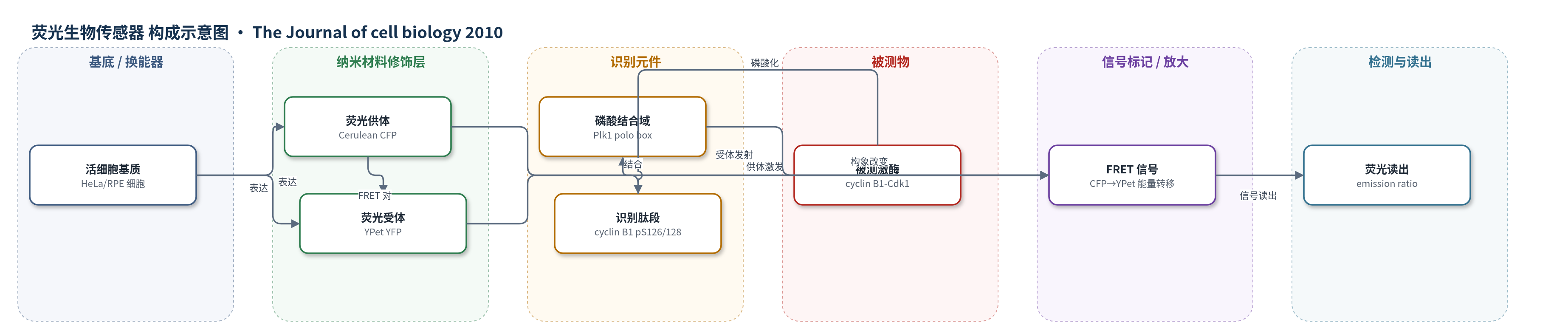
点击图片查看大图 · 依据论文自动绘制
传感器类型
荧光生物传感器
检测对象
cyclin B1–Cdk1 激酶活性(cyclin B1–Cdk1 activity);样品基质:活 HeLa 细胞、视网膜色素上皮细胞(RPE)的细胞核与细胞质
检测原理
该传感器由 Cerulean(CFP 变体)和 YPet(YFP 变体)通过 Plk1 polo box 最小结构域及 cyclin B1 N 端自磷酸化肽段连接而成。静息状态下,cyclin B1–Cdk1 活性低,肽段未磷酸化,Plk1 polo box 不结合,两个荧光蛋白距离较远,FRET 效率低。当 cyclin B1–Cdk1 被激活后,它磷酸化肽段中的 Ser126 和 Ser128;Plk1 polo box 识别并结合磷酸化 Ser/Thr,使供体与受体距离缩短,CFP 激发后能量转移至 YPet 的效率升高,YFP/CFP 发射比增加。因此 FRET 比值随激酶活性升高而升高,可作为活细胞内 cyclin B1–Cdk1 活性的实时报告。
检测灵敏度
原文未报告 LOD、线性范围、灵敏度斜率或相关系数。
效应效果
该 FRET 传感器特异性报告 cyclin B1–Cdk1 活性,不响应 cyclin A/E–Cdk。HeLa 中 FRET 在 NEBD 前约 27 min 升高,cyclin B1 核积累平均在 FRET 升高后 30 s 开始(27±7 min,n=18);RPE 中提前约 18 min。加入 300 nM Cdk1/2 inhibitor III 后,FRET 于 0.5–1 min 下降,随后 cyclin B1 重新输出(n=6);5 µM ZM447439 无影响(n=6)。100 nM BI 2536 不改变核积累。LMB 处理下前期核输入速率提高 20–54 倍(平均 38 倍,n=26;LMB 组平均 39 倍,n=9)。作者认为其可作为 Cdk1 激活的实时标志,用于研究有丝分裂起始的核质协调。
传感器的构成
- 荧光供体:Cerulean(CFP 变体 A207K),提供激发态能量并作为 FRET 供体
- 荧光受体:YPet(YFP 变体),接受 Cerulean 能量转移并作为 FRET 受体
- 识别结合元件:Plk1 polo box 最小结构域(residues 373–592),特异性结合磷酸化 Ser/Thr
- 识别底物肽:人 cyclin B1 N 端自磷酸化位点肽段(PEPILVDT-S-pS126-P-pS128-P-MET),被 cyclin B1–Cdk1 磷酸化
- 定位变体:NES 或组蛋白 H2B 融合,用于将传感器靶向细胞质或染色体/细胞核
- 信号标记物:无外源标记,FRET 效率变化(CFP→YPet)作为内源荧光信号
中文摘要
cyclin B–Cdk1 激酶是大多数真核细胞进入有丝分裂的触发因子。在动物细胞中,cyclin B 在间期于细胞核与细胞质间穿梭,并在前期迅速富集于细胞核,促进核纤层解聚和核膜崩解(NEBD)。目前 cyclin B1 核内积累的直接触发机制尚不清楚,传统观点认为 Plk1 激酶通过磷酸化抑制其核输出。本研究利用一种特异性检测 cyclin B1–Cdk1 活性的 FRET 生物传感器,发现 cyclin B1–Cdk1 一旦被激活,即立即触发其快速核内积累;该过程主要通过核输入速率提高约 40 倍实现,并在 NEBD 前持续依赖 Cdk1 活性。尽管核内富集明显,仍有相当比例 cyclin B1–Cdk1 保留在细胞质中。核输入增强由核输入机制的改变驱动,既不依赖 Plk1,也不依赖核输出抑制。因此,cyclin B1–Cdk1 激活与其快速核输入之间的内在偶联,协调了有丝分裂起始时细胞核与细胞质的重构。
英文摘要
The cyclin B-Cdk1 kinase triggers mitosis in most eukaryotes. In animal cells, cyclin B shuttles between the nucleus and cytoplasm in interphase before rapidly accumulating in the nucleus at prophase, which promotes disassembly of the nuclear lamina and nuclear envelope breakdown (NEBD). What triggers the nuclear accumulation of cyclin B1 is presently unclear, although the prevailing view is that the Plk1 kinase inhibits its nuclear export. In this study, we use a biosensor specific for cyclin B1-Cdk1 activity to show that activating cyclin B1-Cdk1 immediately triggers its rapid accumulation in the nucleus through a 40-fold increase in nuclear import that remains dependent on Cdk1 activity until NEBD. Nevertheless, a substantial proportion of cyclin B1-Cdk1 remains in the cytoplasm. The increase in nuclear import is driven by changes in the nuclear import machinery that require neither Plk1 nor inhibition of nuclear export. Thus, the intrinsic link between cyclin B1-Cdk1 activation and its rapid nuclear import inherently coordinates the reorganization of the nucleus and the cytoplasm at mitotic entry.