组成图示
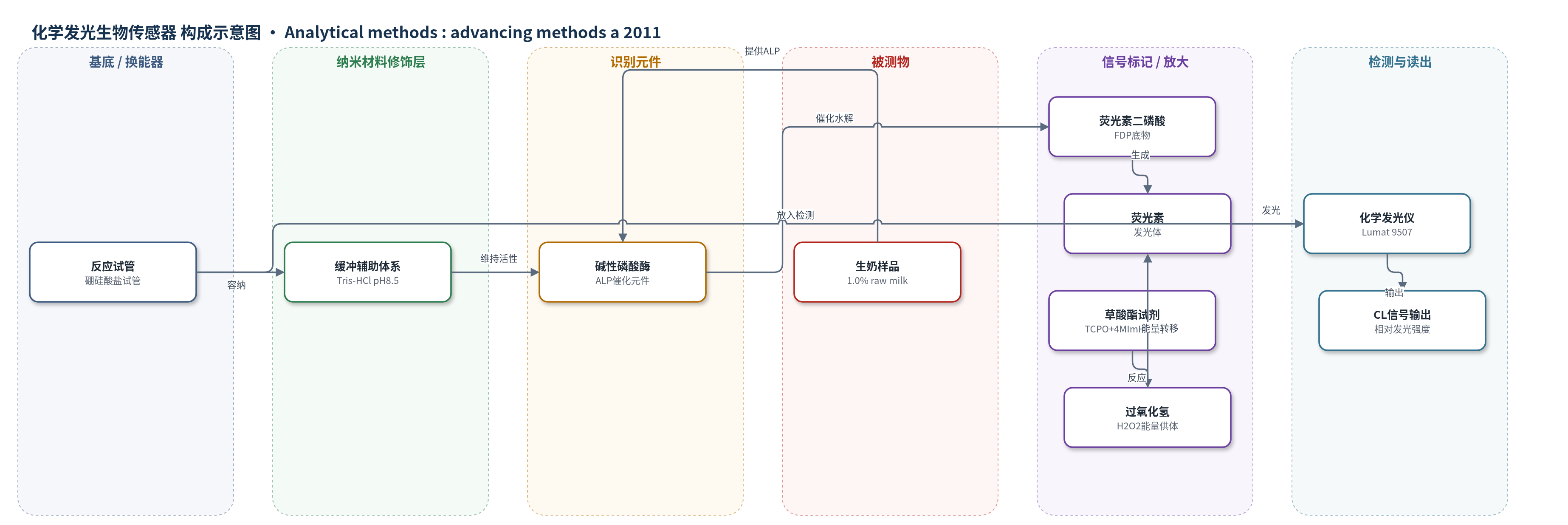
点击图片查看大图 · 依据论文自动绘制
传感器类型
化学发光生物传感器
检测对象
碱性磷酸酶(alkaline phosphatase, ALP);样品基质:生奶、巴氏奶(1.0%牛奶稀释于裂解缓冲液)
检测原理
该传感器以酶促反应作为识别/催化事件:奶样中的碱性磷酸酶(ALP)催化荧光素二磷酸(FDP)去磷酸化,生成荧光素。随后加入过氧化氢(H2O2)和由双(2,4,6-三氯苯基)草酸酯(TCPO)与4-甲基咪唑(4MImH)原位生成的1,10-草酰二咪唑(ODI),ODI与H2O2反应形成高能中间体,并将能量转移至荧光素,使其进入激发态并发射化学发光。荧光素浓度随ALP活性增加而增加,因此相对化学发光强度与ALP浓度成正比。该方法利用酶催化产生发光体,并通过ODI-CL能量转移放大信号,无需外部激发光源,适合快速筛查牛奶巴氏消毒状态。
检测灵敏度
LOD: 3.7 mU/L;线性范围: 39–2500 mU/L;灵敏度斜率: 0.0051(y = 0.0051x + 0.1836);R^2 = 0.9975(摘要报告 R^2 = 0.998);LOQ: 20 mU/L
效应效果
ODI-CL法的线性范围(39–2500 mU/L)明显宽于荧光法(156–1250 mU/L)和1,2-二氧杂环丁烷化学发光法(156–625 mU/L),检出限为3.7 mU/L,低于荧光法48.2 mU/L和二氧杂环丁烷法21.1 mU/L。对含1.0%生奶的未知样品A、B、C测定,ODI-CL的CV分别为3.1%、3.5%和4.0%,优于荧光法(6.6%、8.3%)和二氧杂环丁烷法(5.6%)。文中未报告选择性、稳定性或加标回收率。作者指出其总分析时间快于吸收检测免疫分析,可低成本、高灵敏地按350 mU/L公共卫生阈值和100 mU/L内部调查水平监控牛奶是否充分巴氏消毒。
传感器的构成
- 反应容器/样品体系:硼硅酸盐试管(borosilicate test tube)与裂解缓冲液(lysis buffer,含Tris-HCl、NaCl、Triton X-100、1.0%巴氏奶),承载样品与反应。
- 样品基质:生奶或巴氏奶(raw/pasteurized milk,稀释至1.0%),提供被测ALP。
- 识别/催化元件:碱性磷酸酶(ALP,alkaline phosphatase),催化底物FDP水解。
- 底物/信号前体:荧光素二磷酸四铵盐(FDP,fluorescein diphosphate tetrammonium salt),被ALP水解生成荧光素。
- 化学发光试剂:双(2,4,6-三氯苯基)草酸酯(TCPO)与4-甲基咪唑(4MImH)在乙酸乙酯中反应生成1,10-草酰二咪唑(ODI)。
- 氧化剂/能量供体:过氧化氢(H2O2),与ODI反应形成高能中间体并转移能量至荧光素。
- 缓冲/辅助体系:Tris-HCl缓冲液(pH 8.5)、MgCl2、ZnCl2、EDTA、甘油,维持ALP活性与反应条件。
- 换能/读出部件:Lumat 9507化学发光仪(Lumat 9507 Luminometer)及双分配器,注入试剂并读取相对CL强度。
中文摘要
本研究开发了一种基于1,10-草酰二咪唑化学发光(ODI-CL)检测的简易生物传感器,用于快速定量和筛查生奶及巴氏奶中的碱性磷酸酶(ALP),以判断市售牛奶是否经过充分巴氏消毒。含不同ALP活性的1.0%牛奶标准液及含1.0%生奶的样品与荧光素二磷酸(FDP)在室温下孵育15 min,ALP催化FDP水解生成荧光素。随后加入H2O2以及由双(2,4,6-三氯苯基)草酸酯(TCPO)与4-甲基咪唑在乙酸乙酯中反应原位生成的ODI,测得的荧光素相对化学发光强度与奶中ALP浓度成正比。ODI-CL法线性范围为39–2500 mU/L(R2=0.998),检出限为3.7 mU/L,均优于现有荧光法和1,2-二氧杂环丁烷化学发光法。该低成本、高灵敏传感器可用于按美国和欧盟新采用的350 mU/L公共卫生阈值及欧盟100 mU/L内部调查水平监控牛奶巴氏消毒状态。
英文摘要
A simple biosensor with 1,1'-oxalyldiimidazole chemiluminescence (ODI-CL) detection capable of rapidly quantifying and screening alkaline phosphatase (ALP) in raw and pasteurized milk was developed as an indicator for confirming whether commercial milk is properly pasteurized. Fluorescein was formed when standards containing 1.0% milk with different activities of ALP and samples containing 1.0% raw milk were incubated with fluorescein diphosphate (FDP) for 15 min at room temperature. The relative CL intensity of fluorescein measured with the addition of 80 mM H2O2 and ODI formed from the reaction of 2.0 μM bis(2,4,6-trichlorophenyl) oxalate and 10.0 μM 4-methyl imidazole in ethyl acetate was proportional to the concentration of ALP in milk. The range (39∼2500 mU/L) of linear calibration curve (R2 = 0.998) for the quantification of ALP in milk using ODI-CL detection was wider than those using currently applied fluorescence and 1,2-dioxetane CL detections. Also, the limit of detection (3.7 mU/L) determined using the former detection, which has good precision, was lower than those reported using the latter detections. In conclusion, the cost-effective and highly sensitive biosensor with ODI-CL detection can be applied to monitor whether milk is pasteurized according to acceptable ALP activities threshold level (350 mU/L) for public safety newly adopted by US and EU and the internal investigation level (100 mU/L) proposed by EU.