组成图示
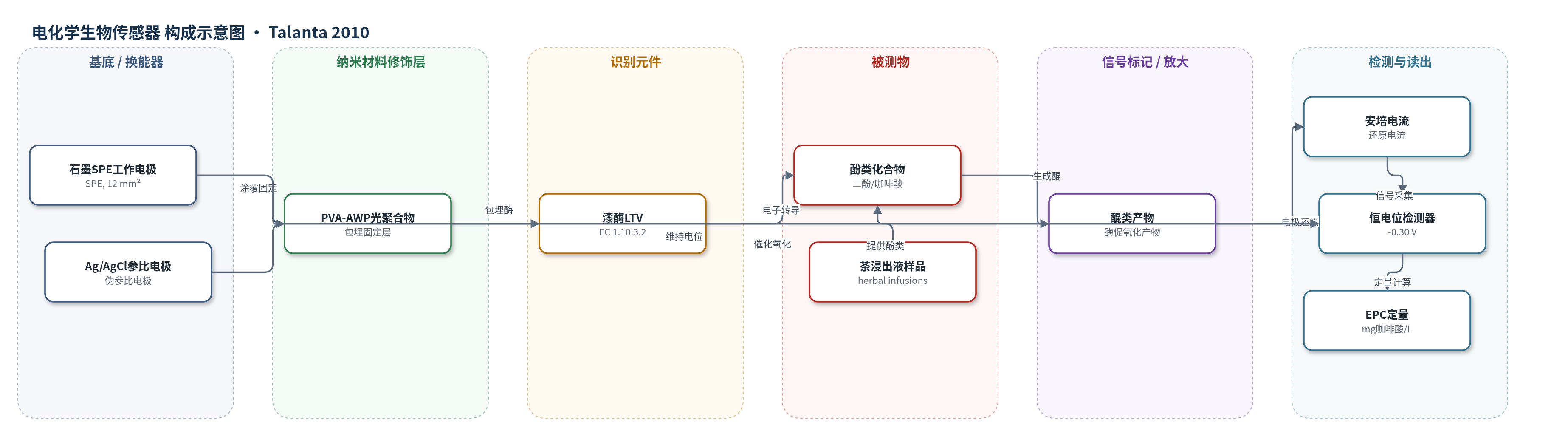
点击图片查看大图 · 依据论文自动绘制
传感器类型
电化学生物传感器
检测对象
酚类化合物(phenolic compounds):邻二酚(catechol, o-diphenol)、间二酚(resorcinol, m-diphenol)、对二酚/氢醌(hydroquinone, p-diphenol)、咖啡酸(caffeic acid);样品基质:茶/草本浸出液(tea/herbal infusions)及缓冲液标准溶液。
检测原理
该传感器以漆酶为识别元件,酚类化合物(邻/间/对二酚、咖啡酸)扩散进入PVA-AWP膜后被漆酶催化氧化,生成醌类或自由基物种。醌类产物进一步扩散至石墨SPE工作电极表面,在恒电位-0.30 V下发生电化学还原,产生与底物浓度成正比的还原电流。检测在0.1 M醋酸缓冲液(pH 4.7)、30°C下进行,酶促氧化与电极还原共同决定安培信号;底物浓度越高,生成的可还原醌类越多,电流响应越大。该过程无需外加电子供体或化学放大,主要依赖漆酶催化和醌类直接电子转导。
检测灵敏度
咖啡酸: LOD 0.524 μM;线性范围 0.5–130 μM;灵敏度 24.91 ± 0.42 nA μM−1;R^2 = 0.9991;邻二酚: LOD 0.558 μM;线性范围 0.5–175 μM;灵敏度 18.83 ± 0.76 nA μM−1;R^2 = 0.9951;氢醌: LOD 1.071 μM;线性范围 1.1–130 μM;灵敏度 9.44 ± 0.19 nA μM−1;R^2 = 0.9988;间二酚: LOD 35.432 μM;线性范围 50–250 μM;灵敏度 0.110 ± 0.002 nA μM−1;R^2 = 0.9989
效应效果
传感器对邻、间、对二酚及咖啡酸响应良好,等摩尔邻二酚/氢醌混合灵敏度约11 nA μM−1,可耐受混合物。50 μM邻二酚重复RSD为2.73%;4°C干燥储存一年后保持约60%信号,寿命>6个月。茶浸出液直接进样,响应<30 s。与Folin–Ciocalteu法相比,7种草本EPC较低(Palo azul 109.2对297.5 mg咖啡酸/L),因酶只氧化二酚。作者认为其简单、样品处理少、响应快,适合快速监测茶多酚。
传感器的构成
- 基底/换能器电极:石墨丝网印刷电极(SPE),三电极配置,工作电极面积12 mm²,提供电子转导与安培检测
- 参比/对电极:Ag/AgCl伪参比电极与印刷对电极,维持恒电位与电流回路
- 修饰/固定层:聚乙烯醇光聚合物PVA-AWP(含叠氮基团侧链水溶性光聚合物),包埋酶并允许底物与醌类扩散
- 识别元件:云芝漆酶(LTV,EC 1.10.3.2),催化邻/间/对二酚及咖啡酸氧化
- 信号中间体:酶促生成的醌类/自由基物种,在工作电极负电位下还原产生电流
- 检测介质:0.1 M醋酸缓冲液(pH 4.7,30°C),维持酶活性与离子环境
- 读出装置:恒电位安培检测(-0.30 V),LC-4C/BAS安培检测器记录电流
中文摘要
本文报道了一种基于云芝漆酶(LTV)的安培生物传感器,用于监测茶浸出液中酚类化合物含量。该真菌酶通过包埋于含叠氮基团侧链的水溶性聚乙烯醇光聚合物PVA-AWP中,固定于一次性石墨丝网印刷电极(SPE)的工作电极表面。作者对pH、温度和应用电位进行了优化,并测定了线性范围、检出限、操作稳定性与储存稳定性。在0.1 M醋酸缓冲液(pH 4.7)中传感器响应最高,且具有良好的重现性和操作稳定性,估计使用寿命大于6个月。LTV-SPE对邻二酚、间二酚、对二酚及咖啡酸进行了校准,并用于直接测定茶浸出液的等效酚含量(EPC)。与Folin–Ciocalteu分光光度法相比,该安培方法具有操作简便、样品处理少、响应时间短等优点,可快速评估天然提取物中与抗氧化能力相关的酚类含量。
英文摘要
An amperometric biosensor based on laccase, from Trametes versicolor (LTV), was developed and optimized for monitoring the phenolic compounds content in tea infusions. The fungal enzyme was immobilized by entrapment within polyvinyl alcohol photopolymer PVA-AWP (azide-unit pendant water-soluble photopolymer) onto disposable graphite screen-printed electrodes (SPE). Sensitivity optimization in terms of pH, temperature and applied potential was carried out. The linear range, detection limit, operational and storage stabilities were also determined. The laccase biosensor (LTV-SPE) was calibrated for o-, m- and p-diphenol as well as caffeic acid. The highest response was found at 0.1M acetate buffer pH 4.7, though it must be added the good reproducibility and operational stability were also obtained. The useful lifetime of the biosensor is estimated to be greater than 6 months. LTV-SPE was used for the determination of the equivalent phenol content (EPC) in tea infusions by the direct addition into the electrochemical cell: the results were compared with those from the Folin-Ciocalteu spectrophotometric method. The amperometric detection exhibits some interesting advantages such as high simplicity, minimal sample preparation and shorter response time. A stable and sensitive amperometric response was obtained toward standard diphenolic compounds and herbal infusions. These biosensors are useful for easy and fast monitoring of EPC that can be related to the antioxidant capacity of natural extracts.