组成图示
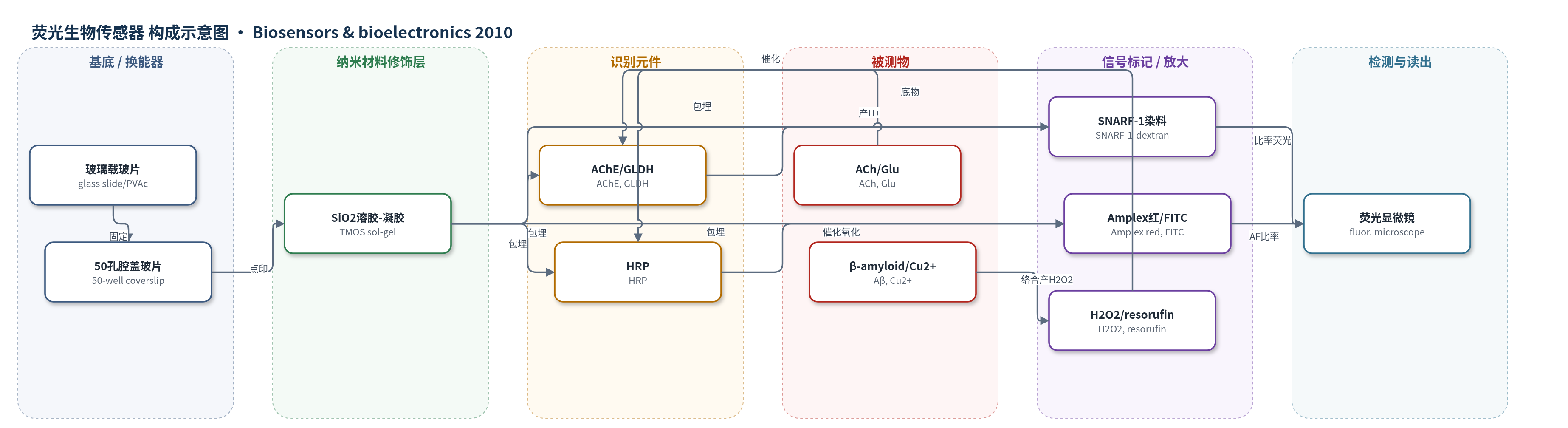
点击图片查看大图 · 依据论文自动绘制
传感器类型
荧光生物传感器
检测对象
β-淀粉样蛋白(β-amyloid/Aβ)、乙酰胆碱(acetylcholine, ACh)、谷氨酸(glutamate, Glu)、过氧化氢(H2O2);样品基质为缓冲液及加标人血清(5倍稀释)。
检测原理
传感器采用双通道比率荧光机制。ACh和Glu分别被AChE和GLDH催化水解/氧化,产生H+使局部pH下降;pH敏感染料carboxy SNARF-1-dextran的酸式与碱式分别在580–590 nm和630–640 nm发射,I640/I580随pH变化,从而反映ACh/Glu浓度。β-amyloid与Cu2+络合并生成H2O2,HRP催化H2O2将Amplex red氧化为resorufin,在590 nm产生强荧光;FITC-dextran作为pH内参校正斑点尺寸,Amplex red/FITC-dextran(AF)比率随H2O2/β-amyloid浓度升高而增大。
检测灵敏度
LOD: H2O2 1.57 nM;β-amyloid 0.63 nM(摘要)/2.5 ng/mL(缓冲液)/2.3 ng/mL(人血清);Glu 0.55 μM(摘要)/0.53 μM(缓冲液)/4.5 μM(人血清);ACh 1.0 μM(摘要)/1.02 μM(人血清)/0.30 μM(缓冲液)。线性范围: β-amyloid 0.01–100 μg/mL(缓冲液,r^2=0.982;人血清,r^2=0.993,斜率1.63/0.95);H2O2 0.1–10,000 μM;ACh 5–9000 μM(人血清,r^2=0.995)/3个数量级(缓冲液);Glu 100–10,000 μM(人血清,r^2=0.988)/2–3个数量级。RSD: β-amyloid 8.5%;ACh 2.5%;Glu 5%。
效应效果
该阵列可同步检测多分析物,ACh/Glu对β-amyloid无明显抑制;ACh在高浓度下因水解产H+对Glu检测产生负交叉。金属离子中Mn2+低于10 μM影响小,10–100 μM使信号下降20–30%;Zn2+干扰更强,0.01–1 μM使信号降至70–80%,10–100 μM降至57–60%。加标人血清中β-amyloid线性范围0.01–100 μg/mL,r^2=0.993,LOD 2.3 ng/mL,斜率1.63(缓冲液0.95);ACh 5–9000 μM,r^2=0.995;Glu 100–10,000 μM,r^2=0.988。响应时间20 min,动态范围4–5个数量级,较LSPR免疫芯片更易制备、低成本且快速。
传感器的构成
- 基底/反应腔:玻璃载玻片(glass microscope slide)经K2Cr2O7/H2SO4清洗,涂覆5% PVAc(聚醋酸乙烯酯)增强附着,并固定50孔腔盖玻片(50-well chambered coverslip)形成独立反应腔。
- 溶胶-凝胶基质:TMOS(四甲基硅氧烷)在1 mM HCl酸催化下形成SiO2溶胶-凝胶多孔膜,包埋酶与荧光染料并维持酶活性。
- 酶识别/催化元件:AChE(乙酰胆碱酯酶)水解ACh产H+;GLDH(谷氨酸脱氢酶)催化Glu产H+;HRP(辣根过氧化物酶)催化H2O2氧化Amplex red。
- pH荧光指示剂:carboxy SNARF-1-dextran(羧基SNARF-1-葡聚糖)用于ACh/Glu的pH比率荧光(I640/I580)。
- 信号标记/内参染料:Amplex red(Amplex红)被HRP/H2O2氧化为resorufin产生590 nm荧光;FITC-dextran(FITC-葡聚糖)作为pH内参校正斑点尺寸,形成AF ratio。
- 辅助稳定剂:PVA(聚乙烯醇)和甘油(glycerol)加入溶胶-凝胶混合物,保持酶活性并稳定凝胶。
- 金属离子辅助:Cu2+与β-amyloid络合并促进H2O2生成,增强β-amyloid检测。
中文摘要
本研究制备了一种基于溶胶-凝胶的光学阵列生物传感器,用于同时分析阿尔茨海默病(AD)潜在生物标志物。以β-淀粉样蛋白、乙酰胆碱和谷氨酸为传感探针。将荧光染料羧基SNARF-1-葡聚糖分别与谷氨酸脱氢酶和乙酰胆碱酯酶共包埋,用于检测谷氨酸和乙酰胆碱;将Amplex红和FITC-葡聚糖与辣根过氧化物酶共包埋,用于检测β-淀粉样蛋白和过氧化氢。该传感器可同时分析多分析物且无明显交叉干扰,H2O2、β-淀粉样蛋白、谷氨酸和乙酰胆碱的检出限分别为1.57 nM、0.63 nM、0.55 μM和1.0 μM。所开发阵列传感器还用于检测加标人血清中的多分析物,β-淀粉样蛋白动态范围达4个数量级,表明其可用于AD相关多分析物的同时分析。
英文摘要
The sol-gel-derived optical array-based biosensor for the simultaneous analysis of multiple analytes as potential markers for Alzheimer's disease was fabricated. beta-Amyloid, acetylcholine and glutamate were selected as the biosensing probes. The fluorescent dye, carboxy SNARF-1-dextran, was co-immobilized with glutamate dehydrogenase and acetylcholinesterase for sensing glutamate and acetylcholine, respectively, while Amplex red and FITC-dextran were immobilized with horseradish peroxidase for determination of beta-amyloid and hydrogen peroxide (H(2)O(2)). The biosensors exhibited a good performance on simultaneous analysis of multianalytes without obvious cross-interference and the detection limits of H(2)O(2), beta-amyloid, glutamate and acetylcholine were 1.57 nM, 0.63 nM, 0.55 microM, and 1.0 microM, respectively. The developed array biosensors were also applied to determine multianalytes in human serum samples spiked with various concentrations of analytes and showed a good analytical performance with dynamic range of 4 orders of magnitude for beta-amyloid. Results obtained in this study clearly demonstrate the possibility of using a sol-gel-derived optical array-based biosensor for simultaneous analysis of multiple samples in the presence of important analytes for Alzheimer's disease.