组成图示
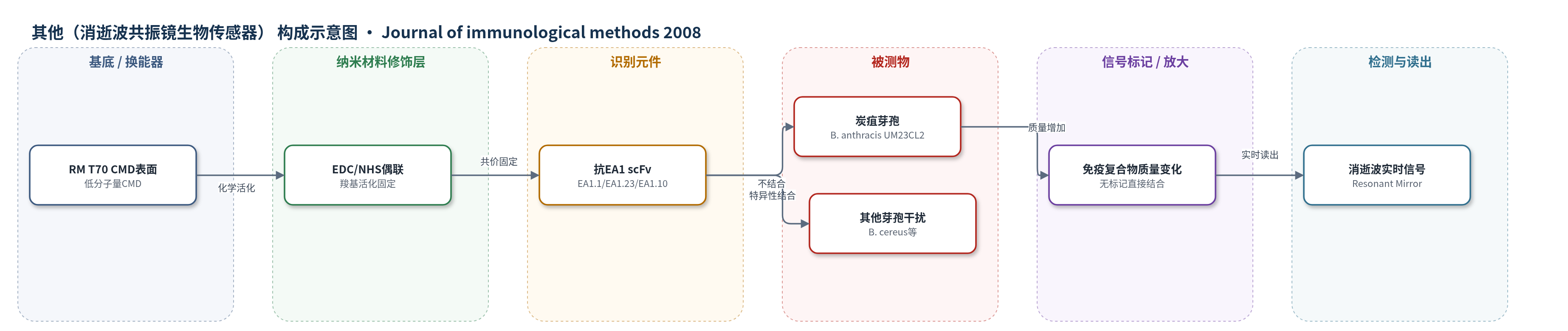
点击图片查看大图 · 依据论文自动绘制
传感器类型
其他(消逝波共振镜生物传感器)
检测对象
炭疽芽孢(Bacillus anthracis spores,UM23CL2);样品基质为PBS 0.05% Tween 20中的完整或超声裂解芽孢悬液,另以其他芽孢杆菌芽孢作为干扰对照。
检测原理
抗EA1 scFv通过EDC/NHS化学偶联固定于Resonant Mirror的CMD表面。当样品中的炭疽芽孢流过传感器表面时,芽孢表面或外膜中的EA1抗原与固定化scFv发生特异性免疫结合。结合事件使传感器表面质量/折射率发生变化,消逝波共振镜据此产生实时信号。信号强度随芽孢浓度增加而增大;完整芽孢因表面抗原可及性较低,信号弱于超声裂解芽孢,后者释放更多EA1表位,提高结合量。该检测为无标记直接免疫结合,未使用酶、荧光或化学发光放大;表面可用20 mM KOH再生。竞争筛选获得的scFv仅识别炭疽杆菌EA1,因此可排除其他芽孢杆菌干扰。
检测灵敏度
原文未报告LOD、线性范围、灵敏度斜率或R^2。
效应效果
竞争筛选从免疫scFv库中快速获得6个独特抗EA1 scFv,ELISA和BIAcore显示其对多种芽孢杆菌S层蛋白无交叉反应;Western blot中仅EA1.20和EA10.4对B. pumilus有极低交叉反应,且未在ELISA、Resonant Mirror或BIAcore中观察到。BIAcore动力学分析显示这些scFv对EA1具有表观纳摩尔亲和力,最高KA为5.85E+10 M^-1(EA1.1)。在Resonant Mirror上,scFv可实时检测完整炭疽UM23CL2芽孢,超声裂解后信号显著增强;对照抗EA1单克隆抗体不能检测完整芽孢,仅超声后有少量结合,并对超声B. cereus 11145芽孢产生检测。scFv对其他芽孢杆菌完整或超声芽孢均无交叉反应,表明该方法具有高特异性和低假阳性,适用于生物威胁因子实时检测。
传感器的构成
- 基底/换能器:Resonant Mirror T70低分子量羧甲基葡聚糖(CMD)比色皿表面,提供消逝波换能界面和羧基固定位点
- 化学偶联层:EDC/NHS活化CMD表面羧基,实现抗体共价固定(原文未列具体活化剂品牌)
- 识别元件:竞争筛选抗EA1单链抗体scFv(EA1.1、EA1.23、EA1.10)或对照抗EA1单克隆抗体mAb,特异性识别炭疽杆菌EA1
- 被测物:Bacillus anthracis UM23CL2芽孢(完整或超声裂解),提供EA1抗原
- 信号标记物:无外源标记物,直接免疫结合引起表面质量/折射率变化
- 再生剂:20 mM KOH,用于结合后表面再生
- 读出装置:Resonant Mirror消逝波生物传感器,实时监测表面结合信号
中文摘要
本文报道了一种用于快速、特异性检测炭疽芽孢的生物识别元件制备策略。作者以炭疽杆菌表面层蛋白EA1为靶标,从免疫小鼠脾细胞构建单链抗体(scFv)库,并采用标准非竞争生物筛选和竞争生物筛选两种方法筛选抗EA1 scFv。非竞争筛选获得的scFv虽能识别炭疽杆菌EA1,但与其他芽孢杆菌属物种的S层蛋白存在交叉反应。竞争筛选则利用其他芽孢杆菌S层蛋白进行负向选择,获得对炭疽杆菌EA1高度特异、表观亲和力达纳摩尔级的scFv。随后,将这些scFv固定于消逝波生物传感器Resonant Mirror表面,实现了对完整炭疽芽孢的实时、特异性检测,且未观察到对其他芽孢杆菌的假阳性。该方法展示了重组抗体技术在生物威胁因子检测中的优势。
英文摘要
We describe a targeted approach for the production of biological recognition elements capable of fast, specific detection of anthrax spores on biosensor surfaces. The aim was to produce single chain antibodies (scFvs) to EA1, a Bacillus anthracis S-layer protein that is also present, although not identical, in related to Bacillus species. The aim of the work was to produce antibodies that would detect B. anthracis EA1 protein and intact spores with a high degree of specificity, but would not detect other Bacillus species. Existing monoclonal antibodies were evaluated and found to recognise B. anthracis EA1 and S-layer proteins from other closely related Bacillus species. Recombinant anti-EA1 scFvs were isolated from B. anthracis immune library that contained antibody genes raised against B. anthracis spores and purified exosporium. Two approaches for scFv selection were used; standard (non-competitive) panning, and competitive panning. The non-competitive biopanning strategy isolated scFvs that recognised EA1 from B. anthracis, but also cross-reacted with other Bacillus species. In contrast, the competitive panning approach used S-layer proteins from other Bacillus species to generate scFvs that were highly specific to B. anthracis EA1 and demonstrated apparent nanomolar binding affinities. Specific, real time detection of B. anthracis spores was demonstrated with these scFvs using an evanescent wave biosensor, the Resonant Mirror. The approach described can be used to generate specific antibodies to any desired target where homologous proteins also exist in closely related species, and demonstrates clear advantages to using recombinant technology to produce biological recognition elements for detection of biological threat agents.