组成图示
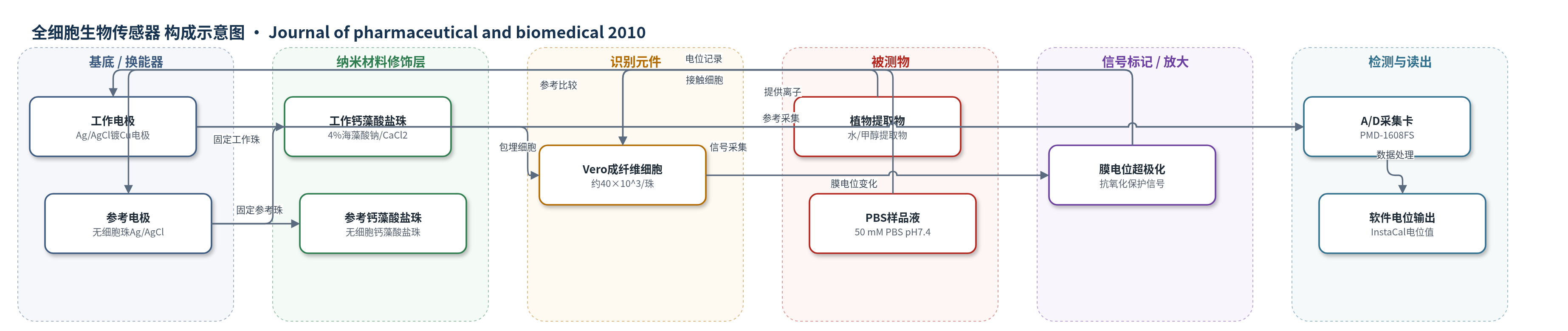
点击图片查看大图 · 依据论文自动绘制
传感器类型
全细胞生物传感器
检测对象
四种斯洛文尼亚药用植物提取物(鼠尾草 Salvia officinalis、蓍草 Achillea millefolium、牛至 Origanum vulgare subsp. vulgare、黄龙胆 Gentiana lutea)的抗氧化活性;样品基质:水提取物、甲醇提取物(以50 mM PBS稀释)
检测原理
该传感器以固定化 Vero 成纤维细胞为生物识别元件。细胞包埋于钙藻酸盐珠中时存在氧化应激,膜脂质氧化和钙离子通量改变会影响膜电位。当样品中的植物抗氧化物接触细胞时,可减轻膜氧化损伤、改善膜完整性,并改变跨膜离子通量,使细胞膜发生超极化。工作 Ag/AgCl 电极与无细胞参考电极之间的电位差随膜电位变化而改变,PMD-1608FS A/D 卡记录 0–180 s 内最大电位变化或稳定电位。校准显示 K+ 20–144 mM 引起线性超极化,BHA 0.1 和 1 mM 分别使响应增加 21 和 41 mV,因此电位变化可反映抗氧化活性强弱。
检测灵敏度
LOD: 未报告;线性范围: 20–144 mM K+(校准);BHA: 0.1 mM 增加21 mV,1 mM 增加41 mV;R^2: 未报告
效应效果
该细胞生物传感器检测时间约 3 min,每个样品用 5 个传感器测试,实验重复 4 次,结果以标准误差表示。与 DPPH 比色法相比,两种方法无绝对相关性:水提取物中蓍草和鼠尾草叶的 DPPH 清除活性最高,而生物传感器法中鼠尾草叶活性明显高于其他叶提取物;甲醇提取物中牛至、蓍草和鼠尾草的 DPPH 清除活性相近且最高。无论方法如何,黄龙胆根提取物活性最低。作者认为该传感器受提取物光学性质干扰小、样品用量少,可作为快速、高通量、可重复筛选植物源抗氧化物的工具,但选择性仍需进一步验证。
传感器的构成
- 工作电极:80% Cu 电化学镀 Ag/AgCl 电极(直径 0.75 mm),用于记录细胞膜电位变化
- 参考电极:无细胞钙藻酸盐珠连接的 Ag/AgCl 电极,作为电位参考
- 固定化基质:4% (w/v) 海藻酸钠(sodium alginate)与 0.8 M CaCl2 交联形成钙藻酸盐珠(calcium alginate beads)
- 生物识别元件:Vero 成纤维细胞(Vero fibroblast cells),约 40×10^3 个/珠,作为全细胞识别元件
- 样品介质:50 mM PBS(pH 7.4)稀释植物提取物,提供离子环境
- 信号读出:PMD-1608FS A/D 卡与 InstaCal 软件,记录 0–180 s 电位变化
中文摘要
本研究评估了四种斯洛文尼亚药用植物(鼠尾草 Salvia officinalis、蓍草 Achillea millefolium、牛至 Origanum vulgare subsp. vulgare 和黄龙胆 Gentiana lutea)的甲醇提取物与水提取物的抗氧化活性。采用分光光度法测定其对 DPPH· 自由基的清除能力,并利用实验室自制的全细胞生物传感器评价其生物活性;该传感器基于固定化 Vero 成纤维细胞,检测时间约 3 min。结果显示,提取物抗氧化活性同时受提取溶剂和检测方法影响;无论采用何种方法,黄龙胆根提取物的清除活性最低。植物提取物处理固定化细胞后,细胞膜电位升高,表现为膜超极化,可能源于氧化导致的膜损伤减少。该新型细胞生物传感器可用作快速、高通量筛选植物源化合物抗氧化特性的工具。
英文摘要
We investigated the antioxidant activity of methanolic and water extracts of Slovene accessions of four medicinal plant species (Salvia officinalis, Achillea millefolium, Origanum vulgare subsp. vulgare and Gentiana lutea). Their free radical-scavenging activity against the DPPH. free radical was studied with a spectrophotometric assay, while their biological activity with the help of a laboratory-made biosensor based on immobilized fibroblast cells (assay duration: 3 min). The observed antioxidant activity of the extracts from the four investigated medicinal plant species was dependent on both the solvent used for extraction and the assay method (conventional or biosensor-based). Independently from the assay method and the solvent used for extraction, the lowest scavenging activity was observed in root extracts of G. lutea. Treatment of the immobilized cells with the plant extracts resulted in an increase of the cell membrane potential (membrane hyperpolarization), possibly due to the reduction of membrane damage due to oxidation. The novel cell biosensor could be utilized as a rapid, high throughput tool for screening the antioxidant properties of plant-derived compounds.