组成图示
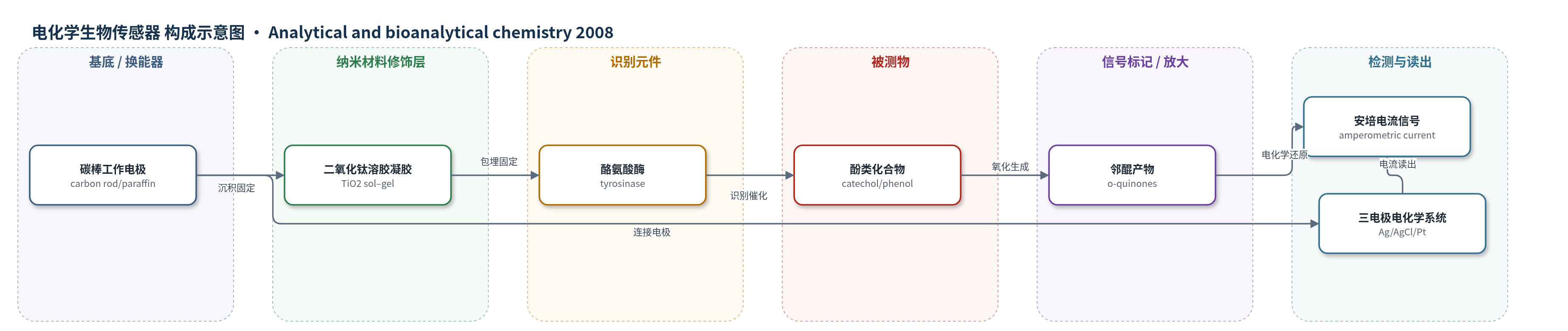
点击图片查看大图 · 依据论文自动绘制
传感器类型
电化学生物传感器
检测对象
儿茶酚(catechol)、对甲酚(p-cresol)、苯酚(phenol)、对氯苯酚(p-chlorophenol)、对甲基儿茶酚(p-methylcatechol);样品基质:环境水样(泉水、地表水/河水)
检测原理
该传感器以碳棒为工作电极,将酪氨酸酶包埋于二氧化钛溶胶-凝胶中。酚类化合物扩散进入凝胶层,被酪氨酸酶催化氧化:单酚在分子氧作用下转化为邻苯二酚,并进一步氧化为邻醌。生成的邻醌在碳电极表面发生电化学还原,产生与还原速率成正比的安培电流。在pH 6、0 mV(vs Ag/AgCl)、25 °C条件下,稳态电流与酚浓度呈对数线性关系(log I = a + b log C)。由于酶催化将酚转化为可电化学还原的醌,信号随被测物浓度升高而增大;低电位工作可抑制背景氧化并降低干扰。
检测灵敏度
儿茶酚(catechol):LOD: 9×10⁻⁸ mol L−1;线性范围: 2.2×10⁻⁷–1.3×10⁻⁵ mol L−1;灵敏度: 2.0×10^3 mA mol−1 L(7.1×10^3 mA mol−1 L cm−2)。苯酚(phenol):LOD: 1.3×10⁻⁷ mol L−1;线性范围: 4.4×10⁻⁷–1.1×10⁻⁵ mol L−1;灵敏度: 1.4×10^3 mA mol−1 L。对甲酚(p-cresol):LOD: 1.4×10⁻⁷ mol L−1;线性范围: 2.2×10⁻⁷–7.7×10⁻⁶ mol L−1;灵敏度: 1.3×10^3 mA mol−1 L。对氯苯酚(p-chlorophenol):LOD: 1.7×10⁻⁷ mol L−1;线性范围: 2.2×10⁻⁷–1.3×10⁻⁵ mol L−1;灵敏度: 1.1×10^3 mA mol−1 L。对甲基儿茶酚(p-methylcatechol):LOD: 3.2×10⁻⁷ mol L−1;线性范围: 4.4×10⁻⁷–1.2×10⁻⁵ mol L−1;灵敏度: 5.7×10^2 mA mol−1 L。
效应效果
传感器重现性良好:5个电极在6.7×10⁻⁷ mol L−1儿茶酚中RSD为0.3%、0.5%、1.4%、1.5%、2.4%,不同批次电极RSD为3.2%。操作稳定性方面,连续10次测量保留100%初始响应,20次后保留90%;4 °C储存7天保留75%,2周后55%。Plackett–Burman实验表明,Mg2+和Ca2+不直接影响响应,而HCO3−、SO4^2−、Cl−和Cu2+产生显著干扰。采用标准加入法测定泉水和地表水加标儿茶酚,回收率分别为105.6%–116.1%和106.6%–124.1%。与文献中其他酪氨酸酶传感器相比,该传感器灵敏度和检出限更优,但储存稳定性较差,适用于环境水样中低浓度酚类监测。
传感器的构成
- 工作电极基底:碳棒(carbon rod)经石蜡(paraffin)浸渍绝缘,不锈钢丝导电,提供电子转导界面
- 二氧化钛溶胶-凝胶固定层:由钛酸四异丙酯(titanium isopropoxide)水解缩合形成的TiO2 sol–gel,包埋并稳定酶
- 识别元件:酪氨酸酶(tyrosinase, E.C. 1.14.18.1),催化酚类氧化生成邻醌
- 信号产物:邻醌(o-quinones),由酶催化生成并在碳电极上还原产生电流
- 电化学辅助电极:Ag/AgCl(3 mol L−1 KCl)参比电极与铂丝(Pt wire)对电极,构成三电极测量系统
- 检测介质:0.1 mol L−1磷酸盐缓冲液(phosphate buffer, pH 6),维持稳定pH与离子强度
中文摘要
为检测环境水样中的酚类化合物,本文提出一种基于固定在二氧化钛溶胶-凝胶中的酪氨酸酶的安培生物传感器。测定了该传感器对儿茶酚、对甲酚、苯酚、对氯苯酚和对甲基儿茶酚的分析特性。儿茶酚的线性范围为2.2×10⁻⁷–1.3×10⁻⁵ mol L−1,检出限为9×10⁻⁸ mol L−1,灵敏度为2.0×10^3 mA mol−1 L。按照Plackett–Burman实验设计研究了水样基质成分对电极响应的影响,考察了水中常见的Mg2+、Ca2+、HCO3−、SO4^2−和Cl−等潜在干扰离子;由于CuSO4有时作为防腐剂加入水样,也考察了Cu2+。结果表明,在所测离子中只有Mg2+和Ca2+不直接影响电极响应。该生物传感器采用标准加入法用于泉水和地表水中儿茶酚的测定。
英文摘要
For detection of phenolic compounds in environmental water samples we propose an amperometric biosensor based on tyrosinase immobilized in titania sol-gel. The analytical characteristics toward catechol, p-cresol, phenol, p-chlorophenol, and p-methylcatechol were determined. The linear range for catechol determination was 2.2 x 10(-7)-1.3 x 10(-5) mol L(-1) with a limit of detection of 9 x 10(-8) mol L(-1) and sensitivity 2.0 x 10(3) mA mol(-1) L. The influence of sample matrix components on the electrode response was studied according to Plackett-Burman experimental design. The potential interferents Mg(2+), Ca(2+), HCO3(-), SO4(2-), and Cl(-), which are usually encountered in waters, were taken into account in the examination. Cu(2+) was also taken into account, because CuSO(4) is sometimes added to a water sample, as a preservative, before determination of phenolic compounds. It was found that among the ions tested only Mg(2+) and Ca(2+) did not directly affect the electrode response. The developed biosensor was used for determination of catechol in spring and surface water samples using the standard addition method.