组成图示
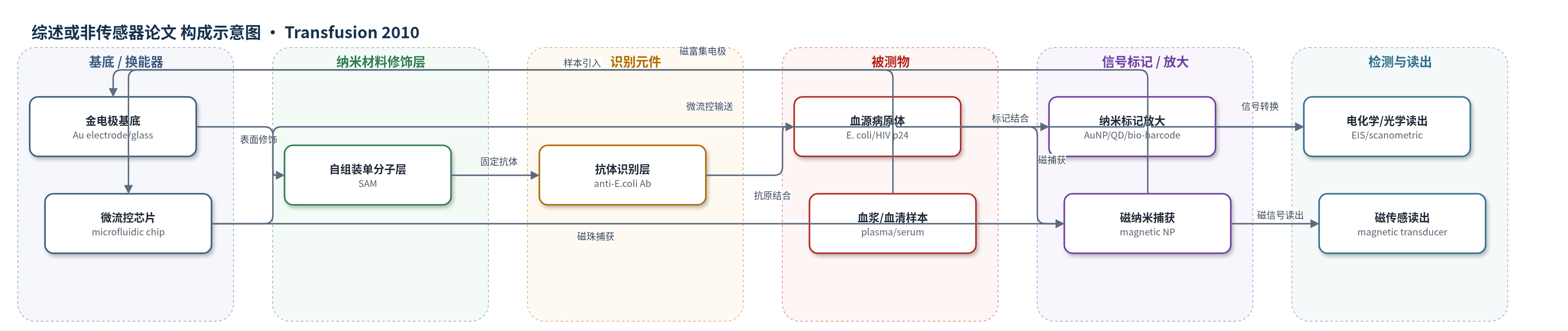
点击图片查看大图 · 依据论文自动绘制
传感器类型
综述或非传感器论文
检测对象
血源传播病原体(HIV、HBV、HCV、西尼罗河病毒、基孔肯雅热病毒、疟原虫、克氏锥虫、朊病毒)及细菌/抗原(E. coli、S. aureus、B. anthracis、B. subtilis、Yersinia pestis、Salmonella enterica、HIV p24、登革病毒抗体、PSA);样品基质:全血、血浆、血清、人工加标血、培养物。
检测原理
综述概括多种传感检测原理:生物识别元件(抗体、DNA探针、核酸适配体或酶)固定在换能器表面,与血样中的病原体、抗原或核酸结合后,引起界面质量、电荷、光学性质或磁性质变化。SPR通过共振角变化反映结合质量;电化学阻抗/电导通过界面阻抗或电导变化反映抗原抗体结合;荧光/比色体系利用量子点、金纳米颗粒或银增强产生光信号;磁纳米标签通过磁场变化被磁换能器检测。信号放大主要依靠纳米材料:金纳米颗粒银增强、量子点荧光、生物条形码DNA标签释放后扫描检测、磁纳米颗粒富集目标。被测物浓度越高,结合事件越多,界面变化或标记物数量越大,输出信号越强。
检测灵敏度
综述报道多类方法:E. coli 电导免疫传感器 LOD: 1 CFU/mL;E. coli 电化学阻抗线性范围: 10–10^3 CFU/mL(SPR 对照灵敏度: 10^7 CFU/mL);生物条形码 DNA LOD: 550 zmol/L(B. anthracis)、2.5 fmol/L(B. subtilis)、0.5 pmol/L(HBV/HIV/Ebola/variola)、5 pmol/L(毛细管);HIV p24 LOD: 4 fmol/L,线性范围: 4.2 fmol/L–420 pmol/L;金纳米颗粒比色 LOD: 10^-15 mol/L(20,000 copies/mL);微流控 PSA LOD: 0.5 fmol/L;Salmonella 电化学 DNA LOD: <10 amol/L;磁纳米标签动态范围: over 6 orders of magnitude。
效应效果
文中比较显示,电化学阻抗法检测E. coli在10–10^3 CFU/mL呈线性,优于SPR的10^7 CFU/mL;电导免疫传感器达1 CFU/mL且结合特异性良好。生物条形码法检测HIV p24比ELISA敏感约150倍,可提前约3天发现血清转换;在112份感染血浆中灵敏度100%、特异性99%,检测范围4.2 fmol/L–420 pmol/L。磁纳米标签平台可64通道多重检测,灵敏度较ELISA提高约1000倍,动态范围超过6个数量级。微流控生物条形码检测PSA达0.5 fmol/L,较商品ELISA高约4个数量级;登革微流控系统用100 μL血清30 min完成。作者认为微纳集成第二代系统有望用于血源病原体多重筛查。
传感器的构成
- 基底/换能器:金电极或玻璃金膜,用于电化学阻抗、电导或SPR信号换能
- 修饰层:自组装单分子层(SAM)、磁纳米颗粒(magnetic NP)或微流控通道,用于固定识别元件或富集目标
- 识别元件:抗E. coli抗体、抗HIV p24抗体、DNA寡核苷酸探针,用于特异性识别病原体或核酸
- 信号标记:金纳米颗粒(AuNP)、量子点(QD)、生物条形码DNA标签,用于光学、电化学或磁信号放大
- 读出系统:电化学阻抗/电导仪、扫描光学系统、磁换能器、微流控芯片,用于信号转换与检测
中文摘要
与血源传播病原体相关的输血安全是重大公共卫生问题,尤其面对新发和再发感染病原体的持续出现,包括西尼罗河病毒、基孔肯雅热病毒等新病毒,疟原虫、克氏锥虫等新菌株/虫株,以及致病朊病毒蛋白(变异型克雅病)。已知病毒(乙型肝炎病毒、丙型肝炎病毒、人类免疫缺陷病毒)的基因组突变也可能产生可逃避诊断检测的变异株。因此,需要能够同时检测多种血源传播病原体的新技术,以发展和改进筛查策略。DNA微阵列已在免疫血液学实验室用于血型基因分型,但其在感染病原体检测中的应用受到额外技术障碍限制,例如目标基因组之间的变异和基因组内变异使目标扩增和多重分析复杂化。基于替代检测策略的生物传感器技术进步为病原体检测提供了新视角,但其是否适用于生物体液诊断应用仍有争议。当前纳米技术也为改善样品制备、目标捕获和检测步骤提供了新工具。结合微技术与纳米技术的第二代装置,使开发可用于血液传播病原体筛查的创新性多重检测方案更接近现实。
英文摘要
Transfusion safety relating to blood-transmissible agents is a major public health concern, particularly when faced with the continuing emergence of new infectious agents. These include new viruses appearing alongside other known reemerging viruses (West Nile virus, Chikungunya) as well as new strains of bacteria and parasites (Plasmodium falciparum, Trypanosoma cruzi) and finally pathologic prion protein (variant Creutzfeldt-Jakob disease). Genomic mutations of known viruses (hepatitis B virus, hepatitis C virus, human immunodeficiency virus) can also be at the origin of variants susceptible to escaping detection by diagnostic tests. New technologies that would allow the simultaneous detection of several blood-transmissible agents are now needed for the development and improvement of screening strategies. DNA microarrays have been developed for use in immunohematology laboratories for blood group genotyping. Their application in the detection of infectious agents, however, has been hindered by additional technological hurdles. For instance, the variability among and within genomes of interest complicate target amplification and multiplex analysis. Advances in biosensor technologies based on alternative detection strategies have offered new perspectives on pathogen detection; however, whether they are adaptable to diagnostic applications testing biologic fluids is under debate. Elsewhere, current nanotechnologies now offer new tools to improve the sample preparation, target capture, and detection steps. Second-generation devices combining micro- and nanotechnologies have brought us one step closer to the potential development of innovative and multiplexed approaches applicable to the screening of blood for transmissible agents.