组成图示
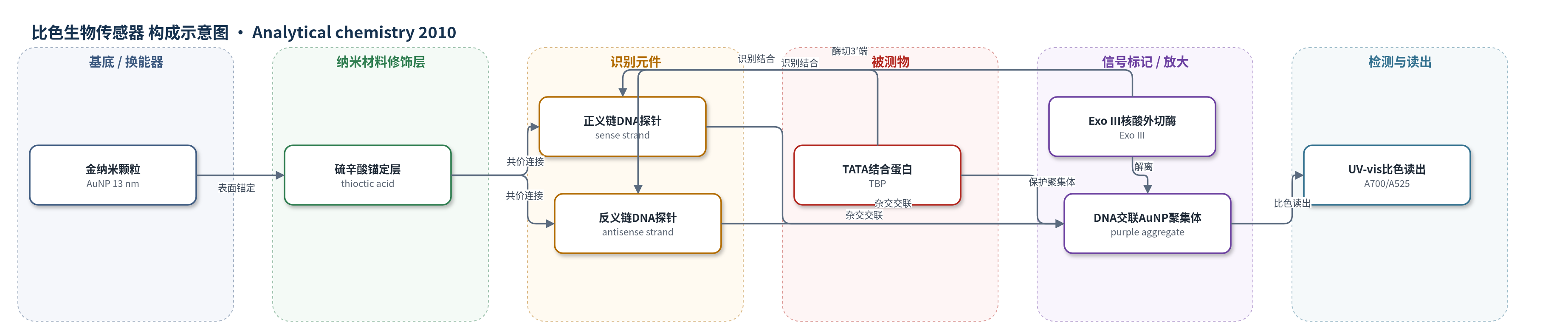
点击图片查看大图 · 依据论文自动绘制
传感器类型
比色生物传感器
检测对象
TATA结合蛋白(TATA binding protein, TBP);样品基质:蛋白溶液/细胞裂解液
检测原理
传感器以AuNP表面等离子体颜色为换能信号。硫辛酸将含TATA位点的正义链和互补反义链稳定连接在AuNP上,杂交形成DNA交联AuNP聚集体,溶液呈紫红色。加入Exo III后,未结合蛋白的双链DNA从反义链3′凹陷端被逐步消化,交联断裂,聚集体解离为分散AuNP,吸收峰由约550 nm蓝移至约525 nm,溶液由紫变红。当TBP结合TATAAAG序列时,蛋白-DNA复合物产生空间位阻,阻止Exo III接近3′末端,聚集体稳定保持紫红色。TBP浓度越高,被保护的聚集体越多,A700/A525比值越大,从而实现比色定量。
检测灵敏度
LOD: 10 nM(约0.3 µg mL-1);线性范围: 0–120 nM
效应效果
该传感器对TBP具有序列特异性:TATA位点突变序列不能保护聚集体,非同源蛋白BSA、甲基转移酶M.HhaI和p53蛋白均不引起保护,也不干扰TBP结合。与基于Exo III保护的荧光法相比,AuNP网络中蛋白结合提供稳定、长时间保护,吸收信号在1 h内基本不变,无需时间依赖监测,技术稳健性更高。定量检测中,A700/A525与TBP浓度在0–120 nM呈准线性关系,LOD 10 nM(约0.3 µg/mL),优于或相当现有均相荧光法。同批四次重复RSD约4.3%,不同批四次RSD约5.4%。作者认为该方法可用于细胞裂解液中多种序列特异性DNA结合蛋白及其DNA结合活性的快速筛查。
传感器的构成
- 基底/换能器:柠檬酸包覆金纳米颗粒(citrate-capped AuNP,13±2 nm),提供距离依赖表面等离子体颜色信号。
- 表面锚定层:硫辛酸(thioctic acid)环二硫键锚,将寡核苷酸稳定连接于 AuNP 表面,抗 DTT 等硫醇置换。
- 识别元件1:氨基修饰正义链寡核苷酸(sense strand,5′-NH2-T20...,3′-dT5 突出),含 TATA 结合位点,突出端防止 Exo III 消化。
- 识别元件2:氨基修饰反义链寡核苷酸(antisense strand,5′-NH2-T10...),与正义链互补杂交,3′ 凹陷端供 Exo III 单向消化。
- 信号放大/酶切元件:大肠杆菌核酸外切酶 III(E. coli Exo III),从 3′ 凹陷端非过程性消化双链 DNA,使 AuNP 聚集体解离。
- 反应介质:10 mM Tris-HCl(pH 7.0)、4 mM MgCl2、10 µM DTT 缓冲液,维持 Exo III 活性并检验抗硫醇干扰。
- 信号标记:无外源荧光/酶标记,AuNP聚集体表面等离子体颜色(紫红/红)作为比色信号。
- 读出方式:UV-vis 吸收光谱(525/700 nm,A700/A525)或肉眼比色,紫红色聚集体与红色分散 AuNP 区分。
中文摘要
本文报道了一种基于核酸外切酶III(Exo III)保护的金纳米颗粒(AuNP)比色生物传感策略,用于快速、灵敏且可视地检测序列特异性DNA结合蛋白。该策略依赖靶蛋白与其结合序列的特异性相互作用,保护DNA交联AuNP聚集体免受Exo III介导的消化。作者发现,靶蛋白结合到聚集AuNP网络中的结合序列后,可对DNA产生稳定且长时期的保护;不同于仅基于DNA时间性保护的常规荧光检测,这种稳定保护提供了DNA-蛋白相互作用的静态颜色转变指示,无需时间依赖监测,因而提高了技术稳健性和操作便利性。此外,引入硫辛酸作为稳定锚定物将DNA连接在AuNP上,避免了常见酶体系中硫醇化合物的干扰。以TATA结合蛋白为模型靶标,该方法可实现靶蛋白的特异、简单和定量检测,线性响应范围为0–120 nM,检出限为10 nM。
英文摘要
A novel exonuclease III (Exo III) protection-based colorimetric biosensing strategy was developed for rapid, sensitive, and visual detection of sequence-specific DNA-binding proteins. This strategy relied on the protection of DNA-cross-linked gold nanoparticle (AuNP) aggregates from Exo III-mediated digestion by specific interactions of target proteins with their binding sequences. Interestingly, we disclosed a new finding that binding of target proteins to their binding sequences in the aggregated AuNP network rendered a stable and long-period protection of DNA. Unlike conventional fluorescence assays merely based on temporal protection of DNA from Exo III digestion, the stable protection afforded a static color transition indicator for DNA-protein interactions with no time-dependent monitoring required in the assay. Therefore, it furnished the developed strategy with improved technical robustness and operational convenience. Furthermore, we introduced thioctic acid as a stable anchor for tethering DNA on AuNPs. This DNA-tethering protocol circumvented the interferences from thiol compounds in common enzymatic systems. The Exo III protection-based colorimetric biosensor was demonstrated using a model target of TATA binding protein, a key transcriptional factor involving in various transcriptional regulatory networks. The results revealed that the method allowed a specific, simple, and quantitative assay of the target protein with a linear response range from 0 to 120 nM and a detection limit of 10 nM.