组成图示
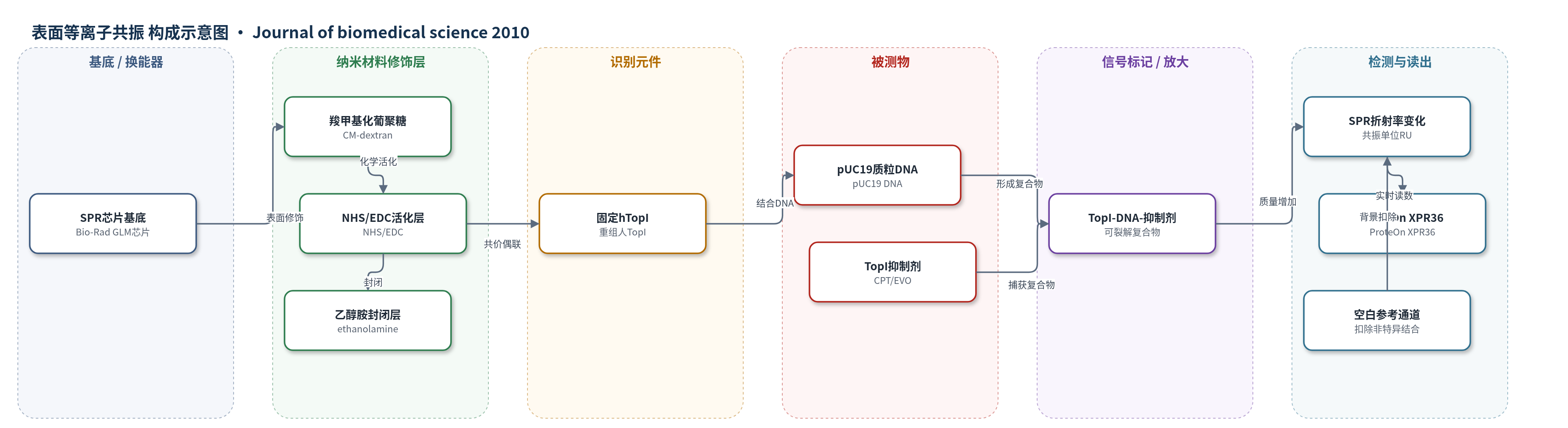
点击图片查看大图 · 依据论文自动绘制
传感器类型
表面等离子共振(SPR)生物传感器
检测对象
拓扑异构酶 I 抑制剂(TopI inhibitors,CPT/EVO);样品基质:含 pUC19 质粒 DNA 的 Topo 反应缓冲液(40 mM Tris-acetate pH 7.5、2.5 mM MgCl2、100 mM NaCl、1 mM EDTA)
检测原理
重组人 TopI(hTopI)通过 NHS/EDC 氨基偶联化学固定在 SPR 芯片的羧甲基化葡聚糖表面,并用乙醇胺封闭未反应羧基。检测时,含 pUC19 质粒 DNA 的 Topo 反应缓冲液流过芯片,hTopI 与 DNA 结合并催化形成共价 TopI-DNA 中间体。当 CPT 或 EVO 等 TopI 抑制剂同时存在时,抑制剂结合或嵌入 TopI-DNA 复合物,阻止 DNA 再连接,使可裂解复合物被捕获在芯片表面。表面吸附质量增加引起局部折射率变化,SPR 以共振单位(RU)实时读出;抑制剂浓度越高,捕获复合物越多,RU 上升越明显。单独 CPT/EVO 无 DNA 时不结合固定 hTopI,RU 基本不变;空白通道用于扣除非特异结合和体相折射率变化,DMSO 校正用于消除溶剂折射率差异。
检测灵敏度
原文未报告 LOD、线性范围、灵敏度斜率或相关系数。
效应效果
固定 hTopI 达 4000 RU;抗 hTopI 抗体和 pUC19(0–1000 ng/mL)均剂量依赖增加 RU,说明保留 DNA 结合活性。CPT(0–250 nM)单独无显著 RU 增加,与 pUC19 共流时 RU 增加,KD = 4.1×10^-29(Ka = 9.11×10^7,Kd = 3.74×10^-21,相对仅 DNA);EVO(0–125 nM)与 pUC19 共流时 KD = 5.15×10^-20(Ka = 7.27×10^7,Kd = 3.74×10^-12,相对仅 DNA)。VP-16 不结合 TopI 芯片,显示选择性。空白通道扣除非特异结合,DMSO 校正折射率,数据为三次独立实验代表。作者认为该方法无标记、实时、低靶标消耗,可用于 TopI 抑制剂亲和力比较与初筛。
传感器的构成
- 基底/换能器:Bio-Rad General Layer Medium (GLM) SPR 芯片,提供表面等离子共振换能表面与样品流路
- 修饰层:羧甲基化葡聚糖(carboxylmethylated dextran),提供羧基用于 hTopI 共价偶联
- 活化层:N-羟基琥珀酰亚胺(NHS)与 N-乙基-N'-(3-二甲氨基丙基)碳二亚胺(EDC),活化羧基形成氨基偶联化学
- 识别元件:重组人拓扑异构酶 I(hTopI),固定配体,保留 DNA 结合与催化活性
- 封闭剂:乙醇胺(ethanolamine, pH 8.0),淬灭未反应羧基,降低非特异结合
- 样品流路:pUC19 质粒 DNA 与 TopI 抑制剂(CPT/EVO),形成 TopI-DNA-抑制剂可裂解复合物
- 参考/再生:空白通道与 0.5 M NaCl/0.05 M NaOH,扣除非特异结合并再生表面
- 检测系统:Bio-Rad ProteOn XPR 36,实时记录共振单位(RU)
中文摘要
拓扑异构酶 I(TopI)反应中间体是由酶与切口 DNA 共价连接形成的 TopI-DNA 复合物,可被抑制剂捕获并导致再连接失败。表面等离子共振(SPR)已用于 TopI 抑制研究,但多数方法将小分子或短序列核苷酸固定于芯片,而将 TopI 作为流动分析物。本研究建立了一种将 TopI 蛋白固定于 SPR 芯片的无标记检测方法,并以靶向 DNA-TopI 复合物的喜树碱(CPT)作为代表性抑制剂进行验证。纯化重组人 TopI(hTopI)被共价偶联到传感器芯片上;抗 hTopI 抗体和 pUC19 质粒分别与固定 hTopI 结合时,共振单位(RU)呈剂量依赖性增加,表明固定 hTopI 保留 DNA 结合活性。单独 CPT 或 evodiamine(EVO)流过芯片时未引起显著 RU 增加;而 pUC19 与 TopI 抑制剂共同流过芯片时 RU 增加,证实该方法可用于 DNA-TopI 结合物的结合动力学研究和 TopI 抑制剂初筛。结果表明,芯片固定的 TopI 保留 DNA 结合和催化中间体活性,可为无标记相互作用研究和初筛提供可靠平台。
英文摘要
BACKGROUND: The topoisomerase I (TopI) reaction intermediate consists of an enzyme covalently linked to a nicked DNA molecule, known as a TopI-DNA complex, that can be trapped by inhibitors and results in failure of re-ligation. Attempts at new derivative designs for TopI inhibition are enthusiastically being pursued, and TopI inhibitors were developed for a variety of applications. Surface plasmon resonance (SPR) was recently used in TopI-inhibition studies. However, most such immobilized small molecules or short-sequence nucleotides are used as ligands onto sensor chips, and TopI was used as the analyte that flowed through the sensor chip.
METHODS: We established a sensor chip on which the TopI protein is immobilized to evaluate TopI inhibition by SPR. Camptothecin (CPT) targeting the DNA-TopI complex was used as a representative inhibitor to validate this label-free method.
RESULTS: Purified recombinant human TopI was covalently coupled to the sensor chip for the SPR assay. The binding of anti-human (h)TopI antibodies and plasmid pUC19, respectively, to the immobilized hTopI was observed with dose-dependent increases in resonance units (RU) suggesting that the immobilized hTopI retains its DNA-binding activity. Neither CPT nor evodiamine alone in the analyte flowing through the sensor chip showed a significant increase in RU. The combination of pUC19 and TopI inhibitors as the analyte flowing through the sensor chip caused increases in RU. This confirms its reliability for binding kinetic studies of DNA-TopI binders for interaction and for primary screening of TopI inhibitors.
CONCLUSIONS: TopI immobilized on the chip retained its bioactivities of DNA binding and catalysis of intermediates of the DNA-TopI complex. This provides DNA-TopI binders for interaction and primary screening with a label-free method. In addition, this biochip can also ensure the reliability of binding kinetic studies of TopI.