组成图示
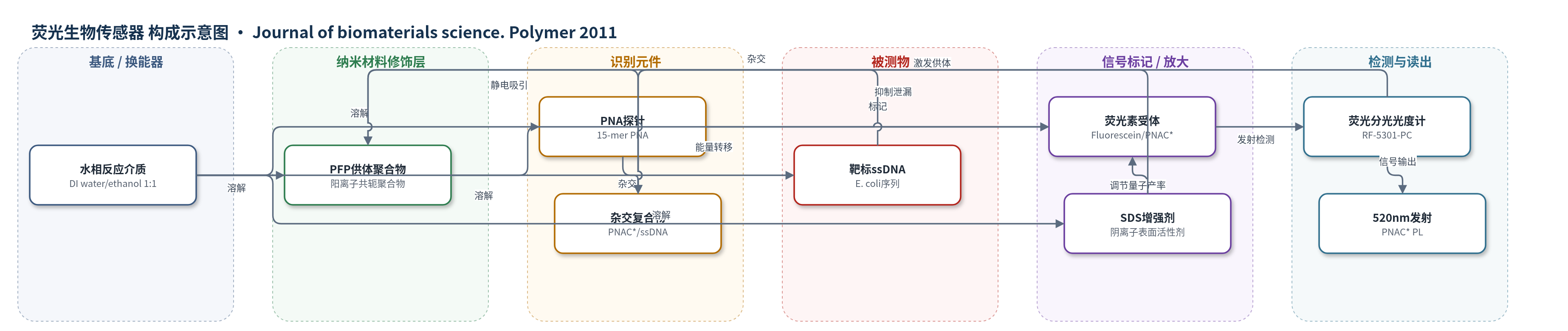
点击图片查看大图 · 依据论文自动绘制
传感器类型
荧光生物传感器
检测对象
大肠杆菌单链 DNA 序列(E. coli ssDNA,互补序列 ACCTTTGCTCATTGA 与非互补序列 GTTGGGTGGATAGTG);样品基质为水相缓冲液/乙醇-水混合液(DI water/ethanol 1:1、1×TE buffer、pH 5.5 HCl/DI water)。
检测原理
PNA 探针与互补 ssDNA 杂交形成带负电的 PNAC*/ssDNA 复合物,并被阳离子 PFP 静电吸引,使供体 PFP 与受体荧光素距离小于 Förster 半径。376 nm 激发 PFP 后,激子能经偶极-偶极相互作用非辐射转移至 PNAC*,PFP 蓝光发射猝灭,PNAC* 约 520 nm 发射增强。SDS 将荧光素二聚/三聚体解离为单体,提高互补复合物中 PNAC* 的量子产率;对非互补中性 PNAC*,SDS 包裹降低其水溶性,使泄漏信号接近噪声。因此互补靶标浓度越高,受体发射越强,信噪比增大。
检测灵敏度
LOD: 2.5 nM(含 1 mM SDS);LOD: 25 nM(无 SDS);判据: S/N = 4
效应效果
加入 SDS 后,互补 ssDNA 的 PNAC* 发射强度约提高 2 倍(100%),非互补泄漏信号从 30 au 降至 12 au(噪声 6 au),选择性显著提高。检测限由无 SDS 时的 25 nM 降至含 1 mM SDS 时的 2.5 nM,灵敏度提高约 10 倍。SDS 浓度为 1 mM 时 FRET 强度最大;实验重复 4 次,结果一致性在 5% 以内。老化研究显示新鲜溶液效率最高,旧样品受体 PL 信号明显下降,说明长期稳定性有限。方法仅需约 25 nM ssDNA 和 PNAC*,成本低、操作快,适合 DNA 序列检测。
传感器的构成
- 供体发光层:水溶性阳离子共轭聚合物 PFP(poly[9,9-di(6,6′-N,N′-trimethylammonium)hexylfluorenyl-2,7-diyl)-alt-co-(1,4-phenylene)]dibromide),蓝光发射,作为 FRET 供体。
- 识别元件:15-mer PNA 探针(Flu-TCAATGAGCAAAGGT),与 E. coli 靶标 ssDNA 互补杂交。
- 信号标记物:荧光素(Fluorescein)标记的 PNA,即 PNAC*,作为 FRET 受体并产生约 520 nm 发射。
- 信号增强剂:阴离子表面活性剂 SDS(sodium dodecyl sulphate),解离荧光素聚集体并抑制非互补泄漏信号。
- 反应介质:DI water/ethanol 1:1(v/v)、pH 5.5 HCl/DI water 和 1×TE buffer,用于溶解 PFP、PNAC* 与 ssDNA 并维持杂交。
- 读出装置:Shimadzu RF-5301-PC 荧光分光光度计,376 nm 激发并监测 PNAC* 发射。
中文摘要
本文报道了一种用于 DNA 序列检测的改进型荧光生物传感器策略。该体系由水溶性阳离子共轭聚合物 PFP、荧光素标记的肽核酸探针 PNAC*、单链 DNA 靶标和阴离子表面活性剂 SDS 组成,基于 Förster 共振能量转移(FRET)实现检测。当 ssDNA 与 PNA 探针互补时,形成带负电的 PNAC*/ssDNA 杂交复合物,并被阳离子 PFP 静电吸引;在 376 nm 激发下,PFP 的激子能非辐射转移至荧光素受体,使 PFP 发射猝灭而 PNAC* 约 520 nm 发射增强。加入 SDS 后,荧光素二聚体/三聚体被解离为单体,互补序列下 PNAC* 光致发光强度约提高 2 倍;非互补序列下 SDS 包裹中性 PNAC*,降低其水溶性和量子产率,使泄漏信号接近噪声。检测限由无 SDS 时的 25 nM 降至含 1 mM SDS 时的 2.5 nM,灵敏度提高约 10 倍。该方法简单、快速、低成本,可区分互补与非互补 DNA 序列。
英文摘要
An improved strategy has been developed for detection of DNA sequence by using water-soluble cationic conjugated polymer (PFP)/single-strand (ss) DNA and peptide nucleic acid labeled with fluorescent dye (PNAC*), where an anionic surfactant (sodium dodecyl sulphate, SDS) system has been used to improve the sensitivity of the sensor. The method of detection is simple to use, fast and cost-effective. This method uses the phenomenon of Forester Resonance Energy Transfer (FRET). The detection sensitivity of the biosensor has been improved by about ten times by using the anionic surfactant. It is observed that the effect of surfactant is to increase the photoluminescence (PL) intensity of the PNAC* when the sequence of the DNA is complementary (to that of PNA probe). On the other hand when the two sequences are non-complementary, the PL intensity of the PNAC* is further reduced as compared to the case when surfactant was absent.