组成图示
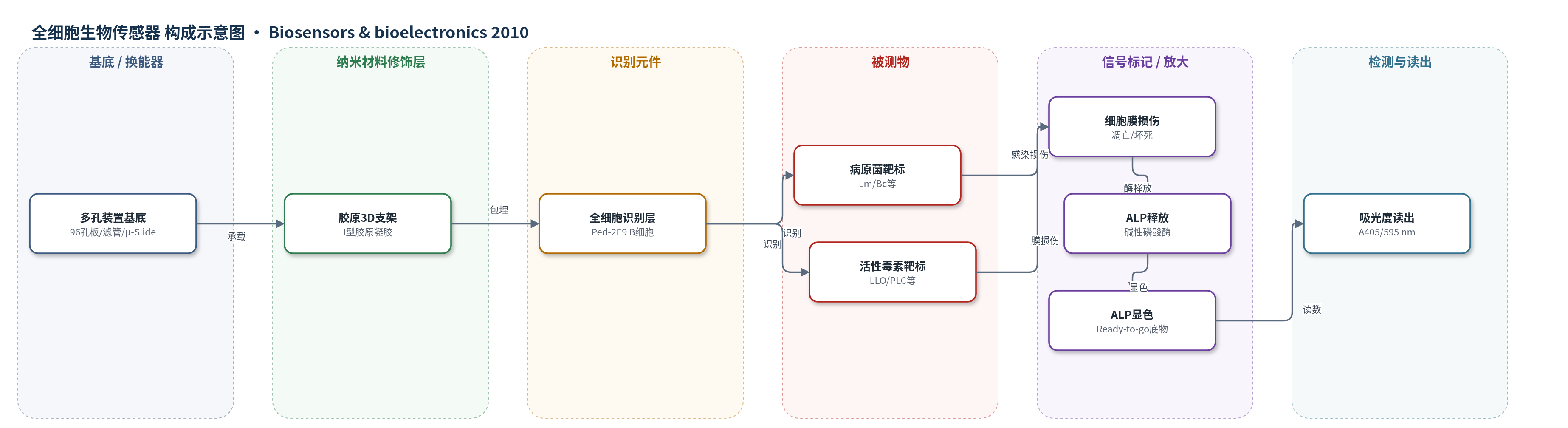
点击图片查看大图 · 依据论文自动绘制
传感器类型
全细胞生物传感器
检测对象
单核细胞增生李斯特菌 Listeria monocytogenes (Lm)、产肠毒素芽孢杆菌 Bacillus (B. cereus)、弧菌 Vibrio、微球菌 Micrococcus、沙雷氏菌 Serratia;毒素:金黄色葡萄球菌β-溶血素 β-hemolysin、产气荚膜梭菌磷脂酶C phospholipase C (PLC)、海葵细胞毒素 cytolysin、李斯特菌溶素O listeriolysin O (LLO)、芽孢杆菌肠毒素 enterotoxin;样品基质:即食肉制品(热狗、萨拉米)、米饭、牛奶、瓶装水/饮料
检测原理
该传感器以胶原三维支架包埋的Ped-2E9 B淋巴细胞为识别与换能单元。当样品中的致病细菌或活性细胞毒素接触细胞时,细菌可感染细胞或毒素直接破坏细胞膜,诱导凋亡/坏死并释放胞内碱性磷酸酶(ALP)。释放的ALP与Ready-to-go ALP底物发生酶促显色反应,生成有色产物,其A405/595 nm吸光度随细胞损伤程度增加而升高,从而反映病原菌或毒素浓度。由于只有活菌/活性毒素能引起膜损伤和ALP释放,非致病菌或失活毒素基本不产生信号,因此可区分风险活性。胶原3D结构提高细胞生理响应,ALP酶催化提供信号放大。
检测灵敏度
LOD: 毒素 10–40 ng(2 h);L. monocytogenes 10^3–10^4 CFU/ml(4–6 h);β-hemolysin、PLC、LLO、Bc-tox 10 ng/ml;cytolysin 40 ng/ml;L. monocytogenes 2 h 10^6 CFU;剂量响应范围: 20 ng/ml–40 μg/ml(毒素)
效应效果
传感器可区分致病/非致病与活性/失活:热狗中Lm 10^2–10^6 CFU/g经18 h富集后细胞毒性24.54–81.46%,L. innocua 10^6 CFU/g仅3.41%;萨拉米10^2–10^6 CFU/g为10.81–70.10%。米饭/牛奶中B. cereus 10^4 CFU/g/ml产生71.23/60.66%和45.58/43.27%,B. subtilis仅2.15/1.73%。毒素70℃15 min后降至5.65–6.15%,表明只响应活性毒素。Device II/III适合颗粒食品,Device I适合饮料;背景菌群可使LOD偏移1–2 log,作者认为可用于食品快速筛查。
传感器的构成
- 装置基底:Costar 96-well plate、Millipore filtration tube (UFC40HV0S)、ibidi μ-Slide (80106),承载样品与细胞凝胶并提供光学/过滤读出通道
- 三维支架层:neutralized type I collagen (1.5 mg/ml) 形成3D胶原凝胶,固定细胞并模拟体内微环境
- 识别元件:Ped-2E9 B lymphocyte cell line (约2.5×10^7 viable cells/ml),作为全细胞识别元件响应致病菌/活性毒素
- 细胞维持层:DMEM–phenol red free (PRF) 含2.5% FBS用于培养,测试用serum-free DMEM–PRF维持细胞活性
- 样品导入/过滤层:Device III中0.22 μm filter位于sample delivery-port,Device II通过离心使样品透过滤管
- 信号标记/底物:Ready-to-go ALP liquid substrate (Sigma)与释放的碱性磷酸酶(ALP)反应显色
- 读出层:plate reader或handheld USB2000 mini-spectrophotometer (Ocean Optics)测定A405/595 nm吸光度
中文摘要
本研究开发并验证了一种用于食品防御与食品安全的哺乳动物全细胞生物传感器。构建了三种可处理不同样品类型的原型,并在食品和饮料中测试。传感元件为封装于胶原三维支架中的B淋巴细胞Ped-2E9细胞系。该传感器通过检测分析物与哺乳动物细胞的相互作用,区分致病与非致病微生物及活性与失活毒素,从而评估风险。它对单核细胞增生李斯特菌、产肠毒素芽孢杆菌、弧菌、微球菌、沙雷氏菌,以及金黄色葡萄球菌β-溶血素、产气荚膜梭菌磷脂酶C、海葵细胞毒素、李斯特菌溶素O和芽孢杆菌肠毒素均呈阳性。毒素检出限为2 h内10–40 ng,L. monocytogenes为4–6 h内10^3–10^4 CFU/ml,且在同属非致病菌或背景菌群存在时仍可检测。加标食品中,传感器可从即食肉制品和米饭中检出10^2–10^4 CFU/g的L. monocytogenes和Bacillus cereus,并仅从米饭、牛奶和水样中检出纳克级活性毒素。三种原型对饮料均表现良好,Device II和III最适合颗粒食品,表明其可用于多种病原菌或毒素的快速筛查。
英文摘要
Development and validation of a mammalian cell-based biosensor for application in food defense and food safety was investigated. Three prototypes of the biosensor capable of handling different sample types were developed and tested with food and beverages. The sensing element is a B lymphocyte Ped-2E9 cell-line, encapsulated in collagen matrix in 3D scaffold. The uniqueness of this biosensor is that it detects analyte interaction with mammalian cells and is able to distinguish pathogenic from non-pathogenic and active from inactive toxins, rendering accurate estimation of the risk associated with the agents. This sensor gave positive signal for a broad range of bacterial pathogens; Listeria monocytogenes, enterotoxigenic Bacillus, Vibrio, Micrococcus and Serratia, and toxins; α-hemolysin from Staphylococcus aureus, phospholipase C from Clostridium perfringens, cytolysin from sea anemone Stoichactis helianthus, listeriolysin O from L. monocytogenes, and enterotoxin from Bacillus. Detection limit for toxins was 10-40 ng in 2 h while for a model bacterial pathogen, L. monocytogenes, 10(3)-10(4) CFU/ml in 4-6 h, even in the presence of a mixture of higher concentrations of non-pathogenic species of the same genera or common background microflora. With inoculated food and beverage, the sensor detected L. monocytogenes and Bacillus cereus at a low initial concentration of 10(2)-10(4) CFU/g from ready-to-eat meat and rice, and only active toxins at nanogram quantities from rice, milk and water samples. Though all the three prototypes performed well with beverages, Devices II & III are most suitable for testing particulate foods. These data present promising evidence for possible application of this biosensor for rapid detection of multiple pathogens or toxins for food defense and food safety application.