组成图示
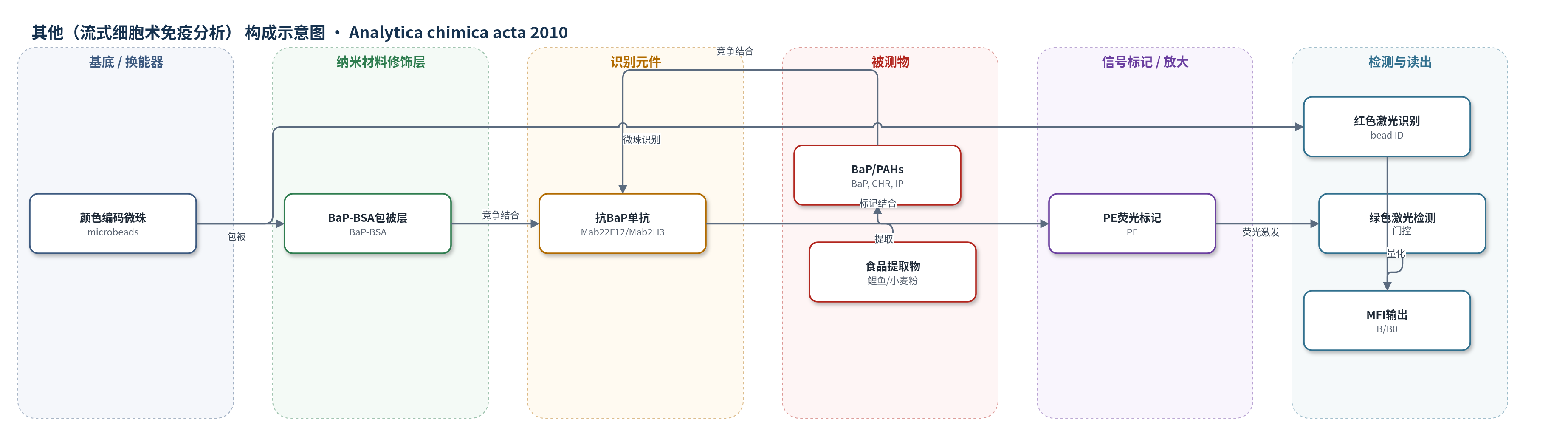
点击图片查看大图 · 依据论文自动绘制
传感器类型
其他(流式细胞术免疫分析)
检测对象
苯并[a]芘(BaP)、CHR(chrysene)、IP(indeno[1,2,3-cd]pyrene)等多环芳烃(PAHs);样品基质:烟熏鲤鱼和小麦粉提取物
检测原理
FCIA 采用竞争免疫分析。BaP-BSA 偶联物包被在颜色编码微珠表面,样品中的 BaP 或其他交叉反应 PAHs 与包被抗原竞争结合抗 BaP 单克隆抗体。结合到微珠上的抗体经 PE 标记后,由流式细胞仪检测:红色激光先识别微珠,绿色激光激发 PE 并记录平均荧光强度(MFI)。当样品中 BaP 浓度升高时,更多抗体被游离 BaP 占据,微珠表面结合的 PE 减少,MFI 及 B/B0 下降,从而通过校准曲线定量。该方法无酶促放大,主要依靠荧光标记和流式单颗粒检测提高灵敏度,并可利用不同微珠/抗体组合实现多 PAHs 筛查。
检测灵敏度
IC50: Mab22F12 0.3 μg L-1;Mab2H3 3.2 μg L-1;MabBaP 10 μg L-1
效应效果
FCIA 对 BaP 的 IC50 为 0.3 μg/L,与先前使用相同抗体的 ELISA 在缓冲液中的灵敏度相当。交叉反应显示其对 EFSA PAH8 中部分化合物有响应:Mab22F12 对 CHR 为 53%、IP 为 25%,Mab2H3 对 CHR 为 24%、IP 为 81%;对 BjF 的交叉反应较高(146% 和 127%)。方法已用于烟熏鲤鱼和小麦粉提取物,污染样品 MFI 高于非污染样品。作者认为 FCIA 比现有筛查方法更具优势,可简化样品前处理并扩展为多分析物食品污染谱检测。
传感器的构成
- 微珠基底:颜色编码微珠(color encoded microbeads),作为流式细胞术识别与抗原包被载体
- 抗原包被层:BaP-BSA 偶联物(BaP-BSA)包被微珠,提供 BaP 竞争结合位点
- 识别元件:抗 BaP 小鼠单克隆抗体(Mab22F12、Mab2H3、MabBaP),识别 BaP 及交叉反应 PAHs
- 信号标记物:藻红蛋白(PE),用于绿色激光荧光读出
- 样品基质:烟熏鲤鱼和小麦粉提取物中的 PAHs/BaP
- 读出系统:流式细胞仪,红色激光识别微珠,绿色激光量化 MFI
中文摘要
本文报道了一种用于食品中多环芳烃(PAHs)检测的高灵敏流式细胞术免疫分析(FCIA)。该方法以苯并[a]芘(BaP)为标志物,采用颜色编码微珠作为载体,将 BaP-BSA 偶联物包被于微珠表面,并引入抗 BaP 小鼠单克隆抗体(Mab22F12、Mab2H3、MabBaP)和藻红蛋白(PE)标记,通过红色激光识别微珠、绿色激光检测荧光信号,实现样品中 BaP 的竞争性免疫检测。结果显示,Mab22F12 的 IC50 为 0.3 μg/L,Mab2H3 为 3.2 μg/L,MabBaP 为 10 μg/L;FCIA 对 EFSA 关注的 CHR 和 IP 也具有交叉反应,分别可达 53% 和 81%。该方法可应用于烟熏鲤鱼和小麦粉等真实食品提取物,作者认为其可作为现有筛查方法的替代,并有望扩展为多分析物食品污染谱检测。
英文摘要
Food contamination caused by chemical hazards such as persistent organic pollutants (POPs) is a worldwide public health concern and requires continuous monitoring. The chromatography-based analysis methods for POPs are accurate and quite sensitive but they are time-consuming, laborious and expensive. Thus, there is a need for validated simplified screening tools, which are inexpensive, rapid, have automation potential and can detect multiple POPs simultaneously. In this study we developed a flow cytometry-based immunoassay (FCIA) using a color-encoded microbeads technology to detect benzo[a]pyrene (BaP) and other polycyclic aromatic hydrocarbons (PAHs) in buffer and food extracts as a starting point for the future development of rapid multiplex assays including other POPs in food, such as polychlorinated biphenyls (PCBs) and polybrominated diphenyl ethers (PBDEs). A highly sensitive assay for BaP was obtained with an IC(50) of 0.3 microg L(-1) using a monoclonal antibody (Mab22F12) against BaP, similar to the IC(50) of a previously described enzyme-linked immunosorbent assay (ELISA) using the same Mab. Moreover, the FCIA was 8 times more sensitive for BaP compared to a surface plasmon resonance (SPR)-based biosensor immunoassay (BIA) using the same reagents. The selectivity of the FCIAs was tested, with two Mabs against BaP for 25 other PAHs, including two hydroxyl PAH metabolites. Apart from BaP, the FCIAs can detect PAHs such as indenol[1,2,3-cd]pyrene (IP), benz[a]anthracene (BaA), and chrysene (CHR) which are also appointed by the European Food Safety Authority (EFSA) as suitable indicators of PAH contamination in food. The FCIAs results were in agreement with those obtained with gas chromatography-mass spectrometry (GC-MS) for the detection of PAHs in real food samples of smoked carp and wheat flour and has great potential for the future routine application of this assay in a simplex or multiplex format in combination with simplified extraction procedure which are under development.