组成图示
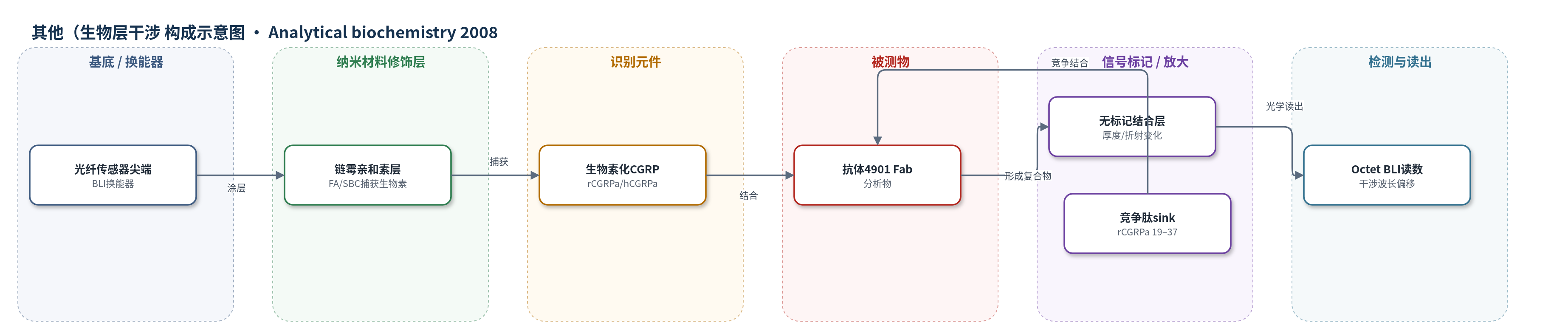
点击图片查看大图 · 依据论文自动绘制
传感器类型
其他(生物层干涉(BLI)生物传感器)
检测对象
CGRPα 肽(rCGRPa、hCGRPa 及截短肽)、抗体 4901(IgG/Fab);样品基质为 HBS-EP 缓冲液(含 1 mg/mL BSA)的开放微孔板溶液
检测原理
Octet采用生物层干涉(BLI):光纤尖端表面固定配体(抗体4901或生物素化CGRP),当分析物(CGRP肽或4901 Fab)结合后,尖端生物层厚度/折射率增加,使参考层与样品层反射光发生干涉,产生波长偏移(nm)。结合量随分析物浓度升高而增大,实时记录结合与解离曲线。对无流动的微孔板体系,解离阶段加入过量竞争肽rCGRPa 19–37作为sink,捕获解离的Fab,抑制其再结合到尖端,使数据符合1:1 Langmuir模型,从而计算kon、koff和KD。溶液竞争实验则用固定探针尖端检测游离抗体浓度,竞争肽抑制结合,拟合得到不受固定方向影响的亲和力。
检测灵敏度
原文未报告 LOD、线性范围、灵敏度斜率或 R^2。
效应效果
Octet在约1000倍亲和力范围内给出与SPR平台相近的结果,动力学常数通常相差在2倍以内。对4901 Fab结合CGRP尖端,sink条件下rCGRPa的KD为2.0±0.4 nM,hCGRPa为36±1 nM,且尖端间与循环间重现性良好。小分子CGRP直接结合低于Octet检测限,但三明治实验证实结合发生。ProteOn与Biacore数据基本一致,Biacore灵敏度更高,可分辨rCGRPa约0.5 nM的亲和力;ProteOn噪声约±4 RU,Biacore约±1 RU。作者认为Octet无需微流控、样品可回收,适合作为高灵敏度SPR的补充和基准工具。
传感器的构成
- 换能器基底:一次性光纤生物传感器尖端(fiber-optic biosensor tips,AR/SBC/FA),承载生物层并产生生物层干涉(BLI)信号
- 化学修饰层:胺反应性(AR)尖端经 EDC/NHS 活化,用于共价偶联抗体 4901;链霉亲和素(SBC/FA)尖端用于捕获生物素化 CGRP
- 识别元件:单克隆抗体 4901(IgG 或 Fab)作为配体,或生物素化 CGRP(rCGRPa/hCGRPa)作为捕获配体
- 封闭/背景层:乙醇胺(ethanolamine)封闭过量反应酯;HBS-EP 缓冲液中加入 1 mg/mL BSA 作为背景/封闭蛋白
- 信号标记物:无标记(label-free)检测,不依赖荧光或酶标记;多克隆抗-rCGRPa 仅用于三明治验证小分子结合
- 辅助竞争/再生试剂:竞争肽 rCGRPa 19–37 作为 sink 抑制再结合;磷酸或 Gentle IgG Elution Buffer/NaCl 用于表面再生
中文摘要
本文评估了ForteBio Octet光学生物传感器在蛋白相互作用动力学与亲和力测定中的应用。Octet基于生物层干涉(BLI),使用一次性光纤传感器尖端,从开放振荡微孔板中直接取样,无需微流控。作者以抗CGRP单克隆抗体4901及其Fab片段为模型,比较Octet与Biacore 3000和ProteOn XPR36两种表面等离子共振(SPR)平台对多种CGRP肽的结合测定。通过加入过量竞争肽的“sink”方法,可消除分析物与尖端配体之间的再结合,使Octet获得与SPR接近的准确动力学常数。尽管Octet灵敏度不足以直接检测小分子结合,但可通过溶液竞争实验间接测定其亲和力,并经SPR平台验证。结果表明,Octet可作为其他高灵敏度生物传感器的实用补充,ProteOn则能以更高通量获得接近Biacore的数据质量,本研究为相关传感器性能评估提供了基准。
英文摘要
ForteBio's Octet optical biosensor harnesses biolayer interferometry to detect and quantify molecular interactions using disposable fiber-optic biosensors that address samples from an open shaking microplate without any microfluidics. We recruited a monoclonal antibody against a panel of peptides to compare the Octet directly with Biacore's well-established 3000 platform and Bio-Rad's recently launched ProteOn XPR36 array system, which use surface plasmon resonance (SPR) to detect the binding of one analyte over four surfaces and six analytes over six surfaces, respectively. A sink method was used to prevent analyte from rebinding the ligand-coated Octet tips and enabled us to extract accurate kinetic rate constants, as judged by their close agreement with those determined by SPR. Although the Octet is not sensitive enough to detect the binding of small molecules directly, it can access their affinities indirectly via solution competition experiments. We conducted similar experiments on the SPR instruments to validate these measurements. The Octet is emerging as a versatile complement to other more sophisticated biosensors, and the ProteOn provides high-quality data near the sensitivity of Biacore but in a more multiplexed format. Our results provide a benchmark for assessing the performance of the above-mentioned sensors.