组成图示
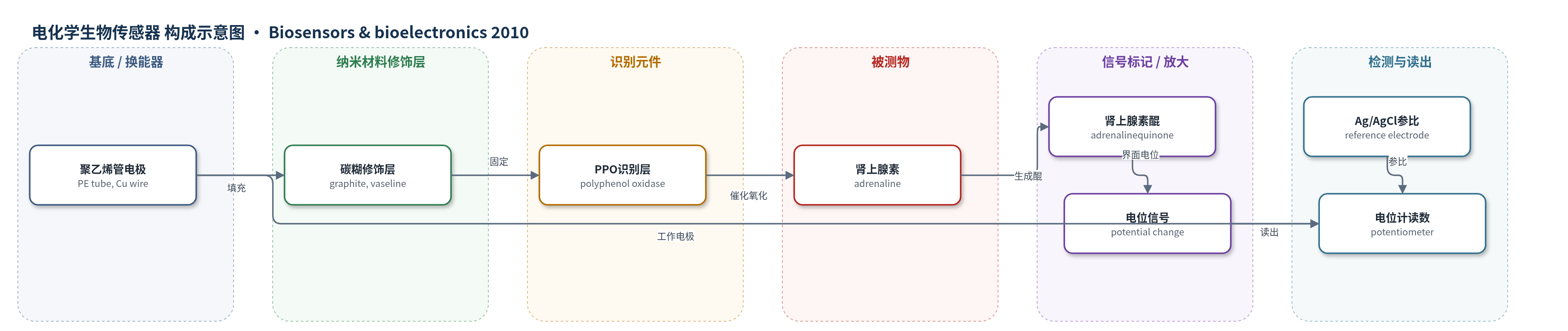
点击图片查看大图 · 依据论文自动绘制
传感器类型
电化学生物传感器
检测对象
肾上腺素(adrenaline/epinephrine);样品基质:药物制剂、大鼠血液、大鼠颈静脉血(体内)
检测原理
该传感器以PPO为生物识别元件,肾上腺素作为邻二酚类底物在PPO催化下发生两电子氧化,生成肾上腺素醌。氧化过程改变碳糊电极/溶液界面的氧化还原状态,使指示电极电位随肾上腺素活度呈对数关系变化,且因两电子过程表现为亚Nernstian响应。测量时以Ag/AgCl为参比电极,在零电流条件下读取指示电极与参比电极之间的电位差,电位变化经校准曲线换算为浓度。体外药物样品用磷酸盐缓冲液校准,血液和体内样品用基质匹配校准;H2O2可氧化并脱附电极表面肾上腺素,使基线恢复,体内则依靠溶解氧实现类似再生。
检测灵敏度
LOD: 8 × 10⁻⁹ mol L−1;线性范围: 8.00 × 10⁻⁹–8.00 × 10⁻⁴ mol L−1(药物/缓冲液);LOD: 8.0 × 10⁻⁷ mol L−1;线性范围: 8.00 × 10⁻⁷–8.00 × 10⁻³ mol L−1(血液)
效应效果
缓冲液和血液精密度CV分别低于0.94%和7.42%。干扰试验中,尿酸、尿素、多巴胺、去甲肾上腺素在1–3倍血液浓度下干扰小于10%;抗坏血酸仅在3倍浓度时干扰约113%。药物样品测定与巴西药典UV法在95%置信水平t检验一致,样品3药典法1.065±0.001 g L−1、传感器1.026±0.002 g L−1。血液加标回收率为89.4%(加入2.73×10⁻⁶ mol L−1,回收2.44×10⁻⁶ mol L−1)。体内大鼠颈静脉注射肾上腺素后电位响应为20.5、9.47、4.87 mV,计算浓度分别为8.63×10⁻⁶、2.49×10⁻⁶、1.48×10⁻⁶ mol L−1,作者认为结果具有应用前景。
传感器的构成
- 基底/换能器电极:聚乙烯管(polyethylene tube, 0.8 mm i.d.)与铜丝(Cu wire),构成微型电极并提供电接触
- 导电糊状基质:石墨粉(graphite powder, 375 mg)与凡士林(vaseline, 125 mg)混合成碳糊,固定酶并导电
- 识别元件:多酚氧化酶(polyphenol oxidase, PPO,50 UA,香蕉Musa sp.粗提物),催化肾上腺素氧化
- 缓冲介质:磷酸盐缓冲液(phosphate buffer, pH 7.00),维持酶活性与电位测量环境
- 参考电极:Ag/AgCl电极,与指示电极构成零电流电位测量回路
- 再生试剂:过氧化氢(H2O2, 0.163 mol L−1),氧化并脱附电极表面肾上腺素,恢复基线
中文摘要
本研究以多酚氧化酶(polyphenol oxidase, PPO)为核心识别元件,构建用于肾上腺素测定的电位法生物传感器。作者测定了多种蔬菜中PPO活性,香蕉(Musa sp.)粗提物活性最佳,达974 UA。传感器由内径0.8 mm的聚乙烯管构成,管内填充含50 UA PPO的磷酸盐缓冲液(pH 7.00)碳糊,凡士林作为黏合剂。用于药物样品时,线性范围为8.00×10⁻⁹至8.00×10⁻⁴ mol L−1,结果与巴西药典方法经t检验一致。用于血液样品时采用基质匹配校准,线性范围为8.00×10⁻⁷至8.00×10⁻³ mol L−1。作者还进行了体内研究,将电极插入Wistar大鼠颈静脉,结果具有良好应用前景。
英文摘要
In this work the polyphenol oxidase (PPO) was the main component of a biosensor for adrenaline determination. The activity of this enzyme was measured in several vegetables. Banana (Musa sp.) extracts presented better results with 974 UA (units of activity). The biosensor was constructed with a polyethylene tube (0.8 mm i.d.) filled with: carbon paste containing 50 UA of the PPO in phosphate buffer (pH=7.00) solution and vaseline as agglutinant. When the biosensor was applied in medicine samples it provided a linear range from 8.00×10(-9) to 8.00×10(-4) mol L(-1); the results obtained with the proposed method and the Brazilian Pharmacopoeia method were in agreement (t-test). When it was applied in blood samples, the matrix-matching calibration was used, and the linear range was from 8.00×10(-7) to 8.00×10(-3) mol L(-1). In vivo studies were also done. The obtained results for those electrodes, which were inserted in the jugular vein of Wistar rats, were very promising.