组成图示
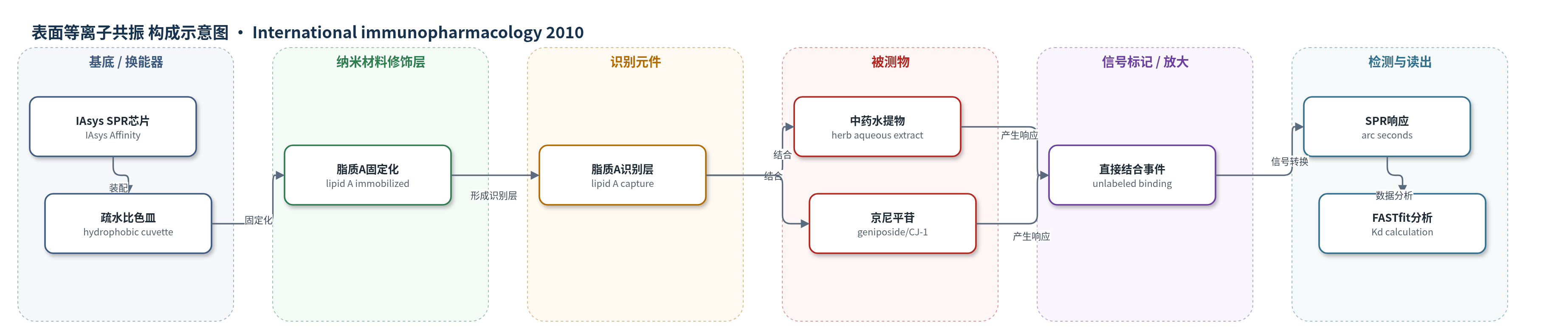
点击图片查看大图 · 依据论文自动绘制
传感器类型
表面等离子共振(SPR)生物传感器
检测对象
脂质A结合物(lipid A-binding compounds,包括中药水提物与京尼平苷 geniposide/CJ-1);样品基质:中药水提物、纯化组分溶液
检测原理
该检测基于SPR亲和传感。脂质A按厂家说明固定于IAsys疏水比色皿表面,形成识别层。将中药水提物或京尼平苷加入PBS/AE后,若样品含有脂质A结合物,则与固定化脂质A发生结合。结合事件改变SPR界面质量与折射率,引起表面等离子共振响应变化。IAsys仪器记录结合响应(arc seconds),随后用PBS/AE洗涤去除非特异结合,并用0.1 M HCl、PBS/AE和10 mM NaOH交替再生表面。FASTplot生成结合曲线,FASTfit计算Kd。信号随结合物浓度和亲和力变化,方法无酶或标记放大,主要用于筛选脂质A结合活性成分。
检测灵敏度
原文未报告LOD、线性范围、灵敏度斜率或相关系数。
效应效果
SPR亲和传感器筛选60种中药水提物,22种显示较高脂质A结合活性(RUN100″),栀子被选中。组分响应Fraction C2最高(76 arc seconds),C2b为68 arc seconds。京尼平苷与脂质A结合Kd为6.77×10⁻⁵ M。LAL法显示0.25、0.5、1.0 μg/ml分别中和0.1 ng/ml LPS的18.9%、31.2%、56.1%。选择性良好:仅抑制LPS/脂质A诱导的TNF-α和IL-6,不抑制CpG DNA、Poly I:C或IL-1β诱导的TNF-α及p38磷酸化;≤400 μg/ml 24 h无细胞毒性。体内40 mg/kg保护致死热灭活大肠杆菌攻击小鼠(对照组24 h内90%死亡),10–40 mg/kg降低血清LPS,40 mg/kg降低TNF-α和IL-6。作者认为其可作抗脓毒症先导化合物。
传感器的构成
- 换能器/传感器芯片:IAsys Affinity Sensors(Thermo Labsystem)SPR光学传感器,提供分子相互作用检测平台
- 固定化表面:疏水比色皿(hydrophobic cuvette),作为脂质A固定化载体
- 识别元件:脂质A(lipid A)固定于疏水比色皿表面,作为捕获配体
- 反应/洗涤液:PBS/AE(含0.025%叠氮化钠和1 mM EDTA,pH 7.4),维持结合环境并洗涤非特异结合
- 再生清洗液:0.1 M HCl、PBS/AE、10 mM NaOH交替洗涤,去除结合物并恢复表面
- 信号读出:IAsys仪器与FASTplot/FASTfit软件,记录结合响应(arc seconds)并计算Kd
中文摘要
脂多糖(LPS/内毒素)是脓毒症的关键病原体识别分子。目前重症脓毒症治疗策略之一是中和LPS,临床试验显示许多传统中药具有抗脓毒症功能。为阐明可中和LPS的传统中药生物活性成分,本研究采用亲和生物传感器技术检测60种中药的脂质A结合能力。栀子(Gardenia jasminoides Ellis)水提物被进一步研究,随后分离得到单体京尼平苷(geniposide)。体外发现京尼平苷可直接结合并中和LPS,在不影响细胞活力的情况下剂量依赖抑制LPS诱导RAW264.7细胞释放细胞因子,并抑制LPS上调的TNF-α mRNA表达;但不降低CpG DNA、Poly I:C或IL-1β诱导的TNF-α释放。京尼平苷剂量依赖下调LPS上调的TLR4 mRNA表达,并抑制LPS诱导的p38 MAPK磷酸化,但不抑制IL-1β诱导的磷酸化。体内,京尼平苷(40 mg/kg)可显著保护受致死量热灭活大肠杆菌攻击的小鼠,并剂量依赖降低内毒素血症小鼠血清内毒素水平,该水平与细胞因子水平密切相关。总之,成功从栀子中分离京尼平苷,其体外直接结合并中和LPS,显著保护脓毒症模型小鼠,可作为抗脓毒症药物开发先导化合物。
英文摘要
Lipopolysaccharide (LPS/endotoxin) is a key pathogen recognition molecule for sepsis. Currently, one of the therapeutic approaches for severe sepsis is focusing on the neutralization of LPS, and clinical trials have shown a lot of traditional Chinese herbs possess anti-sepsis function. Herein, to elucidate the bioactive components of traditional Chinese herbs that can neutralize LPS, the lipid A-binding abilities of sixty herbs were tested using affinity biosensor technology. The aqueous extract of Gardenia jasminoides Ellis, traditionally used to treat inflammation in Asian countries for centuries, was further investigated. Subsequently, a monomer, identified as geniposide, was isolated. In vitro, geniposide was found to directly bind LPS and neutralize LPS. It dose-dependently inhibited cytokines release from RAW264.7 cells induced by LPS without affecting the cell viability, and inhibited TNF-α mRNA expression up-regulated by LPS. However, geniposide did not decrease TNF-α release induced by CpG DNA, Poly I:C or IL-1β. Significantly, geniposide dose-dependently down-regulated TLR4 mRNA expression up-regulated by LPS, and suppressed the phosphorylations of p38 MAKP induced by LPS but not by IL-1β. In vivo, geniposide (40mg/kg) could significantly protect mice challenge with lethal heat-killed E. coli, and dose-dependently decreased the level of serum endotoxin which was tightly associated with the cytokine levels in endotoxemia mice. In summary, we successfully isolated geniposide from G. jasminoides Ellis. Geniposide directly bound LPS and neutralized LPS in vitro, and significantly protected sepsis model mice. Therefore, geniposide could be as a useful lead compound for anti-sepsis drug development.