组成图示
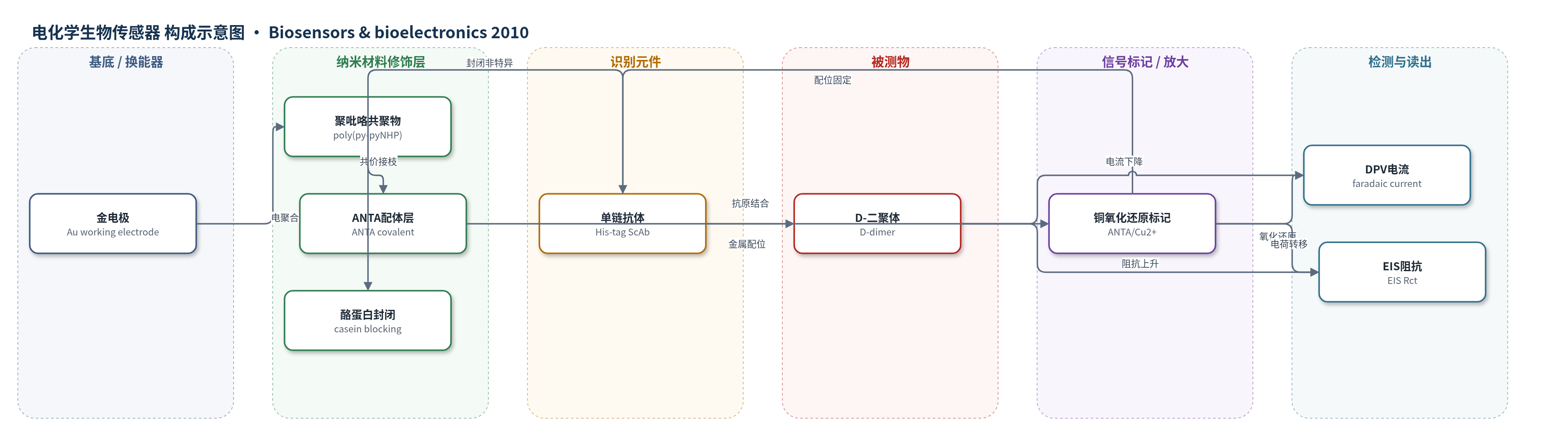
点击图片查看大图 · 依据论文自动绘制
传感器类型
电化学生物传感器
检测对象
D-二聚体(D-dimer);样品基质:PBS缓冲液、人血浆(患者血浆)
检测原理
传感器以金电极为基底,电聚合聚吡咯共聚物形成导电界面,ANTA共价接枝后与Cu2+配位,形成ANTA/Cu2+氧化还原标记;His-tag单链抗体通过组氨酸残基与Cu2+配位固定。D-dimer与ScAb特异性结合后,抗原-抗体复合物在界面形成空间屏蔽,改变双电层厚度并阻碍Cu2+/Cu+电子转移。DPV中150 mV处氧化还原峰电流随D-dimer浓度增加而下降;EIS在-1.2 V下低频阻抗模量及电子转移电阻随浓度增加而增大。信号变化与结合量相关,无需额外标记或酶放大。
检测灵敏度
LOD: 100 pg mL−1;线性范围: 0.1 ng mL−1–500 ng mL−1(EIS);DPV动态范围: 1–500 ng mL−1;Kd: 1 ng mL−1
效应效果
该传感器对D-dimer具有良好选择性,与1 µg/mL BSA和人IgG孵育后SPR、DPV和EIS信号基本不变;酪蛋白封闭和ScAb高特异性抑制非特异结合。6个同法制备传感器的阻抗和DPV响应RSD为7%。在4例DVT患者血浆中,与PATHFAST化学发光酶免疫分析比较,相对偏差为2%、10%、14%和18%,无显著差异,表明可用于临床血浆D-dimer检测。作者认为该平台可扩展至血清中其他蛋白检测。
传感器的构成
- 基底/换能器电极:金电极(Au working electrode),作为三电极体系的工作电极
- 导电聚合物层:聚吡咯共聚物 poly(py-pyNHP),由吡咯(py)与功能化吡咯 pyNHP 电聚合,提供导电骨架和活性酯位点
- 配体修饰层:N-α-双(羧甲基)-L-赖氨酸(ANTA)共价接枝至 pyNHP 活性酯,形成 poly(py-pyANTA)
- 氧化还原标记/固定层:Cu2+ 与 ANTA 配位形成 ANTA/Cu2+ 复合物,提供 Cu2+/Cu+ 氧化还原信号并固定 His-tag
- 识别元件:His-tag 单链抗体(ScAb,anti-D-dimer,3B6 衍生),通过 His-tag 与 Cu2+ 配位固定
- 封闭剂:酪蛋白(casein,50 mg mL−1),封闭非特异性结合位点
中文摘要
本文报道一种用于检测并定量深静脉血栓(DVT)生物标志物D-二聚体(D-dimer)的快速灵敏方法。该免疫传感器以固定于换能器表面的单链抗体(ScAb)为识别元件,形成致密受体层。检测基于接枝于聚吡咯骨架上的N-α-双(羧甲基)-L-赖氨酸(ANTA)/Cu2+复合物的氧化还原活性。所得杂化材料聚吡咯/ANTA/金属配合物/His-tag ScAb经AFM、SPR和差分脉冲伏安法(DPV)表征以优化传感器构建。D-dimer与抗体结合后,ANTA/Cu2+复合物氧化还原活性发生显著变化,结合常数Kd为1 ng/mL。电化学阻抗谱(EIS)可监测D-dimer结合,在PBS中0.1–500 ng/mL呈线性响应,检出限为100 pg/mL。该生物层在患者血浆样品中检测D-dimer具有相同灵敏度。该方法通用性强,可用于血清中其他蛋白检测。
英文摘要
We describe a rapid and sensitive method for detection and quantification of d-dimer which is a biomarker present at elevated concentrations in patients with deep vein thrombosis (DVT) disorders. The method uses an immunosensor based on a single-chain antibody (ScAb) immobilized on a transducer surface and with a densely packed receptor layer. Detection is based on the redox activity of a N-alpha bis(carboxymethyl)-L-lysine (ANTA)/Cu2+ complex attached to a polypyrrole backbone. The resulting hybrid material: polypyrrole ANTA/metal complex/His-tag ScAb was characterized by AFM, surface plasmon resonance (SPR) and differential pulse voltammetry (DPV) for the optimization of the biosensor formation. The biosensor offers a promising template for antibody immobilization and for immunodetection of a specific D-dimer. The biosensor shows a remarkable variation in redox activity of the ANTA/Cu2+ complex after the D-dimer association with a binding constant Kd of 1 ng mL(-1). Electrochemical impedance spectroscopy (EIS) allows monitoring D-dimer association with a linear response between 0.1 ng mL(-1) and 500 ng mL(-1) and a detection limit of 100 pg mL(-1) in PBS is obtained. The biolayer exhibits the same sensitivity for the detection of d-dimer in human patient plasma samples. This assay method is versatile, offers enhanced performance for the evaluation of proteins association and could easily be extended to the detection of other proteins, present in serum human sample.