组成图示
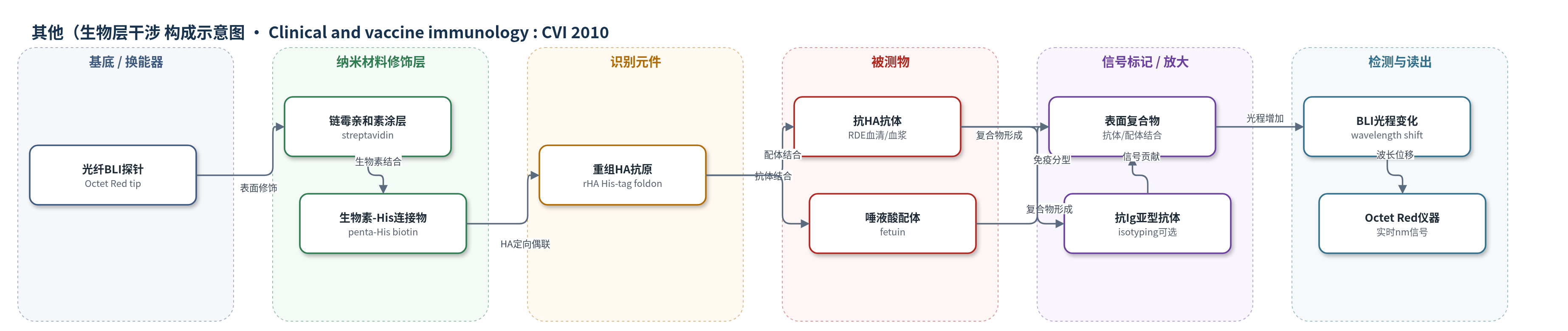
点击图片查看大图 · 依据论文自动绘制
传感器类型
其他(生物层干涉(BLI)生物传感器)
检测对象
抗流感病毒血凝素抗体(anti-HA antibodies)、唾液酸化受体样配体(sialylated receptor-like ligand, fetuin);样品基质:人/雪貂血清或血浆(RDE处理)
检测原理
f-AbBA将重组流感病毒血凝素(rHA)通过C端His标签定向固定在链霉亲和素涂层的光纤BLI探针上。样品中抗HA抗体与探针表面rHA结合后,探针表面生物层厚度增加,改变白光的干涉光程,产生以纳米为单位的波长位移;抗体浓度越高或稀释度越低,结合量越多,位移越大。检测无需荧光或酶标记,直接读取结合动力学。血清经Vibrio cholerae神经氨酸酶(RDE)处理并稀释,以降低唾液酸成分和非特异结合干扰。若检测受体结合功能,可加入含唾液酸的fetuin作为受体模拟物:抗HA抗体占据受体结合位点时会竞争阻断fetuin结合,使fetuin信号下降。该方法可多探针并行分析不同HA亚型,并通过抗人Ig亚型抗体进行免疫分型。
检测灵敏度
原文未报告浓度LOD、线性范围、灵敏度斜率或R^2;报告稀释度检测限:anti-H3-BR07 1:1,280;H1pdm 2,560;H5-VN04 1:640–1:1,280;fetuin抑制有效稀释度 1:160;CV 9.2%(HA装载)、9.1%(血清结合)
效应效果
f-AbBA与HI总体相关,H3 HA相关性最好;检测稀释度通常比HI高1–2倍(H3)、2–4倍(H1)或2–8倍(H5)。anti-H3-BR07血清f-AbBA与HI均为1:1,280;H1pdm f-AbBA为2,560,HI为640–1,280;H5-VN04结合可检至1:640–1:1,280,但fetuin抑制仅在1:160及以下有效。仪器CV为9.2%(HA装载)和9.1%(血清结合)。RDE处理和1:80稀释降低唾液酸干扰,亚型间交叉反应有限。H5-VN04干燥探针在10%蔗糖PBS中室温储存约80天,62天单克隆抗体结合与新鲜探针相近,76天仍保留fetuin结合和血清阻断功能。8通道并行,96样本约1小时,适合疫苗免疫监测。
传感器的构成
- 基底/换能器:光纤生物传感器探针(Octet Red biosensor tip),通过生物层干涉(BLI)将表面结合转化为波长位移
- 表面捕获层:链霉亲和素(streptavidin)涂层,用于捕获生物素化连接物
- 定向连接层:五组氨酸生物素偶联物(penta-His biotin conjugate)或生物素氮杂环三乙酸(BNTA),连接重组HA的His标签
- 识别/捕获抗原层:重组流感病毒血凝素(recombinant HA, rHA),含foldon三聚体和C端His标签,用于捕获抗HA抗体或唾液酸配体
- 样品识别层:RDE处理的血清/血浆中抗HA抗体(anti-HA antibodies)或唾液酸化受体样配体(fetuin)
- 可选信号/分型层:抗人免疫球蛋白亚型抗体(anti-human IgG1/IgG2/IgG3/IgG4/IgA/IgE/IgM)或fetuin,用于免疫分型或受体结合竞争检测
- 缓冲/封闭层:动力学缓冲液(PBS含0.02% Tween 20、0.005%叠氮化钠、100 μg/ml BSA),BSA降低非特异结合,RDE去除唾液酸干扰
中文摘要
在2009年大流行H1N1流感暴发初期,血凝抑制(HI)和微量中和(MN)检测提供了人群交叉反应保护信息,但难以自动化、高通量且实验室间标准化困难。为此,本文报道一种无细胞、无标记的流感抗体生物传感器检测法(f-AbBA),用于流感研究和诊断。该方法利用重组血凝素(HA)与无标记生物层干涉(BLI)技术,实时测量HA与特异性抗HA抗体或唾液酸化配体之间的生物分子相互作用。作者评估了f-AbBA测定血清或血浆中抗HA抗体结合活性、评价疫苗诱导体液免疫应答的能力。该检测可揭示抗原差异对HA抗体结合的影响,并测量对不同HA亚型的结合。研究还表明,该生物传感器可测量HA与模型唾液酸化受体样配体的结合能力。由于干燥HA探针室温储存2个月以上后活性无明显损失,f-AbBA有望用于全球监测实验室,使不同实验室使用同一试剂批次以减少实验室间波动。未来相关试剂和类似技术的发展可为流感监测提供稳健平台。
英文摘要
During the initial pandemic influenza H1N1 virus outbreak, assays such as hemagglutination inhibition and microneutralization provided important information on the relative protection afforded by the population's cross-reactivity from prior infections and immunizations with seasonal vaccines. However, these assays continue to be limited in that they are difficult to automate for high throughput, such as in pandemic situations, as well as to standardize between labs. Thus, new technologies are being sought to improve standardization, reliability, and throughput by using chemically defined reagents rather than whole cells and virions. We now report the use of a cell-free and label-free flu antibody biosensor assay (f-AbBA) for influenza research and diagnostics that utilizes recombinant hemagglutinin (HA) in conjunction with label-free biolayer interferometry technology to measure biomolecular interactions between the HA and specific anti-HA antibodies or sialylated ligands. We evaluated f-AbBA to determine anti-HA antibody binding activity in serum or plasma to assess vaccine-induced humoral responses. This assay can reveal the impact of antigenic difference on antibody binding to HA and also measure binding to different subtypes of HA. We also show that the biosensor assay can measure the ability of HA to bind a model sialylated receptor-like ligand. f-AbBA could be used in global surveillance laboratories since preliminary tests on desiccated HA probes showed no loss of activity after >2 months in storage at room temperature, indicating that the same reagent lots could be used in different laboratories to minimize interlaboratory assay fluctuation. Future development of such reagents and similar technologies may offer a robust platform for future influenza surveillance activities.